Queensland Primary Industries and Fisheries, Entomology, Brisbane, Queensland 4068, Australia.
BMC Evol Biol. 2010 Aug 25;10:257. doi: 10.1186/1471-2148-10-257.
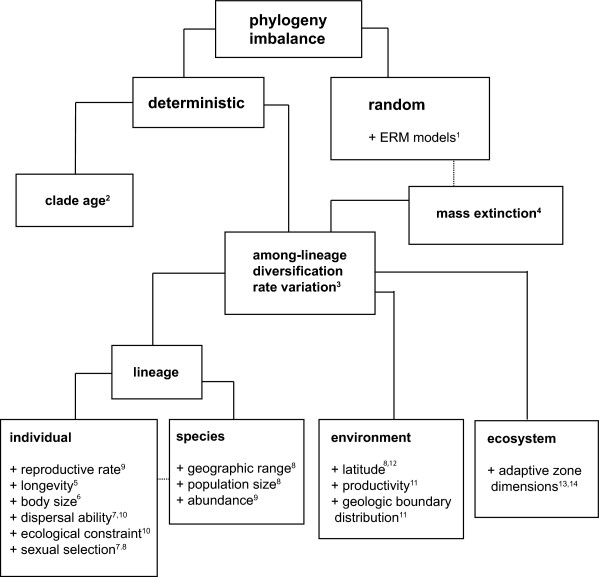
The tree of life is significantly asymmetrical - a result of differential speciation and extinction - but general causes of such asymmetry are unclear. Differences in niche partitioning are thought to be one possible general explanation. Ecological specialization might lead to increases in diversification rate or, alternatively, specialization might limit the evolutionary potential of specialist lineages and increase their extinction risk. Here we compare the diversification rates of gall-inducing and non-galling insect lineages. Compared with other insect herbivores feeding on the same host plant, gall-inducing insects feed on plant tissue that is more nutritious and less defended, and they do so in a favorable microhabitat that may also provide some protection from natural enemies. We use sister-taxon comparisons to test whether gall-inducing lineages are more host-specific than non-galling lineages, and more or less diverse than non-gallers. We evaluate the significance of diversity bipartitions under Equal Rates Markov models, and use maximum likelihood model-fitting to test for shifts in diversification rates.
We find that, although gall-inducing insect groups are more host-specific than their non-galling relatives, there is no general significant increase in diversification rate in gallers. However, gallers are found at both extremes - two gall-inducing lineages are exceptionally diverse (Euurina sawflies on Salicaceae and Apiomorpha scale insects on Eucalytpus), and one gall-inducing lineage is exceptionally species-poor (Maskellia armored scales on Eucalyptus).
The effect of ecological specialization on diversification rates is complex in the case of gall-inducing insects, but host range may be an important factor. When a gall-inducing lineage has a host range approximate to that of its non-galling sister, the gallers are more diverse. When the non-galler clade has a much wider host range than the galler, the non-galler is also much more diverse. There are also lineage-specific effects, with gallers on the same host group exhibiting very different diversities. No single general model explains the observed pattern.
生命之树具有显著的不对称性——这是物种形成和灭绝的结果,但造成这种不对称的一般原因尚不清楚。生态位分化的差异被认为是一种可能的普遍解释。生态特化可能会导致多样化率的增加,或者特化可能会限制特化谱系的进化潜力,并增加它们的灭绝风险。在这里,我们比较了诱导产生虫瘿和非诱导产生虫瘿的昆虫谱系的多样化率。与以同一宿主植物为食的其他昆虫食草动物相比,诱导产生虫瘿的昆虫以更有营养、防御性更低的植物组织为食,并且它们在有利于生长的小生境中以这种方式进食,这种小生境还可能为它们提供一些免受天敌侵害的保护。我们使用姊妹分类群比较来检验诱导产生虫瘿的谱系是否比非诱导产生虫瘿的谱系更具宿主专化性,以及是否比非虫瘿类更具多样性或更少多样性。我们在等速马尔可夫模型下评估多样性二分法的显著性,并使用最大似然模型拟合来检验多样化率的变化。
我们发现,尽管诱导产生虫瘿的昆虫类群比它们的非虫瘿亲缘类群更具宿主专化性,但在诱导产生虫瘿的昆虫中并没有普遍显著的多样化率增加。然而,诱导产生虫瘿的昆虫存在于两个极端——两个诱导产生虫瘿的谱系非常多样化(柳树上的 Eurina 叶蜂和桉树上的 Apiomorpha 介壳虫),而一个诱导产生虫瘿的谱系非常物种贫乏(桉树上的 Maskellia 铠蚧)。
在诱导产生虫瘿的昆虫中,生态特化对多样化率的影响是复杂的,但宿主范围可能是一个重要因素。当一个诱导产生虫瘿的谱系的宿主范围与它的非虫瘿姊妹相似时,虫瘿类就更加多样化。当非虫瘿类的谱系的宿主范围比虫瘿类的谱系宽得多时,非虫瘿类的谱系也更加多样化。还有谱系特异性效应,同一宿主群的虫瘿类表现出非常不同的多样性。没有一个单一的一般模型可以解释观察到的模式。