Pfizer Inc, Global Health Economics and Outcomes Research, New York, NY 10017, USA.
Arthritis Res Ther. 2010;12(4):R162. doi: 10.1186/ar3121. Epub 2010 Aug 25.
Understanding the relationship between patient-reported osteoarthritis (OA) severity and other patient-reported outcomes in the real-world clinical setting can provide a basis for appropriate patient management. The objective of this study was to determine how patient-reported OA severity correlates with patient-reported outcomes including pain, function and productivity.
We used the Adelphi Disease Specific Programme (DSP) for OA, a database aggregated from large, multinational, observational studies for specific chronic diseases. Data were obtained based on a 0 to 100 mm pain visual analogue scale (VAS) and a series of questions including functioning (that is, activities of daily living) and work productivity. OA severity was rated by the patients based on the question "How bad would you say your arthritis is now?" with potential responses of "mild," "moderate," and "severe." Regression models and chi-square analyses were used to evaluate the relationships between self-reported OA severity and other outcomes.
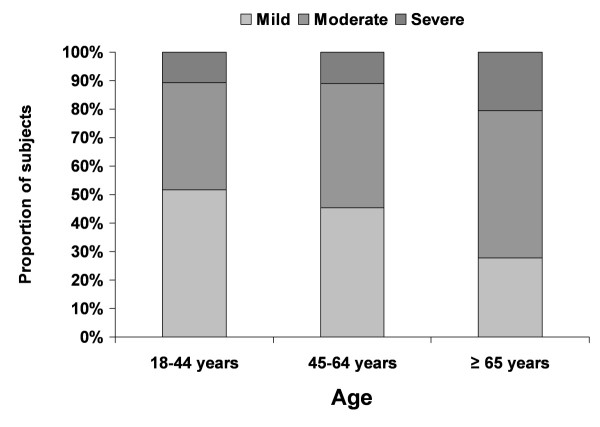
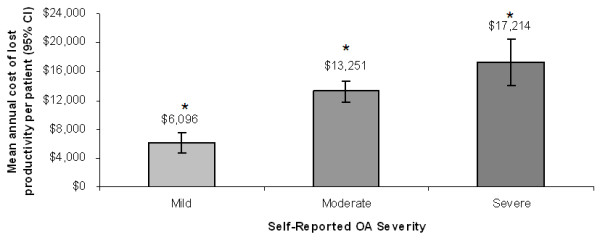
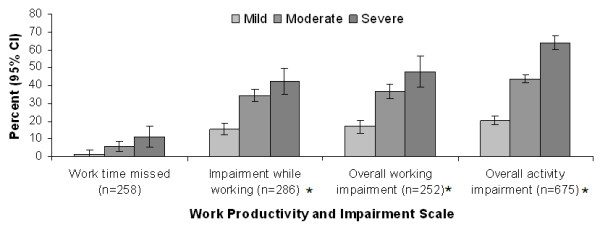
Of 998 subjects in the OA DSP U.S. database, 714 (72.5%) agreed to participate. This sample was predominantly female (61.7%) with a mean age of 63.8 ± 12.9 years. Increased OA severity was associated with an older population (P < 0.05). With increasing OA severity (mild, moderate, severe), statistically significant differences (P < 0.05) were observed in increased pain VAS scores (23.5, 50.2, 70.8, respectively), lower functioning outcomes, and a higher percent of overall work impairment due to OA (17%, 37%, 48%, respectively). The increased work impairment at greater severity levels also resulted in higher costs related to lost work productivity, with annual costs due to lost productivity estimated at $6,096, $13,2510, and $17,214 per patient for self-reported mild, moderate, and severe OA, respectively (P < 0.05 for pairwise comparisons).
In the clinical practice setting, patient-reported OA severity was associated with other key patient-reported outcomes and thus may provide an accurate and tangible assessment of patients' perceptions of their disease. Identifying OA patients by their perceived severity level may be of benefit to patients and health-care providers when choosing treatment options aimed at reducing pain, and improving function and productivity.
了解患者报告的骨关节炎(OA)严重程度与真实临床环境中其他患者报告的结果之间的关系,可以为患者的适当管理提供依据。本研究的目的是确定患者报告的 OA 严重程度与包括疼痛、功能和生产力在内的患者报告结果的相关性。
我们使用 Adelphi 疾病特定计划(DSP)治疗 OA,这是一种从大型跨国观察性研究中聚合的特定慢性疾病数据库。数据是基于 0 到 100mm 疼痛视觉模拟量表(VAS)和一系列问题获得的,包括功能(即日常生活活动)和工作生产力。患者根据“您现在的关节炎有多严重?”这个问题来评估 OA 严重程度,可能的答案为“轻度”、“中度”和“重度”。回归模型和卡方分析用于评估患者自我报告的 OA 严重程度与其他结果之间的关系。
在美国 OA DSP 数据库中,998 名患者中有 714 名(72.5%)同意参与。该样本主要为女性(61.7%),平均年龄为 63.8±12.9 岁。OA 严重程度的增加与年龄较大有关(P<0.05)。随着 OA 严重程度的增加(轻度、中度、重度),疼痛 VAS 评分(分别为 23.5、50.2、70.8)、功能结果降低以及因 OA 导致的整体工作受损比例(分别为 17%、37%、48%)均有统计学显著差异(P<0.05)。在更高的严重程度水平上,工作受损程度的增加也导致了与工作生产力损失相关的更高成本,估计每位患者因轻度、中度和重度 OA 导致的工作生产力损失而产生的年成本分别为 6096 美元、132510 美元和 17214 美元(两两比较均 P<0.05)。
在临床实践环境中,患者报告的 OA 严重程度与其他关键患者报告的结果相关,因此可能提供对患者对其疾病的看法的准确和有形的评估。根据患者感知的严重程度来识别 OA 患者,在选择旨在减轻疼痛、改善功能和生产力的治疗方案时,可能对患者和医疗保健提供者都有益。