Jay G, Jay F T, Friedman R M, Levine A S
J Virol. 1978 May;26(2):411-9. doi: 10.1128/JVI.26.2.411-419.1978.
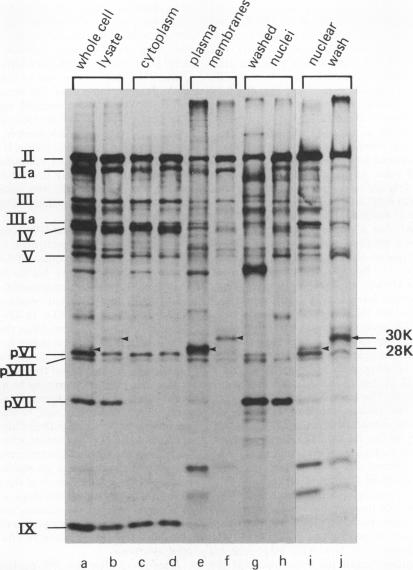
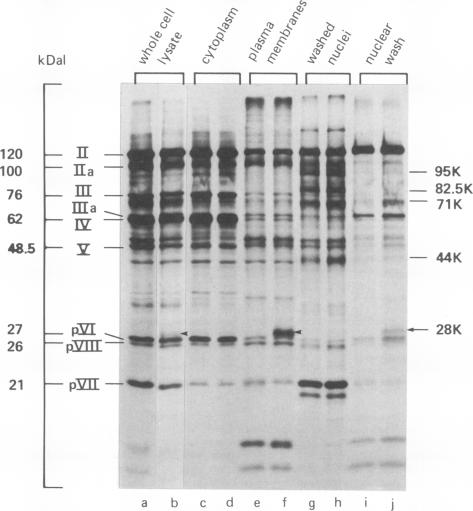
Ad2(+)ND(1), a nondefective hybrid virus containing a segment of the early region of simian virus 40 (SV40) DNA covalently inserted into the human adenovirus 2 genome, enhances the growth of human adenoviruses in simian cells and induces the SV40 U antigen. This hybrid previously has been shown to code for a 28,000 (28K) molecular weight protein not present in wild-type adenovirus 2-infected cells. By radioimmunoprecipitation using sera from hamsters bearing SV40-specific tumors, we have established that the Ad2(+)ND(1)-induced 28K protein is SV40-specific. This Ad2(+)ND(1)-induced protein is synthesized as a 30K molecular weight precursor, which is detectable only when infected cells are pulse-labeled in the presence of the protease inhibitor tosylamino phenylethyl chloromethyl ketone. Upon fractionation of labeled cell extracts, about 80% of the 28K protein is found in the plasma membrane fraction, whereas the remaining 20% is associated with the outer nuclear membrane. This protein is not detectable either in the nucleus or in the cytoplasm. Blockage of proteolytic cleavage by tosylamino phenylethyl chloromethyl ketone did not alter the topographic distribution of this SV40-specific protein, although the amount of the precursor protein in the outer nuclear membrane increased fourfold while that in the plasma membrane was proportionately decreased. This result suggests that the 28K protein is transferred from the outer nuclear membrane to the plasma membrane after posttranslational cleavage of the 30K precursor polypeptide. These data offer further support to the proposal that the 28K protein contains the determinants for SV40 U antigen and is responsible for SV40 enhancement of adenovirus growth in simian cells.
Ad2(+)ND(1)是一种无缺陷的杂交病毒,它含有共价插入人腺病毒2基因组的猿猴病毒40(SV40)DNA早期区域的一个片段,可增强人腺病毒在猿猴细胞中的生长并诱导SV40大T抗原。先前已证明这种杂交病毒编码一种野生型腺病毒2感染细胞中不存在的分子量为28,000(28K)的蛋白质。通过使用来自携带SV40特异性肿瘤的仓鼠的血清进行放射免疫沉淀,我们已确定Ad2(+)ND(1)诱导的28K蛋白质是SV40特异性的。这种Ad2(+)ND(1)诱导的蛋白质作为分子量为30K的前体合成,只有当感染细胞在蛋白酶抑制剂甲苯磺酰氨基苯乙基氯甲基酮存在下进行脉冲标记时才能检测到。在对标记的细胞提取物进行分级分离时,约80%的28K蛋白质存在于质膜部分,而其余20%与外核膜相关。这种蛋白质在细胞核或细胞质中均无法检测到。甲苯磺酰氨基苯乙基氯甲基酮对蛋白水解切割的阻断并未改变这种SV40特异性蛋白质的拓扑分布,尽管外核膜中前体蛋白的量增加了四倍,而质膜中的前体蛋白量则相应减少。这一结果表明,30K前体多肽在翻译后切割后,28K蛋白质从外核膜转移到质膜。这些数据进一步支持了以下提议,即28K蛋白质包含SV40大T抗原的决定簇,并负责SV40增强腺病毒在猿猴细胞中的生长。