Department of Medicine, University of Hong Kong, Hong Kong, China.
Diabetes. 2010 Nov;59(11):2949-59. doi: 10.2337/db10-0582. Epub 2010 Aug 29.
A reduced number of circulating endothelial progenitor cells (EPCs) are casually associated with the cardiovascular complication of diabetes. Adiponectin exerts multiple protective effects against cardiovascular disease, independent of its insulin-sensitizing activity. The objective of this study was to investigate whether adiponectin plays a role in modulating the bioavailability of circulating EPCs and endothelial repair.
Adiponectin knockout mice were crossed with db(+/-) mice to produce db/db diabetic mice without adiponectin. Circulating number of EPCs were analyzed by flow cytometry. Reendothelialization was evaluated by staining with Evans blue after wire-induced carotid injury.
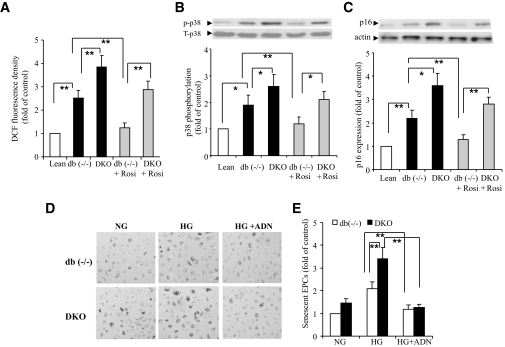
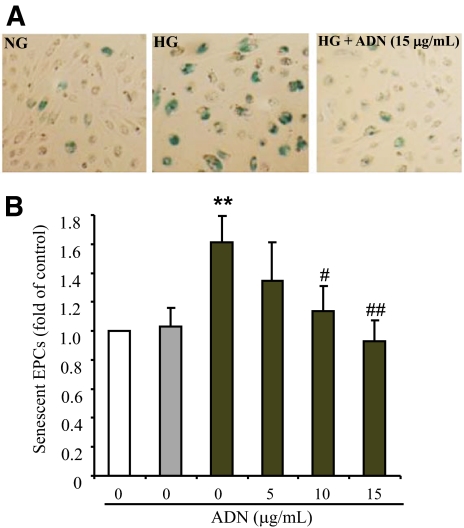
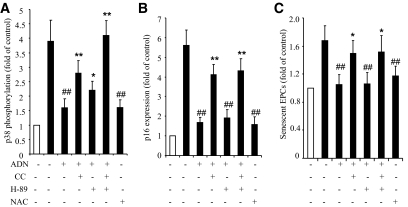
In adiponectin knockout mice, the number of circulating EPCs decreased in an age-dependent manner compared with the wild-type controls, and this difference was reversed by the chronic infusion of recombinant adiponectin. In db/db diabetic mice, the lack of adiponectin aggravated the hyperglycemia-induced decrease in circulating EPCs and also diminished the stimulatory effects of the PPARγ agonist rosiglitazone on EPC production and reendothelialization. In EPCs isolated from both human peripheral blood and mouse bone marrow, treatment with adiponectin prevented high glucose-induced premature senescence. At the molecular level, adiponectin decreased high glucose-induced accumulation of intracellular reactive oxygen species and consequently suppressed activation of p38 MAP kinase (MAPK) and expression of the senescence marker p16(INK4A).
Adiponectin prevents EPC senescence by inhibiting the ROS/p38 MAPK/p16(INK4A) signaling cascade. The protective effects of adiponectin against diabetes vascular complications are attributed in part to its ability to counteract hyperglycemia-mediated decrease in the number of circulating EPCs.
循环内皮祖细胞 (EPC) 的数量减少与糖尿病的心血管并发症有关。脂联素对心血管疾病具有多种保护作用,与其胰岛素增敏活性无关。本研究旨在探讨脂联素是否在调节循环 EPC 的生物利用度和内皮修复中发挥作用。
将脂联素敲除小鼠与 db(+/-) 小鼠杂交,产生没有脂联素的 db/db 糖尿病小鼠。通过流式细胞术分析循环 EPC 的数量。通过 wire-induced 颈动脉损伤后用 Evans blue 染色评估再内皮化。
与野生型对照相比,脂联素敲除小鼠的循环 EPC 数量随年龄的增长呈依赖性下降,而这种差异可被重组脂联素的慢性输注所逆转。在 db/db 糖尿病小鼠中,脂联素的缺乏加剧了高血糖引起的循环 EPC 减少,也减弱了 PPARγ 激动剂罗格列酮对 EPC 产生和再内皮化的刺激作用。在人外周血和鼠骨髓分离的 EPC 中,脂联素处理可防止高葡萄糖诱导的过早衰老。在分子水平上,脂联素可减少高葡萄糖诱导的细胞内活性氧物质的积累,从而抑制 p38 MAP 激酶 (MAPK) 的激活和衰老标志物 p16(INK4A)的表达。
脂联素通过抑制 ROS/p38 MAPK/p16(INK4A)信号级联来防止 EPC 衰老。脂联素对糖尿病血管并发症的保护作用部分归因于其能够抵消高血糖介导的循环 EPC 数量减少。