Division of HIV/AIDS Prevention, Centers for Disease Control and Prevention, Atlanta, Georgia, United States of America.
PLoS Med. 2010 Aug 24;7(8):e1000329. doi: 10.1371/journal.pmed.1000329.
Substance use during sex is associated with sexual risk behavior among men who have sex with men (MSM), and MSM continue to be the group at highest risk for incident HIV in the United States. The objective of this study is to test the efficacy of a group-based, cognitive-behavioral intervention to reduce risk behavior of substance-using MSM, compared to a randomized attention-control group and a nonrandomized standard HIV-testing group.
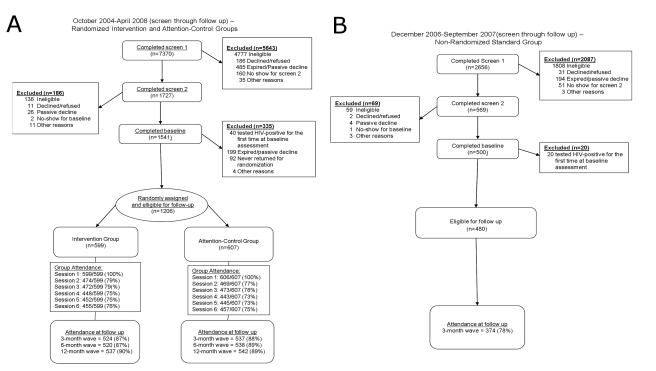
Participants (n = 1,686) were enrolled in Chicago, Los Angeles, New York City, and San Francisco and randomized to a cognitive-behavioral intervention or attention-control comparison. The nonrandomized group received standard HIV counseling and testing. Intervention group participants received six 2-h group sessions focused on reducing substance use and sexual risk behavior. Attention-control group participants received six 2-h group sessions of videos and discussion of MSM community issues unrelated to substance use, sexual risk, and HIV/AIDS. All three groups received HIV counseling and testing at baseline. The sample reported high-risk behavior during the past 3 mo prior to their baseline visit: 67% reported unprotected anal sex, and 77% reported substance use during their most recent anal sex encounter with a nonprimary partner. The three groups significantly (p<0.05) reduced risk behavior (e.g., unprotected anal sex reduced by 32% at 12-mo follow-up), but were not different (p>0.05) from each other at 3-, 6-, and 12-mo follow-up. Outcomes for the 2-arm comparisons were not significantly different at 12-mo follow-up (e.g., unprotected anal sex, odds ratio = 1.14, confidence interval = 0.86-1.51), nor at earlier time points. Similar results were found for each outcome variable in both 2- and 3-arm comparisons.
These results for reducing sexual risk behavior of substance-using MSM are consistent with results of intervention trials for other populations, which collectively suggest critical challenges for the field of HIV behavioral interventions. Several mechanisms may contribute to statistically indistinguishable reductions in risk outcomes by trial group. More explicit debate is needed in the behavioral intervention field about appropriate scientific designs and methods. As HIV prevention increasingly competes for behavior-change attention alongside other "chronic" diseases and mental health issues, new approaches may better resonate with at-risk groups.
ClinicalTrials.gov NCT00153361. Please see later in the article for the Editors' Summary.
性活动中物质的使用与男男性行为者(MSM)的性风险行为相关联,而 MSM 仍然是美国新感染 HIV 风险最高的群体。本研究的目的是测试一种基于群体的认知行为干预措施,以减少物质使用的 MSM 的风险行为,与随机分配的注意对照组和非随机标准 HIV 检测组进行比较。
参与者(n = 1686)在芝加哥、洛杉矶、纽约市和旧金山招募,并随机分配到认知行为干预组或注意对照组。非随机组接受标准的 HIV 咨询和检测。干预组的参与者接受了六次 2 小时的小组会议,重点是减少物质使用和性风险行为。注意对照组的参与者参加了六次 2 小时的小组会议,观看了与物质使用、性风险和 HIV/AIDS 无关的 MSM 社区问题的视频和讨论。所有三组在基线时都接受了 HIV 咨询和检测。样本报告在基线前 3 个月内有高风险行为:67%的人报告了无保护的肛交,77%的人报告了最近与非主要伴侣进行肛交时使用了物质。三组在 3 个月、6 个月和 12 个月的随访中均显著(p<0.05)降低了风险行为(例如,在 12 个月的随访中,无保护的肛交减少了 32%),但在 3 个月、6 个月和 12 个月的随访中彼此之间没有差异(p>0.05)。在 12 个月的随访中,两组比较的结果(例如,无保护的肛交,优势比=1.14,置信区间=0.86-1.51),以及更早的时间点,均无显著差异。在 2 臂和 3 臂比较的每个结果变量中都发现了相似的结果。
这些减少物质使用的 MSM 性风险行为的结果与针对其他人群的干预试验结果一致,这些结果共同表明 HIV 行为干预领域面临着严峻的挑战。一些机制可能导致试验组风险结果的统计学上无差异减少。行为干预领域需要就适当的科学设计和方法进行更明确的辩论。随着 HIV 预防越来越与其他“慢性”疾病和心理健康问题争夺行为改变的注意力,新的方法可能会更好地引起高危人群的共鸣。
ClinicalTrials.gov NCT00153361。请稍后在文章中查看编辑摘要。