Department of Anesthesiology and Pain Medicine, Chonnam National University, Medical School, Gwangju, Korea.
Korean J Pain. 2010 Sep;23(3):172-8. doi: 10.3344/kjp.2010.23.3.172. Epub 2010 Aug 26.
Tumor necrosis factor-alpha and other proinflammatory cytokines are becoming well recognized as key mediators in the pathogenesis of many types of neuropathic pain. Thalidomide has profound immunomodulatory actions in addition to their originally intended pharmacological actions. There has been debate on the analgesic efficacy of opioids in neuropathic pain. The aim of this study was to investigate the effect of thalidomide and morphine on a spinal nerve ligation model in rats.
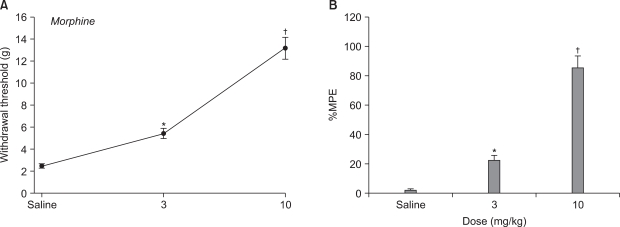
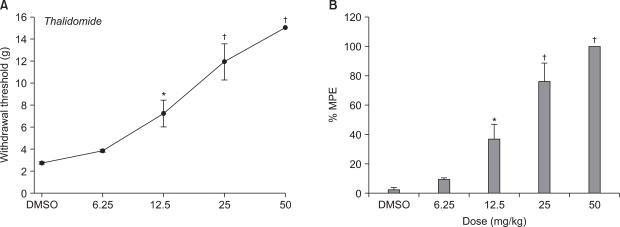
Male Sprague-Dawley rats weighing 100-120 g were used. Lumbar (L) 5 and 6 spinal nerve ligations were performed to induce neuropathic pain. For assessment of mechanical allodynia, mechanical stimulus using von Frey filament was applied to the paw to measure withdrawal threshold. The effects of intraperitoneal thalidomide (6.25, 12.5, 25 and 50 mg/kg, respectively) and morphine (3 and 10 mg/kg, respectively) were examined on a withdrawal threshold evoked by spinal nerve ligation.
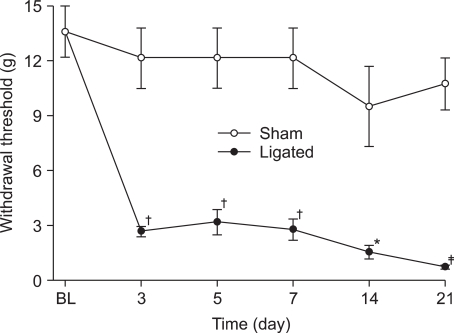
After L5 and 6 spinal nerve ligation, paw withdrawal thresholds on the ipsilateral side were significantly decreased compared with pre-operative baseline and with those in the sham-operated group. Intraperitoneal thalidomide and morphine significantly increased the paw withdrawal threshold compared to controls and produced dose-responsiveness.
Systemic thalidomide and morphine have antiallodynic effect on neuropathic pain induced by spinal nerve ligation in rat. These results suggest that morphine and thalidomide may be alternative therapeutic approaches for neuropathic pain.
肿瘤坏死因子-α和其他促炎细胞因子已被广泛认为是多种神经性疼痛发病机制中的关键介质。沙利度胺除了其原有的药理学作用外,还具有深刻的免疫调节作用。关于阿片类药物在神经性疼痛中的镇痛效果一直存在争议。本研究旨在探讨沙利度胺和吗啡对大鼠脊神经结扎模型的影响。
使用体重为 100-120g 的雄性 Sprague-Dawley 大鼠。进行腰椎(L)5 和 6 脊神经结扎以诱导神经性疼痛。为了评估机械性痛觉过敏,使用 von Frey 细丝施加机械刺激以测量足部退缩阈值。分别腹腔给予沙利度胺(6.25、12.5、25 和 50mg/kg)和吗啡(3 和 10mg/kg),观察其对脊神经结扎引起的退缩阈值的影响。
L5 和 6 脊神经结扎后,同侧足部的退缩阈值与术前基线相比以及与假手术组相比均显著降低。腹腔内给予沙利度胺和吗啡与对照组相比显著增加了足部退缩阈值,并呈现出剂量反应性。
全身给予沙利度胺和吗啡对大鼠脊神经结扎引起的神经性疼痛具有抗痛觉过敏作用。这些结果表明,吗啡和沙利度胺可能是神经性疼痛的替代治疗方法。