Department of Primary Care and Public Health, Imperial College London, London, UK.
Diabetes Care. 2010 Dec;33(12):2592-7. doi: 10.2337/dc10-0989. Epub 2010 Sep 10.
To describe recent trends in the incidence of nontraumatic amputations among individuals with and without diabetes and estimate the relative risk of amputations among individuals with diabetes in England.
We identified all patients aged >16 years who underwent any nontraumatic amputation in England between 2004 and 2008 using national hospital activity data from all National Health Service hospitals. Age- and sex-specific incidence rates were calculated using the total diabetes population in England every year. To test for time trend, we fitted Poisson regression models.
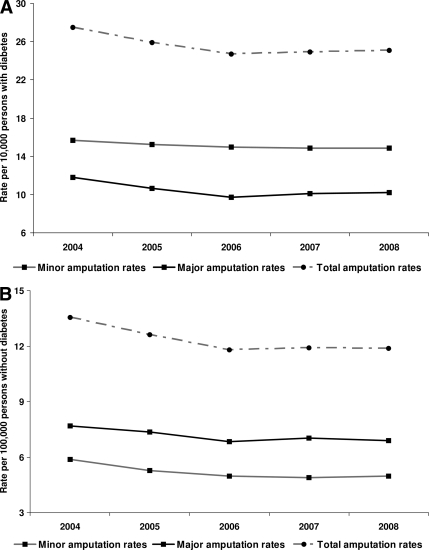
The absolute number of diabetes-related amputations increased by 14.7%, and the incidence decreased by 9.1%, from 27.5 to 25.0 per 10,000 people with diabetes, during the study period (P > 0.2 for both). The incidence of minor and major amputations did not significantly change (15.7-14.9 and 11.8-10.2 per 10,000 people with diabetes; P = 0.66 and P = 0.29, respectively). Poisson regression analysis showed no statistically significant change in diabetes-related amputation incidence over time (0.98 decrease per year [95% CI 0.93-1.02]; P = 0.12). Nondiabetes-related amputation incidence decreased from 13.6 to 11.9 per 100,000 people without diabetes (0.97 decrease by year [0.93-1.00]; P = 0.059). The relative risk of an individual with diabetes undergoing a lower extremity amputation was 20.3 in 2004 and 21.2 in 2008, compared with that of individuals without diabetes.
This national study suggests that the overall population burden of amputations increased in people with diabetes at a time when the number and incidence of amputations decreased in the aging nondiabetic population.
描述近年来英国糖尿病患者和非糖尿病患者中非创伤性截肢的发病率趋势,并估计糖尿病患者截肢的相对风险。
我们利用英国国民保健系统所有医院的国家医院活动数据,确定了 2004 年至 2008 年间所有年龄大于 16 岁的接受任何非创伤性截肢的患者。每年根据英国的糖尿病总人群计算年龄和性别特异性发病率。为了检验时间趋势,我们拟合了泊松回归模型。
研究期间,糖尿病相关截肢的绝对数量增加了 14.7%,发病率从每 10000 名糖尿病患者 27.5 例下降到 25.0 例(两者均 P > 0.2)。小截肢和大截肢的发病率没有显著变化(每 10000 名糖尿病患者分别为 15.7-14.9 例和 11.8-10.2 例;P = 0.66 和 P = 0.29)。泊松回归分析显示,糖尿病相关截肢的发病率随时间没有统计学意义的变化(每年减少 0.98 例[95%CI 0.93-1.02];P = 0.12)。非糖尿病相关截肢的发病率从每 100000 人 13.6 例下降到 11.9 例(每年减少 0.97 例[0.93-1.00];P = 0.059)。与非糖尿病患者相比,2004 年和 2008 年糖尿病患者下肢截肢的相对风险分别为 20.3 和 21.2。
这项全国性研究表明,在非糖尿病老年人群中截肢的数量和发病率下降的同时,糖尿病患者的截肢总体人群负担增加。