George Mason University, Fairfax, VA, USA.
Support Care Cancer. 2011 Oct;19(10):1581-91. doi: 10.1007/s00520-010-0986-7. Epub 2010 Sep 12.
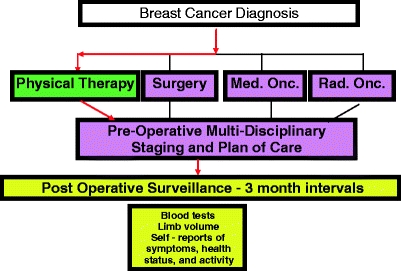
Cancer-related fatigue is common, complex, and distressing. It affects 70-100% of patients receiving chemotherapy and a significant number who have completed their treatments. We assessed a number of variables in women newly diagnosed with primary breast cancer (BrCa) to determine whether biological and/or functional measures are likely to be associated with the development of clinically significant fatigue (CSF). Two hundred twenty-three women participated in a study designed to document the impact of the diagnosis and treatment of primary breast cancer on function. Forty-four had complete data on all variables of interest at the time of confirmed diagnosis but prior to treatment (baseline) and ≥ 9 months post-diagnosis. Objective measures and descriptive variables included history, physical examination, limb volume, hemoglobin, white blood cell count, and glucose. Patient-reported outcomes included a verbal numerical rating of fatigue (0-10, a score of ≥ 4 was CSF), five subscales of the SF-36, Physical Activity Survey, and Sleep Questionnaire. At baseline, the entire cohort (n = 223) and the subset (n = 44) were not significantly different for demographic, biological, and self-reported data, except for younger age (p = 0.03) and ER+ (p = 0.01). Forty-five percent had body mass index (BMI) ≥ 25, 52% were post-menopause, and 52% received modified radical mastectomy, 39% lumpectomy, 52% chemotherapy, 68% radiation, and 86% hormonal therapy. Number of patients with CSF increased from 1 at baseline to 11 at ≥ 9 months of follow-up. CSF at ≥ 9 months significantly correlated with BMI ≥ 25, abnormal white blood cell count, and increase in limb volume and inversely correlated with vigorous activity and physical function (p < 0.05). Fatigue increases significantly following the treatment of BrCa. Predictors of CSF include high BMI and WBC count, increase in limb volume, and low level of physical activity. These are remediable.
癌症相关性疲劳是常见的、复杂的和令人痛苦的。它影响 70-100%接受化疗的患者和相当数量已完成治疗的患者。我们评估了新诊断为原发性乳腺癌(BrCa)的女性的许多变量,以确定生物和/或功能测量是否可能与临床显著疲劳(CSF)的发展相关。223 名女性参与了一项旨在记录原发性乳腺癌诊断和治疗对功能影响的研究。44 名女性在确诊但治疗前(基线)和诊断后≥9 个月时具有所有感兴趣变量的完整数据。客观测量和描述性变量包括病史、体格检查、肢体体积、血红蛋白、白细胞计数和葡萄糖。患者报告的结果包括疲劳的口头数字评分(0-10,得分≥4 为 CSF)、SF-36 的五个子量表、体力活动调查和睡眠问卷。在基线时,整个队列(n=223)和亚组(n=44)在人口统计学、生物学和自我报告数据方面没有显著差异,除了年龄较小(p=0.03)和 ER+(p=0.01)。45%的人 BMI≥25,52%处于绝经后状态,52%接受改良根治性乳房切除术,39%接受乳房肿块切除术,52%接受化疗,68%接受放疗,86%接受激素治疗。CSF 患者的数量从基线时的 1 例增加到随访≥9 个月时的 11 例。≥9 个月时的 CSF 与 BMI≥25、白细胞计数异常、肢体体积增加显著相关,与剧烈活动和身体功能呈负相关(p<0.05)。乳腺癌治疗后疲劳显著增加。CSF 的预测因素包括高 BMI 和白细胞计数、肢体体积增加和低水平的体力活动。这些是可以纠正的。