MRC/Wits Rural Public Health and Health Transitions Research Unit (Agincourt), School of Public Health, Faculty of Health Sciences, University of the Witwatersrand, Johannesburg, South Africa.
Glob Health Action. 2010 Aug 30;3. doi: 10.3402/gha.v3i0.5225.
Detailed information regarding the spatial and/or spatial-temporal distribution of mortality is required for the efficient implementation and targeting of public health interventions.
Identify high risk clusters of mortality within the Agincourt subdistrict for targeting of public health interventions, and highlight areas for further research.
Mortality data were extracted from the Agincourt health and socio-demographic surveillance system (HDSS) for the period 1992-2007. Mortality rates by age group and time were calculated assuming a Poisson distribution and using precise person-time contribution estimates. A spatial scan statistic (Kulldorff) was used to test for clusters of age group specific all-cause and cause-specific mortality both in space and time.
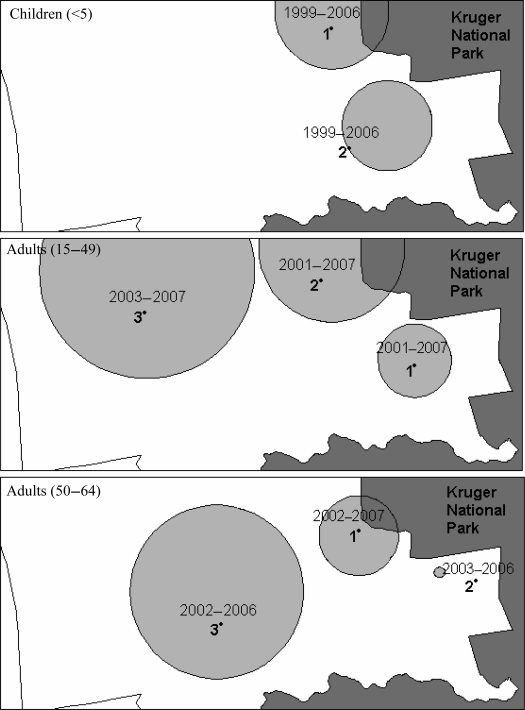
Many statistically significant clusters of higher all-cause and cause-specific mortality were identified both in space and time. Specific areas were consistently identified as high risk areas; namely, the east/south- east and upper east central regions. This corresponds to areas with higher mortality due to communicable causes (especially HIV/TB and diarrhoeal disease) and indicates a non-random element to the distribution of potential underlying causative factors e.g. settlements comprising former. Mozambican refugees in east/south-east of the site, corresponding higher poverty areas, South African villages with higher HIV prevalence, etc. Clusters of older adult mortality were also observed indicating potential non-random distribution of non-communicable disease mortality.
This study has highlighted distinct clusters of all-cause and cause-specific mortality within the Agincourt subdistrict. It is a first step in prioritizing areas for further, more detailed research as well as for future public health follow-on efforts such as targeting of vertical prevention of HIV/TB and antiretroviral rollout in significant child and adult mortality clusters; and assessment and provision of adequate water and sanitation in the child mortality clusters particularly in south-east where diarrheal mortality appears high. Underlying causative factors need to be identified and accurately quantified. Other questions for more detailed research are discussed.
为了有效实施和针对公共卫生干预措施,需要详细了解死亡率的空间和/或时空分布信息。
确定阿格因库尔特区内死亡率的高风险聚集区,以针对公共卫生干预措施,并突出进一步研究的领域。
1992-2007 年期间,从阿格因库尔特健康和社会人口监测系统(HDSS)提取死亡率数据。使用泊松分布假设和精确的人员时间贡献估计值计算按年龄组和时间划分的死亡率。使用空间扫描统计量(Kulldorff)测试年龄组特异性全因死亡率和死因特异性死亡率的空间和时间聚集。
在空间和时间上均发现了许多具有统计学意义的高全因和死因特异性死亡率聚集区。特定区域被一致确定为高风险区域,即东部/东南部和上中东部地区。这与由于传染病(特别是 HIV/TB 和腹泻病)导致的高死亡率相对应,表明潜在因果因素的分布具有非随机性,例如,前莫桑比克难民居住的东部/东南部定居点、对应更高贫困地区、南非 HIV 流行率较高的村庄等。还观察到老年人群死亡率的聚集,表明非传染性疾病死亡率的潜在非随机分布。
本研究强调了阿格因库尔特区内全因和死因特异性死亡率的明显聚集。这是为进一步、更详细的研究以及未来公共卫生后续工作(例如针对 HIV/TB 的垂直预防和在显著儿童和成人死亡率聚集区推出抗逆转录病毒药物)确定优先领域的第一步,也是评估和提供充足的水和卫生设施的第一步,特别是在东南部,腹泻死亡率似乎很高。需要确定和准确量化潜在的因果因素。还讨论了其他更详细研究的问题。