School of Public Health, Faculty of Health Sciences, University of the Witwatersrand, Johannesburg, South Africa.
Glob Health Action. 2013 Jan 24;6:19239. doi: 10.3402/gha.v6i0.19239.
There is a lack of reliable data in developing countries to inform policy and optimise resource allocation. Health and socio-demographic surveillance sites (HDSS) have the potential to address this gap. Mortality levels and trends have previously been documented in rural South Africa. However, complex space-time clustering of mortality, determinants, and their impact has not been fully examined.
To integrate advanced methods enhance the understanding of the dynamics of mortality in space-time, to identify mortality risk factors and population attributable impact, to relate disparities in risk factor distributions to spatial mortality risk, and thus, to improve policy planning and resource allocation.
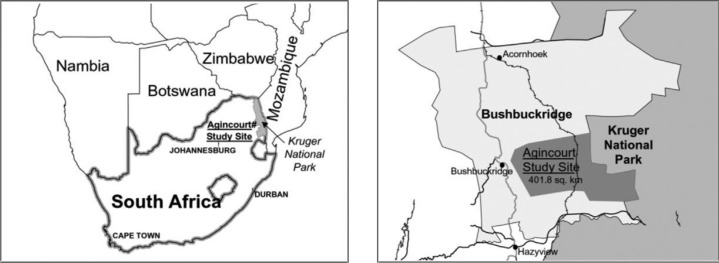
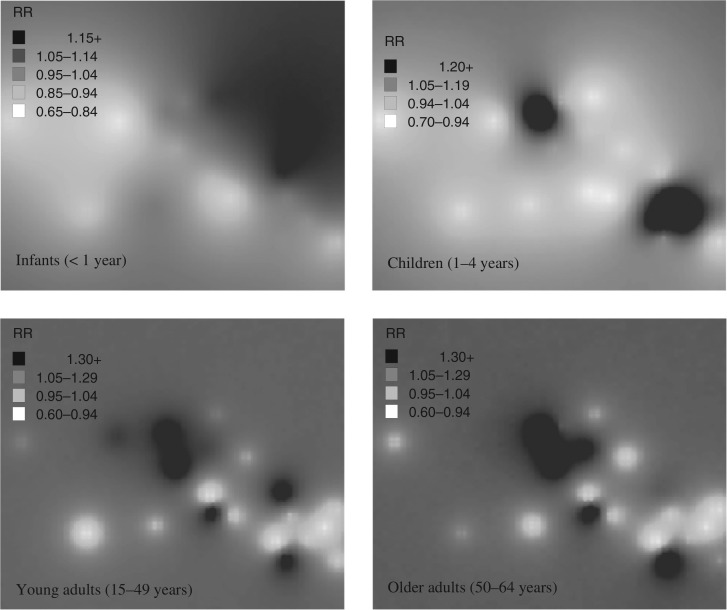
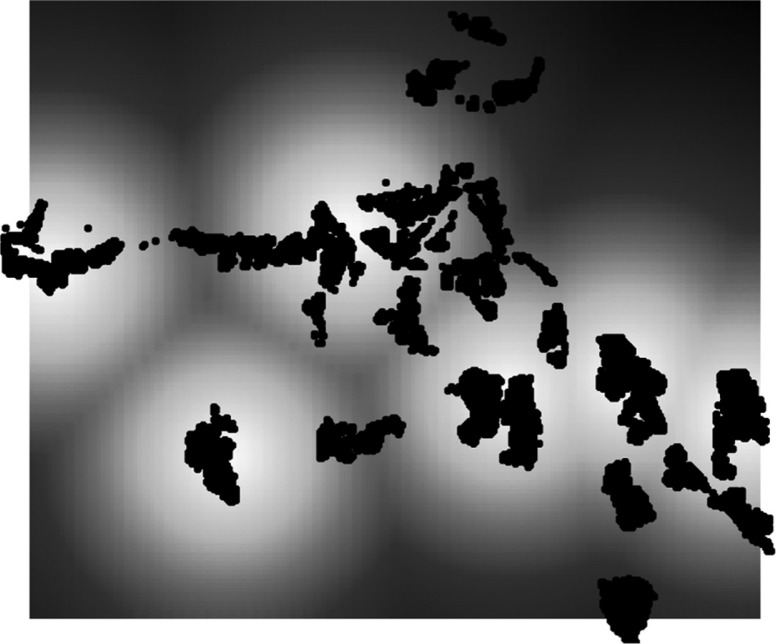
Agincourt HDSS supplied data for the period 1992-2008. Advanced spatial techniques were used to identify significant age-specific mortality 'hotspots' in space-time. Multivariable Bayesian models were used to assess the effects of the most significant covariates on mortality. Disparities in risk factor profiles in identified hotspots were assessed.
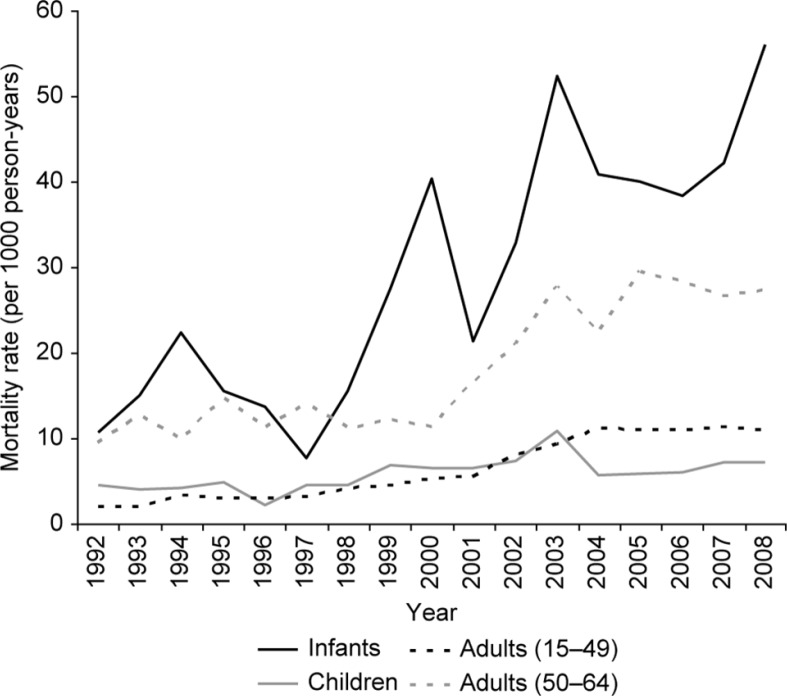
Increasing HIV-related mortality and a subsequent decrease possibly attributable to antiretroviral therapy introduction are evident in this rural population. Distinct space-time clustering and variation (even in a small geographic area) of mortality were observed. Several known and novel risk factors were identified, and population impact was quantified. Significant differences in the risk factor profiles of the identified 'hotspots' included ethnicity; maternal, partner, and household deaths; household head demographics; migrancy; education; and poverty.
A complex interaction of highly attributable multilevel factors continues to demonstrate differential space-time influences on mortality risk (especially for HIV). High-risk households and villages displayed differential risk factor profiles. This integrated approach could prove valuable to decision makers. Tailored interventions for specific child and adult high-risk mortality areas are needed, such as preventing vertical transmission, ensuring maternal survival, and improving water and sanitation infrastructure. This framework can be applied in other settings within the region.
发展中国家缺乏可靠数据来为政策提供信息并优化资源配置。健康和社会人口监测站点(HDSS)有潜力解决这一差距。以前已经记录了南非农村地区的死亡率水平和趋势。然而,死亡率的复杂时空聚类、决定因素及其影响尚未得到充分研究。
整合先进的方法,增强对时空死亡率动态的理解,确定死亡率的风险因素和人群归因影响,将风险因素分布的差异与空间死亡率风险联系起来,从而改善政策规划和资源分配。
Agincourt HDSS 提供了 1992-2008 年期间的数据。先进的空间技术用于识别时空特定年龄的显著死亡率“热点”。多变量贝叶斯模型用于评估对死亡率影响最大的协变量的影响。评估了在确定的热点中风险因素分布的差异。
在这个农村人口中,HIV 相关死亡率的增加以及随后可能归因于抗逆转录病毒治疗的引入是显而易见的。观察到死亡率的明显时空聚类和变化(即使在一个小地理区域内)。确定了几个已知和新的风险因素,并量化了人群影响。确定的“热点”的风险因素分布存在显著差异,包括族裔;孕产妇、伴侣和家庭死亡;家庭户主人口统计学;移民;教育;和贫困。
高度归因的多层次因素的复杂相互作用继续显示出对死亡率风险的时空差异影响(特别是 HIV)。高风险家庭和村庄表现出不同的风险因素分布。这种综合方法可以为决策者提供有价值的信息。需要针对特定儿童和成人高风险死亡率地区采取有针对性的干预措施,例如预防垂直传播、确保孕产妇生存和改善水和卫生基础设施。这个框架可以在该地区的其他环境中应用。