Department of Psychiatry, Academic Medical Center, University of Amsterdam, The Netherlands.
Addict Biol. 2010 Oct;15(4):491-503. doi: 10.1111/j.1369-1600.2010.00242.x. Epub 2010 Sep 14.
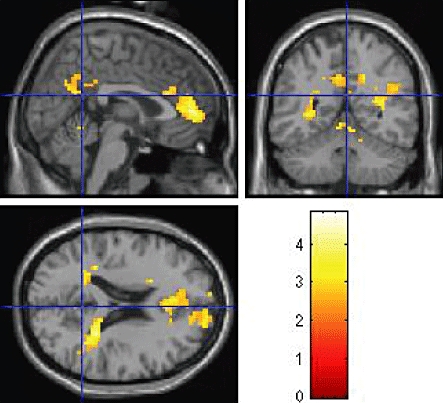
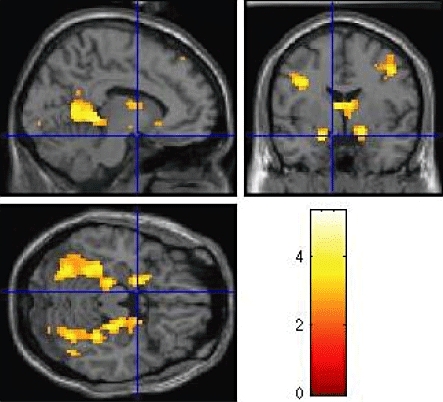
Abnormal cue reactivity is a central characteristic of addiction, associated with increased activity in motivation, attention and memory related brain circuits. In this neuroimaging study, cue reactivity in problem gamblers (PRG) was compared with cue reactivity in heavy smokers (HSM) and healthy controls (HC). A functional magnetic resonance imaging event-related cue reactivity paradigm, consisting of gambling, smoking-related and neutral pictures, was employed in 17 treatment-seeking non-smoking PRG, 18 non-gambling HSM, and 17 non-gambling and non-smoking HC. Watching gambling pictures (relative to neutral pictures) was associated with higher brain activation in occipitotemporal areas, posterior cingulate cortex, parahippocampal gyrus and amygdala in PRG compared with HC and HSM. Subjective craving in PRG correlated positively with brain activation in left ventrolateral prefrontal cortex and left insula. When comparing the HSM group with the two other groups, no significant differences in brain activity induced by smoking cues were found. In a stratified analysis, the HSM subgroup with higher Fagerström Test for Nicotine Dependence scores (FTND M = 5.4) showed higher brain activation in ventromedial prefrontal cortex, rostral anterior cingulate cortex, insula and middle/superior temporal gyrus while watching smoking-related pictures (relative to neutral pictures) than the HSM subgroup with lower FTND scores (FTND M = 2.9) and than non-smoking HC. Nicotine craving correlated with activation in left prefrontal and left amygdala when viewing smoking-related pictures in HSM. Increased regional responsiveness to gambling pictures in brain regions linked to motivation and visual processing is present in PRG, similar to neural mechanisms underlying cue reactivity in substance dependence. Increased brain activation in related fronto-limbic brain areas was present in HSM with higher FTND scores compared with HSM with lower FTND scores.
异常线索反应是成瘾的一个核心特征,与动机、注意力和记忆相关脑回路的活动增加有关。在这项神经影像学研究中,我们比较了问题赌徒(PRG)、重度吸烟者(HSM)和健康对照组(HC)的线索反应。采用功能磁共振成像事件相关线索反应范式,包括赌博、吸烟相关和中性图片,对 17 名寻求治疗的不吸烟 PRG、18 名非赌博 HSM 和 17 名非赌博和不吸烟 HC 进行了研究。与 HC 和 HSM 相比,PRG 观看赌博图片(相对于中性图片)时,枕颞区、后扣带回皮质、海马旁回和杏仁核的大脑激活度更高。PRG 的主观渴求与左外侧前额叶和左岛叶的大脑激活呈正相关。当比较 HSM 组与其他两组时,吸烟线索引起的大脑活动没有发现显著差异。在分层分析中,尼古丁依赖程度较高(FTND 均值=5.4)的 HSM 亚组在观看吸烟相关图片(相对于中性图片)时,腹内侧前额叶、额前皮质、岛叶和中/上颞叶的大脑激活度更高,而 FTND 得分较低(FTND 均值=2.9)的 HSM 亚组和不吸烟的 HC 则没有。在 HSM 中,观看吸烟相关图片时,尼古丁渴求与左前额叶和左杏仁核的激活相关。在与动机和视觉处理相关的脑区,PRG 对赌博图片的区域反应性增加,与物质依赖的线索反应的神经机制相似。与 FTND 得分较低的 HSM 相比,FTND 得分较高的 HSM 中,与吸烟相关的额-边缘脑区的大脑激活度增加。