Vadiraja S Hosakote, Rao M Raghavendra, Nagendra R Hongasandra, Nagarathna Raghuram, Rekha Mohan, Vanitha Nanjundiah, Gopinath S Kodaganuru, Srinath Bs, Vishweshwara Ms, Madhavi Ys, S Ajaikumar Basavalingaiah, Ramesh S Bilimagga, Rao Nalini
Department of Yoga Research, Swami Vivekananda Yoga Anusandhana Samsthana, Bangalore, India.
Int J Yoga. 2009 Jul;2(2):73-9. doi: 10.4103/0973-6131.60048.
This study compares the effects of an integrated yoga program with brief supportive therapy on distressful symptoms in breast cancer outpatients undergoing adjuvant radiotherapy.
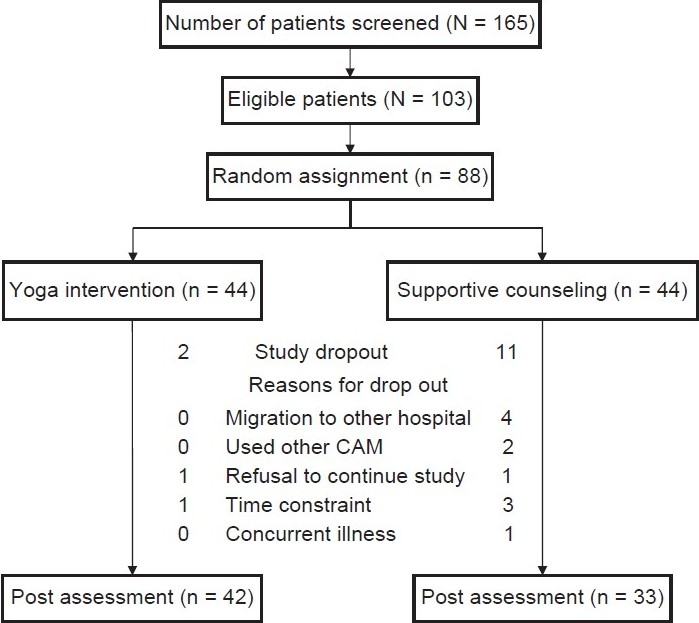
Eighty-eight stage II and III breast cancer outpatients were randomly assigned to receive yoga (n = 44) or brief supportive therapy (n = 44) prior to their radiotherapy treatment. Intervention consisted of yoga sessions lasting 60 min daily while the control group was imparted supportive therapy once in 10 days during the course of their adjuvant radiotherapy. Assessments included Rotterdam Symptom Check List and European Organization for Research in the Treatment of Cancer-Quality of Life (EORTC QoL C30) symptom scale. Assessments were done at baseline and after 6 weeks of radiotherapy treatment.
A GLM repeated-measures ANOVA showed a significant decrease in psychological distress (P = 0.01), fatigue (P = 0.007), insomnia (P = 0.001), and appetite loss (P = 0.002) over time in the yoga group as compared to controls. There was significant improvement in the activity level (P = 0.02) in the yoga group as compared to controls. There was a significant positive correlation between physical and psychological distress and fatigue, nausea and vomiting, pain, dyspnea, insomnia, appetite loss, and constipation. There was a significant negative correlation between the activity level and fatigue, nausea and vomiting, pain, dyspnea, insomnia, and appetite loss.
The results suggest beneficial effects with yoga intervention in managing cancer-and treatment-related symptoms in breast cancer patients.
本研究比较综合瑜伽计划与简短支持性治疗对接受辅助放疗的乳腺癌门诊患者痛苦症状的影响。
88名II期和III期乳腺癌门诊患者在放疗前被随机分配接受瑜伽治疗(n = 44)或简短支持性治疗(n = 44)。干预措施包括每天进行60分钟的瑜伽课程,而对照组在辅助放疗过程中每10天接受一次支持性治疗。评估包括鹿特丹症状检查表和欧洲癌症研究与治疗组织生活质量(EORTC QoL C30)症状量表。在基线和放疗治疗6周后进行评估。
广义线性模型重复测量方差分析显示,与对照组相比,瑜伽组随着时间推移心理痛苦(P = 0.01)、疲劳(P = 0.007)、失眠(P = 0.001)和食欲减退(P = 0.002)显著降低。与对照组相比,瑜伽组的活动水平有显著改善(P = 0.02)。身体和心理痛苦与疲劳、恶心和呕吐、疼痛、呼吸困难、失眠、食欲减退和便秘之间存在显著正相关。活动水平与疲劳、恶心和呕吐、疼痛、呼吸困难、失眠和食欲减退之间存在显著负相关。
结果表明瑜伽干预对管理乳腺癌患者癌症及治疗相关症状有有益效果。