Department of Microbiology and Immunology, Ajou University School of Medicine, Suwon 442-721, Korea.
Immune Netw. 2010 Aug;10(4):126-34. doi: 10.4110/in.2010.10.4.126. Epub 2010 Aug 31.
CD8(+) T cells contribute to the clearance of Hepatitis B virus (HBV) infection and an insufficient CD8(+) T cell response may be one of the major factors leading to chronic HBV infection. Since the HBx antigen of HBV can up-regulate cellular expression of several immunomodulatory molecules, we hypothesized that HBx expression in hepatocytes might affect CD8(+) T cell activity.
We analyzed the activation and apoptosis of CD8(+) T cells co-cultured with primary hepatocytes rendered capable of expressing HBx by recombinant baculovirus infection.
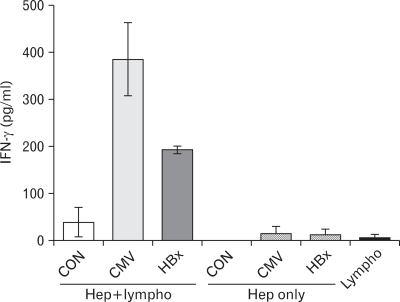
Expression of HBx in hepatocytes induced low production of interferon-γ and apoptosis of CD8(+) T cells, with no effect on CD8 T cell proliferation. However, transcriptional levels of H-2K, ICAM-1 and PD-1 ligand did not correlate with HBx expression in hepatocytes.
Our results suggest that HBx may inhibit CD8(+) T cell response by regulation of interferon-γ production and apoptosis.
CD8(+) T 细胞有助于清除乙型肝炎病毒(HBV)感染,而 CD8(+) T 细胞应答不足可能是导致慢性 HBV 感染的主要因素之一。由于 HBV 的 HBx 抗原可以上调几种免疫调节分子的细胞表达,我们假设 HBx 在肝细胞中的表达可能会影响 CD8(+) T 细胞的活性。
我们分析了用重组杆状病毒感染使能够表达 HBx 的原代肝细胞共培养的 CD8(+) T 细胞的激活和凋亡。
肝细胞中 HBx 的表达诱导干扰素-γ产生减少和 CD8(+) T 细胞凋亡,而对 CD8 T 细胞增殖没有影响。然而,H-2K、ICAM-1 和 PD-1 配体的转录水平与肝细胞中 HBx 的表达无关。
我们的结果表明,HBx 可能通过调节干扰素-γ产生和凋亡来抑制 CD8(+) T 细胞反应。