Department of Environmental Toxicology, University of California, Davis, California 95616, USA.
Chem Res Toxicol. 2010 Nov 15;23(11):1633-46. doi: 10.1021/tx100237w. Epub 2010 Sep 16.
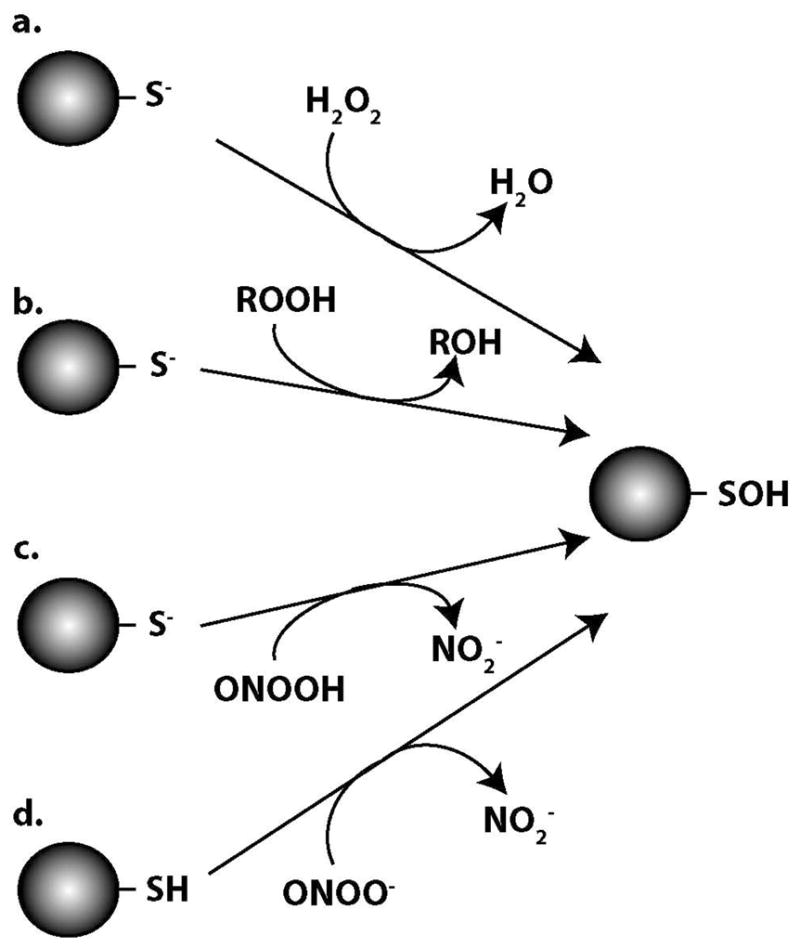
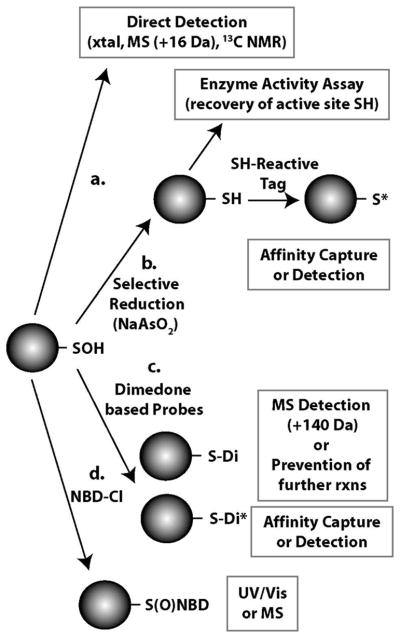
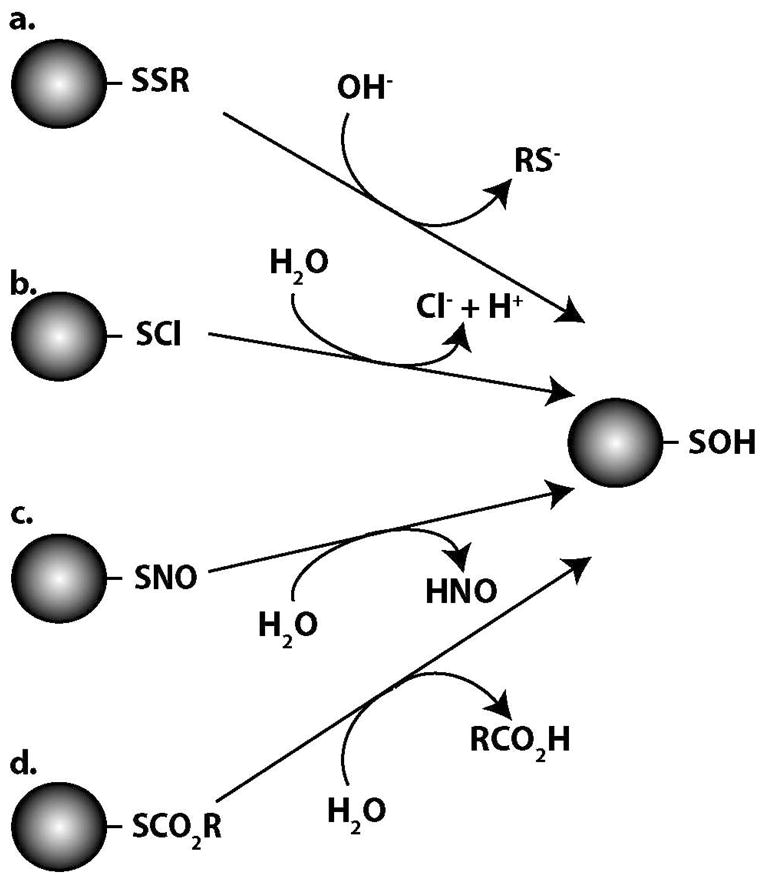
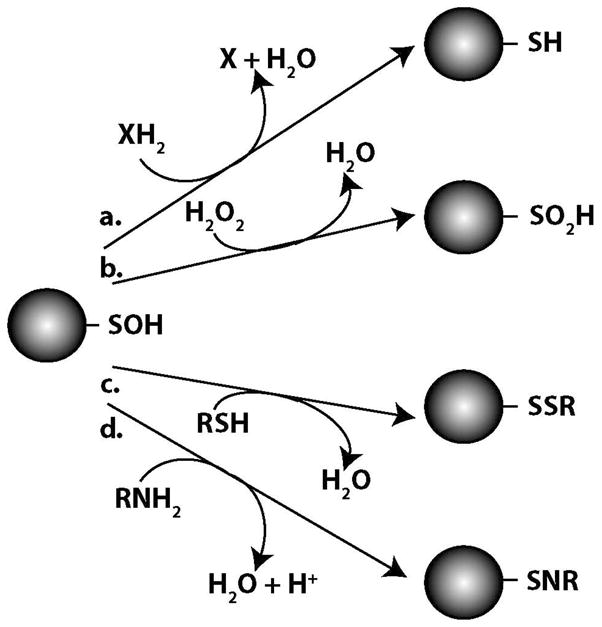
It has become clear in recent decades that the post-translational modification of protein cysteine residues is a crucial regulatory event in biology. Evidence supports the reversible oxidation of cysteine thiol groups as a mechanism of redox-based signal transduction, while the accumulation of proteins with irreversible thiol oxidations is a hallmark of stress-induced cellular damage. The initial formation of cysteine-sulfenic acid (SOH) derivatives, along with the reactive properties of this functional group, serves as a crossroads whereby the local redox environment may dictate the progression of either regulatory or pathological outcomes. Protein-SOH are established as transient intermediates in the formation of more stable cysteine oxidation products both under basal conditions and in response to several redox-active extrinsic compounds. This review details both direct and multistep chemical routes proposed to generate protein-SOH, the spectrum of secondary reactions that may follow their initial formation and the arsenal of experimental tools available for their detection. Pioneering studies that have provided a framework for our current understanding of protein-SOH as well as state-of-the-art proteomic strategies designed for global assessments of this post-translational modification are highlighted.
近几十年来,人们已经清楚地认识到,蛋白质半胱氨酸残基的翻译后修饰是生物学中一个关键的调节事件。有证据表明,半胱氨酸巯基的可逆氧化是基于氧化还原的信号转导的一种机制,而具有不可逆巯基氧化的蛋白质的积累是应激诱导的细胞损伤的标志。半胱氨酸磺酸(SOH)衍生物的最初形成,以及该官能团的反应性,是一个转折点,局部氧化还原环境可能决定调节或病理结果的进展。在基础条件下和响应几种氧化还原活性外源性化合物时,蛋白质-SOH 被确立为形成更稳定的半胱氨酸氧化产物的短暂中间体。本文详细介绍了生成蛋白质-SOH 的直接和多步化学途径、其初始形成后可能发生的次级反应谱以及用于检测它们的实验工具库。强调了为我们当前对半胱氨酸-SOH 的理解提供框架的开创性研究以及设计用于全面评估这种翻译后修饰的最先进的蛋白质组学策略。