Division of HIV/AIDS Prevention, National Center for HIV/AIDS, Viral Hepatitis, STD, and TB Prevention, Centers for Disease Control and Prevention, Atlanta, Georgia, United States of America.
PLoS One. 2010 Sep 15;5(9):e12756. doi: 10.1371/journal.pone.0012756.
While the U.S. HIV epidemic continues to be primarily concentrated in urban area, local epidemiologic profiles may differ and require different approaches in prevention and treatment efforts. We describe the epidemiology of HIV in large urban areas with the highest HIV burden.
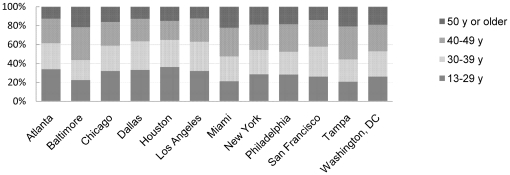
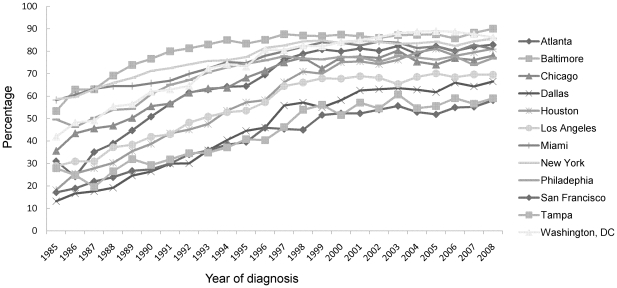
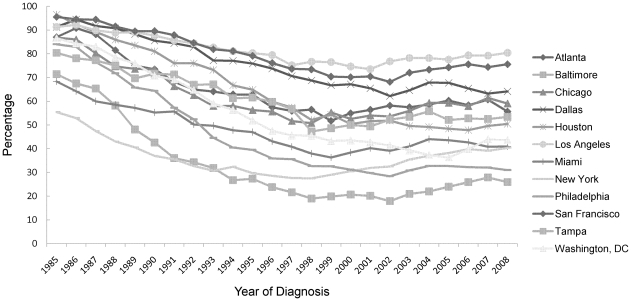
METHODS/PRINCIPAL FINDINGS: We used data from national HIV surveillance for 12 metropolitan statistical areas (MSAs) to determine disparities in HIV diagnoses and prevalence and changes over time. Overall, 0.3% to 1% of the MSA populations were living with HIV at the end of 2007. In each MSA, prevalence was >1% among blacks; prevalence was >2% in Miami, New York, and Baltimore. Among Hispanics, prevalence was >1% in New York and Philadelphia. The relative percentage differences in 2007 HIV diagnosis rates, compared to whites, ranged from 239 (San Francisco) to 1239 (Baltimore) for blacks and from 15 (Miami) to 413 (Philadelphia) for Hispanics. The epidemic remains concentrated, with more than 50% of HIV diagnoses in 2007 attributed to male-to-male sexual contact in 7 of the 12 MSAs; heterosexual transmission surpassed or equaled male-to-male sexual transmission in Baltimore, Philadelphia, and Washington, DC. Yet in several MSAs, including Baltimore and Washington, DC, AIDS diagnoses increased among men-who-have sex with men in recent years.
CONCLUSIONS/SIGNIFICANCE: These data are useful to identify local drivers of the epidemic and to tailor public health efforts for treatment and prevention services for people living with HIV.
虽然美国的艾滋病病毒(HIV)疫情仍主要集中在城市地区,但当地的流行病学特征可能存在差异,需要在预防和治疗工作中采取不同的方法。我们描述了艾滋病病毒负担最重的大城市地区的流行病学特征。
方法/主要发现:我们使用全国性 HIV 监测数据,确定了 12 个大都市统计区(MSA)中 HIV 诊断和流行率的差异以及随时间的变化。总体而言,到 2007 年底,每个 MSA 中约有 0.3%至 1%的人口携带 HIV。在每个 MSA 中,黑人的流行率>1%;在迈阿密、纽约和巴尔的摩,流行率>2%。在西班牙裔中,纽约和费城的流行率>1%。与白人相比,2007 年 HIV 诊断率的相对百分比差异范围从 239(旧金山)到 1239(巴尔的摩)(黑人)和 15(迈阿密)到 413(费城)(西班牙裔)。疫情仍然集中,在 12 个 MSA 中,有超过 50%的 HIV 诊断归因于 7 个 MSA 中男性间的性接触;在巴尔的摩、费城和华盛顿特区,异性传播超过或等同于男男性接触传播。然而,在包括巴尔的摩和华盛顿特区在内的几个 MSA 中,近年来男男性行为者的艾滋病诊断数量有所增加。
结论/意义:这些数据有助于确定疫情的本地驱动因素,并为艾滋病毒感染者的治疗和预防服务量身定制公共卫生工作。