Department of Obstetrics and Gynaecology, Academic Medical Centre, Amsterdam, The Netherlands.
BMC Med Res Methodol. 2010 Sep 27;10:85. doi: 10.1186/1471-2288-10-85.
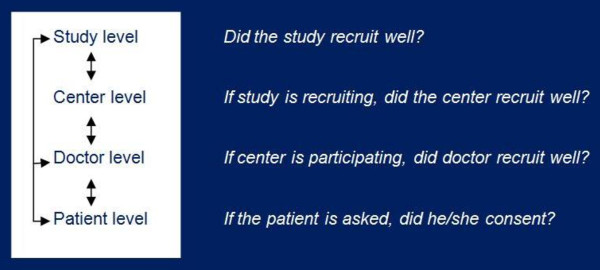
One of the most commonly reported problems of randomised trials is that recruitment is usually slower than expected. Trials will cost more and take longer, thus delaying the use of the results in clinical practice, and incomplete samples imply decreased statistical power and usefulness of its results. We aim to identify barriers and facilitators for successful patient recruitment at the level of the patient, the doctor and the hospital organization as well as the organization and design of trials over a broad range of studies.
METHODS/DESIGN: We will perform two cohort studies and a case-control study in The Netherlands. The first cohort study will report on a series of multicenter trials performed in a nationwide network of clinical trials in obstetrics and gynaecology. A questionnaire will be sent to all clinicians recruiting for these trials to identify determinants--aggregated at centre level--for the recruitment rate. In a case control-study nested in this cohort we will interview patients who refused or consented participation to identify factors associated with patients' consent or refusal. In a second cohort study, we will study trials that were prospectively registered in the Netherlands Trial Register. Using a questionnaire survey we will assess whether issues on hospital organization, trial organization, planning and trial design were associated with successful recruitment, i.e. 80% of the predefined number of patients recruited within the planned time.
This study will provide insight in barriers and facilitators for successful patient recruitment in trials. The results will be used to provide recommendations and a checklist for individual trialists to identify potential pitfalls for recruitment and judge the feasibility prior to the start of the study. Identified barriers and motivators coupled to evidence-based interventions can improve recruitment of patients in clinical trials.
随机试验中最常报告的问题之一是招募通常比预期的要慢。试验将花费更多的时间和成本,从而延迟其在临床实践中的应用,并且不完整的样本意味着统计效力降低,结果的实用性也降低。我们旨在确定患者、医生和医院组织层面以及试验组织和设计层面的成功招募的障碍和促进因素,涵盖广泛的研究。
方法/设计:我们将在荷兰进行两项队列研究和一项病例对照研究。第一项队列研究将报告在全国性妇产科临床试验网络中进行的一系列多中心试验。将向所有招募这些试验的临床医生发送一份问卷,以确定中心层面上影响招募率的决定因素。在这项队列研究中嵌套一项病例对照研究,我们将采访拒绝或同意参与的患者,以确定与患者同意或拒绝相关的因素。在第二项队列研究中,我们将研究在荷兰试验注册处前瞻性注册的试验。我们将使用问卷调查来评估医院组织、试验组织、规划和试验设计等问题是否与成功招募相关,即在计划时间内招募到预定患者人数的 80%。
这项研究将深入了解试验中成功招募患者的障碍和促进因素。研究结果将用于为个体试验者提供建议和清单,以确定招募的潜在陷阱,并在研究开始前判断可行性。确定障碍和激励因素,并结合基于证据的干预措施,可以提高临床试验中患者的招募率。