Institute for Molecular Bioscience, University of Queensland, Brisbane, Queensland 4072, Australia.
J Cell Biol. 2010 Oct 4;191(1):23-9. doi: 10.1083/jcb.200911143. Epub 2010 Sep 27.
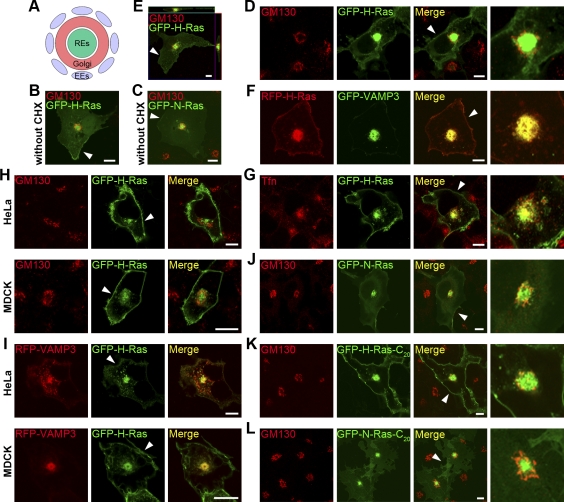
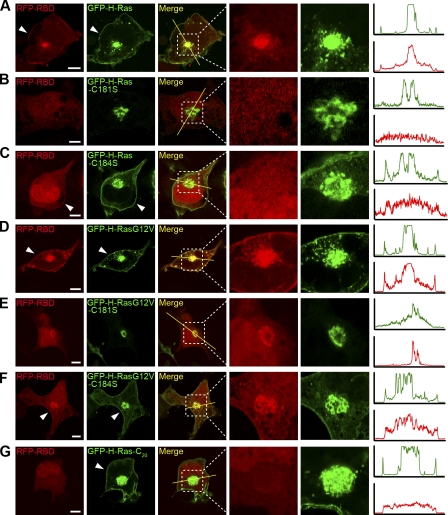
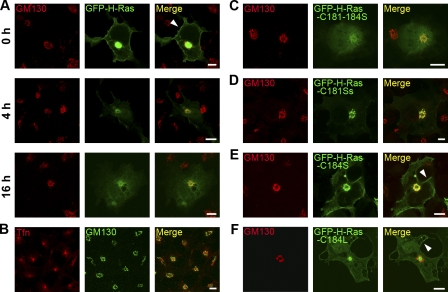
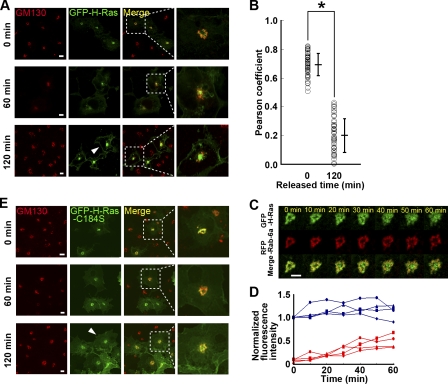
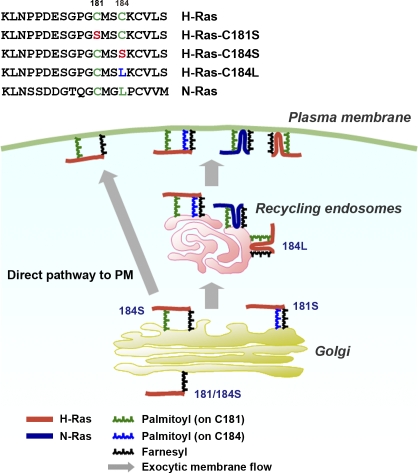
Ras proteins regulate cell growth, death, and differentiation, and it is well established that this functional versatility is accomplished through their different subcellular localizations. Palmitoylated H- and N-Ras are believed to localize at the perinuclear Golgi and plasma membrane (PM). Notably, however, recycling endosomes (REs) also localize to a perinuclear region, which is often indistinguishable from the Golgi. In this study, we show that active palmitoylated Ras proteins mainly localize intracellularly at REs and that REs act as a way station along the post-Golgi exocytic pathway to the PM. H-Ras requires two palmitoyl groups for RE targeting. The lack of either or both palmitoyl groups leads to the mislocalization of the mutant proteins to the endoplasmic reticulum, Golgi apparatus, or the PM. Therefore, we demonstrate that palmitoylation directs Ras proteins to the correct intracellular organelles for trafficking and activity.
Ras 蛋白调节细胞生长、死亡和分化,其通过不同的亚细胞定位来实现这种多功能性已得到充分证实。棕榈酰化的 H-和 N-Ras 被认为位于核周高尔基体和质膜 (PM)。然而,值得注意的是,再循环内体 (RE) 也定位于核周区域,该区域通常与高尔基体无法区分。在这项研究中,我们表明,活性棕榈酰化 Ras 蛋白主要在再循环内体 (RE) 中在细胞内定位,并且再循环内体 (RE) 作为高尔基体后胞吐途径到质膜 (PM) 的中间站。H-Ras 需要两个棕榈酰基基团才能靶向再循环内体 (RE)。缺乏一个或两个棕榈酰基基团会导致突变蛋白错误定位到内质网、高尔基体或质膜。因此,我们证明棕榈酰化将 Ras 蛋白引导到正确的细胞内细胞器进行运输和活性。