Department of Dermatology, Yonsei University College of Medicine, Gangnam Severance Hospital, 712 Eonju-ro, Gangnam-gu, Seoul 135-720, Korea.
Yonsei Med J. 2010 Nov;51(6):808-22. doi: 10.3349/ymj.2010.51.6.808.
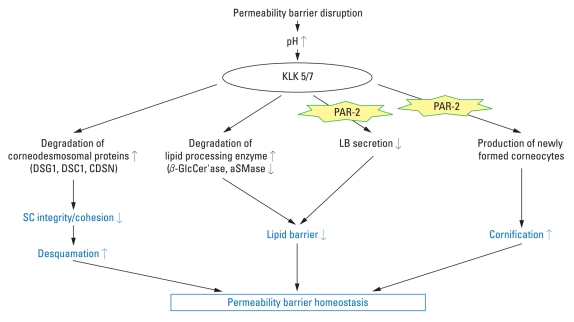
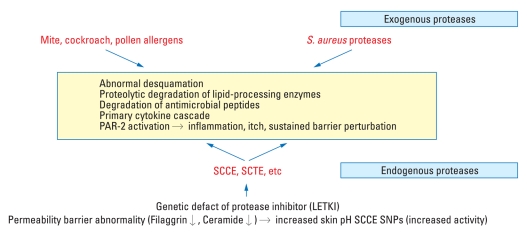
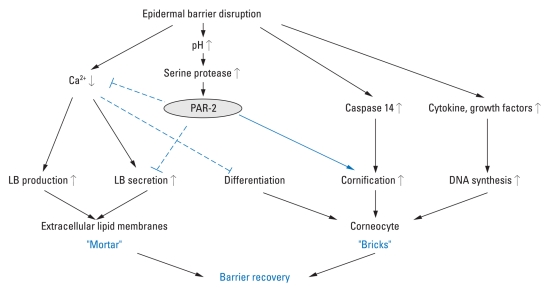
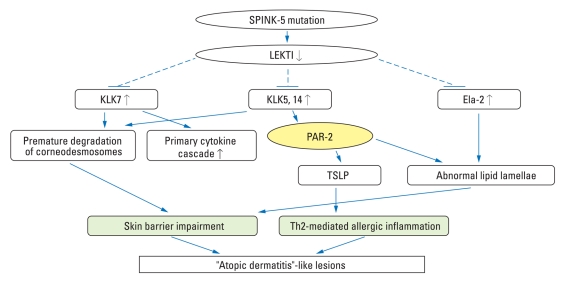
Proteases in the skin are essential to epidermal permeability barrier homeostasis. In addition to their direct proteolytic effects, certain proteases signal to cells by activating protease-activated receptors (PARs), the G-protein-coupled receptors. The expression of functional PAR-2 on human skin and its role in inflammation, pruritus, and skin barrier homeostasis have been demonstrated. Atopic dermatitis (AD) is a multifactorial inflammatory skin disease characterized by genetic barrier defects and allergic inflammation, which is sustained by gene-environmental interactions. Recent studies have revealed aberrant expression and activation of serine proteases and PAR-2 in the lesional skin of AD patients. The imbalance between proteases and protease inhibitors associated with genetic defects in the protease/protease inhibitor encoding genes, increase in skin surface pH, and exposure to proteolytically active allergens contribute to this aberrant protease/ PAR-2 signaling in AD. The increased protease activity in AD leads to abnormal desquamation, degradation of lipid-processing enzymes and antimicrobial peptides, and activation of primary cytokines, thereby leading to permeability barrier dysfunction, inflammation, and defects in the antimicrobial barrier. Moreover, up-regulated proteases stimulate PAR-2 in lesional skin of AD and lead to the production of cytokines and chemokines involved in inflammation and immune responses, itching sensation, and sustained epidermal barrier perturbation with easier allergen penetration. In addition, PAR-2 is an important sensor for exogenous danger molecules, such as exogenous proteases from various allergens, and plays an important role in AD pathogenesis. Together, these findings suggest that protease activity or PAR-2 may be a future target for therapeutic intervention for the treatment of AD.
皮肤中的蛋白酶对于表皮渗透性屏障的稳态至关重要。除了直接的蛋白水解作用外,某些蛋白酶还通过激活蛋白酶激活受体(PARs)即 G 蛋白偶联受体向细胞发出信号。已经证明人皮肤中功能性 PAR-2 的表达及其在炎症、瘙痒和皮肤屏障稳态中的作用。特应性皮炎(AD)是一种多因素炎症性皮肤病,其特征是遗传屏障缺陷和过敏炎症,由基因-环境相互作用维持。最近的研究揭示了丝氨酸蛋白酶和 PAR-2 在 AD 患者皮损皮肤中的异常表达和激活。与蛋白酶/蛋白酶抑制剂编码基因遗传缺陷相关的蛋白酶和蛋白酶抑制剂之间的失衡、皮肤表面 pH 值增加以及暴露于具有蛋白水解活性的变应原,导致 AD 中这种异常的蛋白酶/PAR-2 信号传导。AD 中蛋白酶活性的增加导致异常的脱屑、脂质处理酶和抗菌肽的降解以及原初细胞因子的激活,从而导致渗透性屏障功能障碍、炎症和抗菌屏障缺陷。此外,上调的蛋白酶刺激 AD 皮损皮肤中的 PAR-2,并导致参与炎症和免疫反应、瘙痒感觉以及持续的表皮屏障扰动的细胞因子和趋化因子的产生,更容易使变应原穿透。此外,PAR-2 是外来危险分子(如各种变应原的外来蛋白酶)的重要传感器,在 AD 的发病机制中发挥重要作用。综上所述,蛋白酶活性或 PAR-2 可能成为 AD 治疗干预的未来靶点。