Voss Michelle W, Prakash Ruchika S, Erickson Kirk I, Basak Chandramallika, Chaddock Laura, Kim Jennifer S, Alves Heloisa, Heo Susie, Szabo Amanda N, White Siobhan M, Wójcicki Thomas R, Mailey Emily L, Gothe Neha, Olson Erin A, McAuley Edward, Kramer Arthur F
Department of Psychology, Beckman Institute, University of Illinois at Urbana-Champaign IL, USA.
Front Aging Neurosci. 2010 Aug 26;2. doi: 10.3389/fnagi.2010.00032. eCollection 2010.
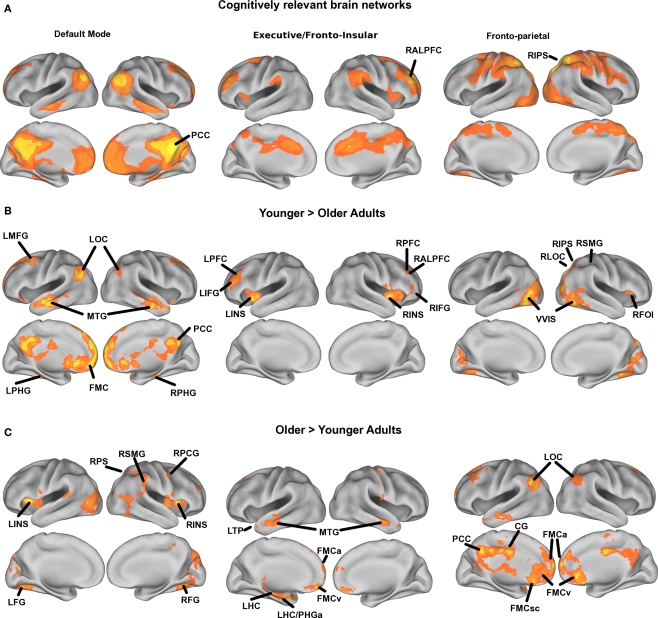
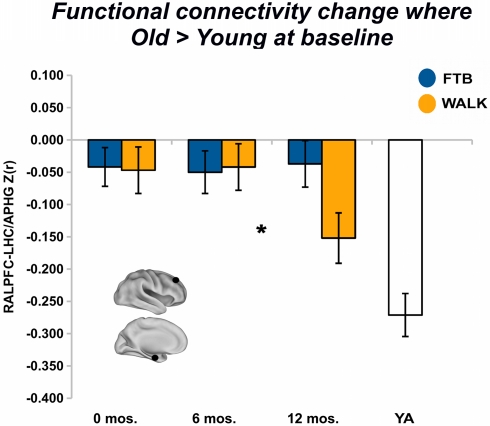
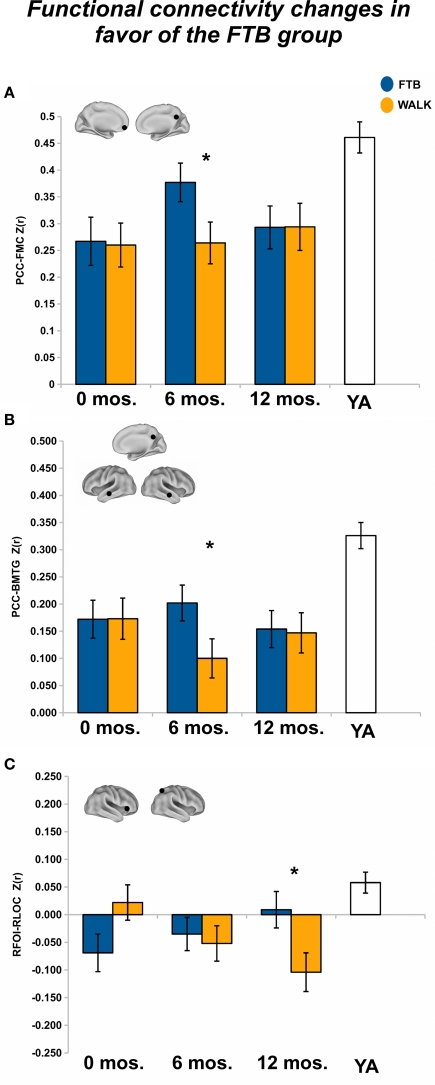
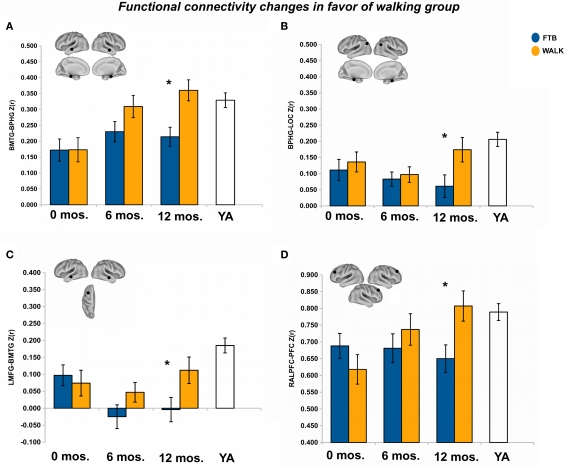
Research has shown the human brain is organized into separable functional networks during rest and varied states of cognition, and that aging is associated with specific network dysfunctions. The present study used functional magnetic resonance imaging (fMRI) to examine low-frequency (0.008 < f < 0.08 Hz) coherence of cognitively relevant and sensory brain networks in older adults who participated in a 1-year intervention trial, comparing the effects of aerobic and non-aerobic fitness training on brain function and cognition. Results showed that aerobic training improved the aging brain's resting functional efficiency in higher-level cognitive networks. One year of walking increased functional connectivity between aspects of the frontal, posterior, and temporal cortices within the Default Mode Network and a Frontal Executive Network, two brain networks central to brain dysfunction in aging. Length of training was also an important factor. Effects in favor of the walking group were observed only after 12 months of training, compared to non-significant trends after 6 months. A non-aerobic stretching and toning group also showed increased functional connectivity in the DMN after 6 months and in a Frontal Parietal Network after 12 months, possibly reflecting experience-dependent plasticity. Finally, we found that changes in functional connectivity were behaviorally relevant. Increased functional connectivity was associated with greater improvement in executive function. Therefore the study provides the first evidence for exercise-induced functional plasticity in large-scale brain systems in the aging brain, using functional connectivity techniques, and offers new insight into the role of aerobic fitness in attenuating age-related brain dysfunction.
研究表明,人类大脑在休息和不同认知状态下会组织成可分离的功能网络,且衰老与特定的网络功能障碍有关。本研究使用功能磁共振成像(fMRI)来检查参与为期1年干预试验的老年人认知相关和感觉脑网络的低频(0.008 < f < 0.08 Hz)相干性,比较有氧和无氧健身训练对脑功能和认知的影响。结果显示,有氧训练提高了衰老大脑在高级认知网络中的静息功能效率。一年的步行增加了默认模式网络和额叶执行网络内额叶、顶叶和颞叶皮质各方面之间的功能连接,这两个脑网络是衰老过程中脑功能障碍的核心。训练时长也是一个重要因素。与6个月时无显著趋势相比,仅在训练12个月后才观察到有利于步行组的效果。一个无氧伸展和锻炼组在6个月后默认模式网络以及12个月后额叶顶叶网络中也显示出功能连接增加,这可能反映了经验依赖性可塑性。最后,我们发现功能连接的变化与行为相关。功能连接增加与执行功能的更大改善相关。因此,本研究使用功能连接技术首次证明了运动诱导衰老大脑大规模脑系统中的功能可塑性,并为有氧健身在减轻与年龄相关的脑功能障碍中的作用提供了新的见解。