Imperial College London, Department of Earth Science and Engineering, London SW7 2AZ, UK.
Anal Bioanal Chem. 2010 Dec;398(7-8):3115-25. doi: 10.1007/s00216-010-4231-5. Epub 2010 Oct 4.
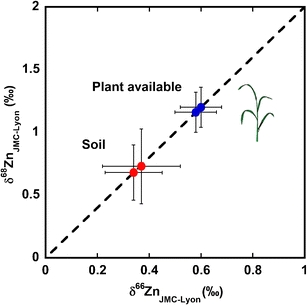
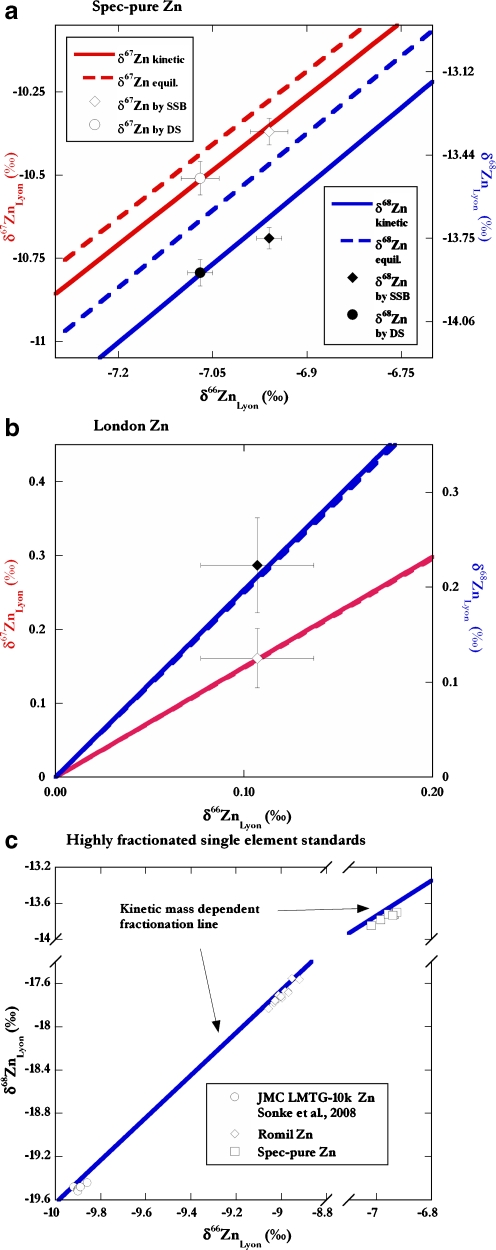
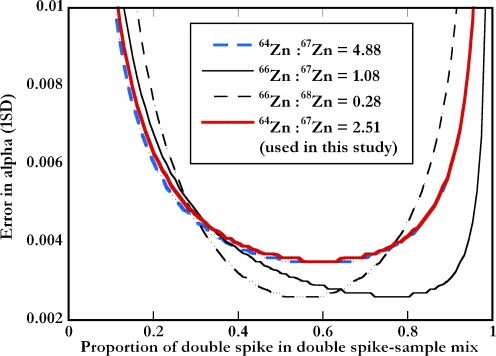
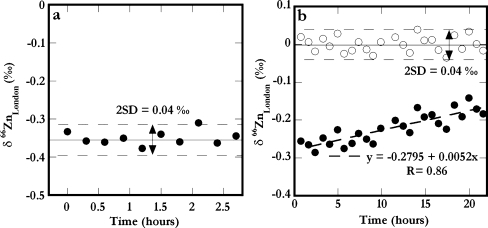
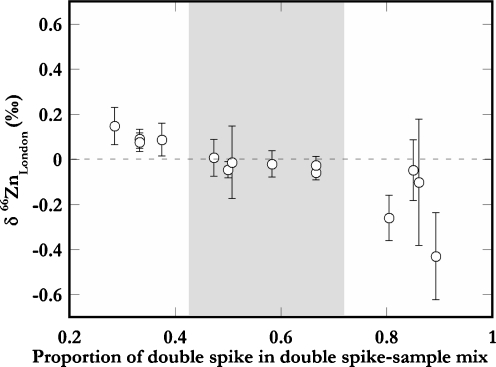
Analysis of naturally occurring isotopic variations is a promising tool for investigating Zn transport and cycling in geological and biological settings. Here, we present the recently installed double-spike (DS) technique at the MAGIC laboratories at Imperial College London. The procedure improves on previous published DS methods in terms of ease of measurement and precisions obtained. The analytical method involves addition of a (64)Zn-(67)Zn double-spike to the samples prior to digestion, separation of Zn from the sample matrix by ion exchange chromatography, and isotopic analysis by multiple-collector inductively coupled plasma mass spectrometry. The accuracy and reproducibility of the method were validated by analyses of several in-house and international elemental reference materials. Multiple analyses of pure Zn standard solutions consistently yielded a reproducibility of about ±0.05‰ (2 SD) for δ(66)Zn, and comparable precisions were obtained for analyses of geological and biological materials. Highly fractionated Zn standards analyzed by DS and standard sample bracketing yield slightly varying results, which probably originate from repetitive fractionation events during manufacture of the standards. However, the δ(66)Zn values (all reported relative to JMC Lyon Zn) for two less fractionated in-house Zn standard solutions, Imperial Zn (0.10 ± 0.08‰: 2 SD) and London Zn (0.08 ± 0.04‰), are within uncertainties to data reported with different mass spectrometric techniques and instruments. Two standard reference materials, blend ore BCR 027 and ryegrass BCR 281, were also measured, and the δ(66)Zn were found to be 0.25 ± 0.06‰ (2 SD) and 0.40 ± 0.09‰, respectively. Taken together, these standard measurements ascertain that the double-spike methodology is suitable for accurate and precise Zn isotope analyses of a wide range of natural samples. The newly installed technique was consequently applied to soil samples and soil leachates to investigate the isotopic signature of plant available Zn. We find that the isotopic composition is heavier than the residual, indicating the presence of loosely bound Zn deposited by atmospheric pollution, which is readily available to plants.
分析天然存在的同位素变化是研究地质和生物环境中锌迁移和循环的一种很有前途的工具。在这里,我们介绍了在伦敦帝国理工学院 MAGIC 实验室新安装的双标(DS)技术。该方法在测量的简便性和获得的精密度方面优于以前发表的 DS 方法。该分析方法包括在消化之前向样品中添加(64)Zn-(67)Zn 双标,通过离子交换色谱将锌与样品基质分离,然后通过多接收电感耦合等离子体质谱对其进行同位素分析。通过对几个内部和国际元素参考物质的分析,验证了该方法的准确性和重现性。对纯锌标准溶液的多次分析一致得到 δ(66)Zn 的重复性约为 ±0.05‰(2 SD),对地质和生物材料的分析也获得了类似的精密度。用 DS 和标准样品套准分析高度分馏的 Zn 标准,得到的结果略有不同,这可能源于标准制造过程中的重复分馏事件。然而,两个分馏程度较低的内部 Zn 标准溶液,Imperial Zn(0.10 ± 0.08‰:2 SD)和 London Zn(0.08 ± 0.04‰)的 δ(66)Zn 值(均相对于 JMC Lyon Zn 报告)在不确定度范围内与使用不同质谱技术和仪器报告的数据一致。还测量了两个标准参考物质,混合矿 BCR 027 和黑麦草 BCR 281,发现 δ(66)Zn 分别为 0.25 ± 0.06‰(2 SD)和 0.40 ± 0.09‰。总的来说,这些标准测量证实,双标方法适用于广泛的天然样品的准确和精确的锌同位素分析。新安装的技术随后被应用于土壤样品和土壤浸出液中,以研究植物有效锌的同位素特征。我们发现,同位素组成比残余物重,表明存在由大气污染沉积的松散结合的锌,这些锌很容易被植物吸收。