Moore Rebekah E T, Larner Fiona, Coles Barry J, Rehkämper Mark
Department of Earth Science and Engineering, Imperial College London, Royal School of Mines, Prince Consort Rd, Kensington, London, SW7 2AZ, UK.
Department of Earth Sciences, University of Oxford, South Parks Road, Oxford, OX1 3AN, UK.
Anal Bioanal Chem. 2017 Apr;409(11):2941-2950. doi: 10.1007/s00216-017-0240-y. Epub 2017 Feb 16.
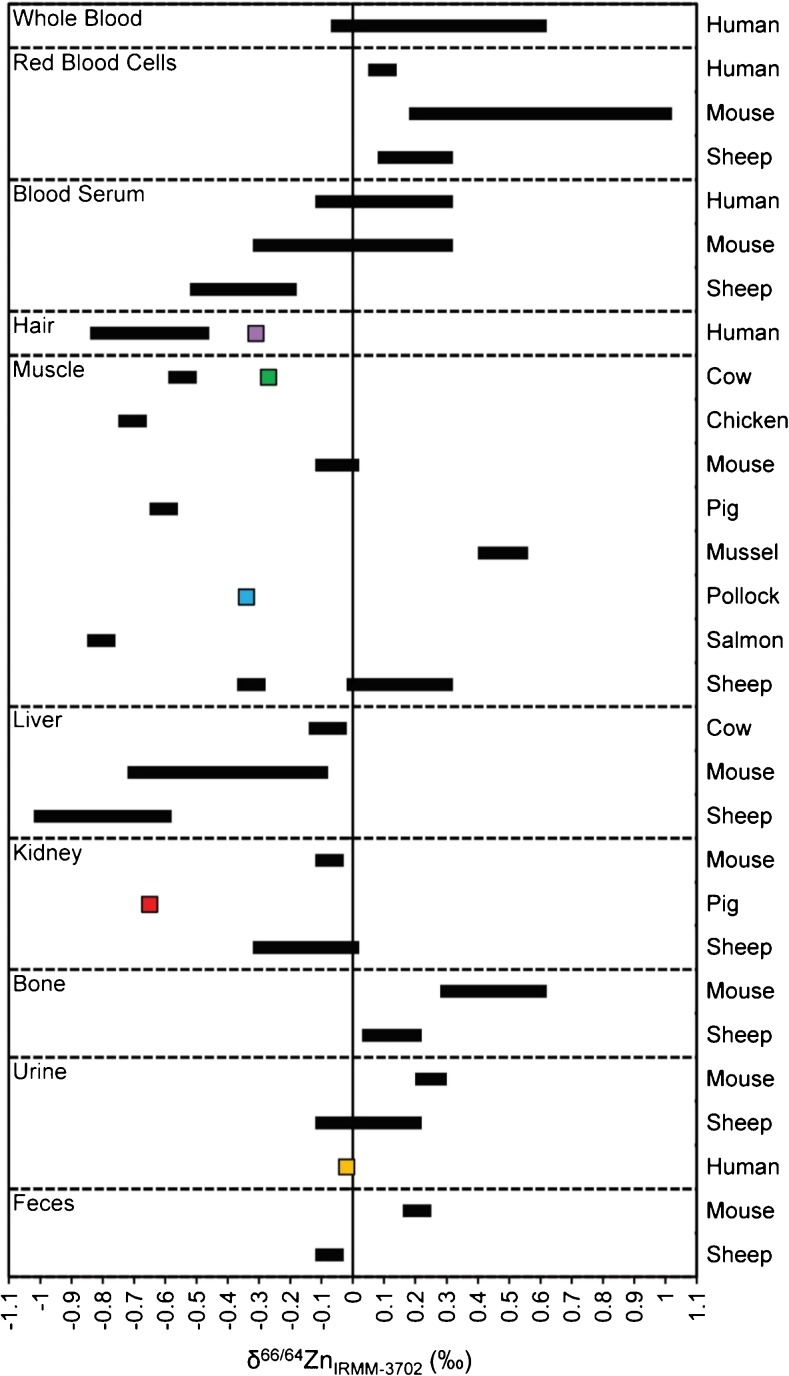
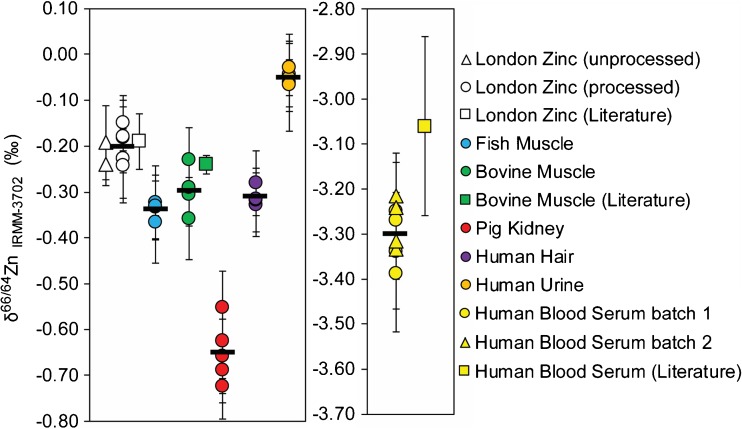
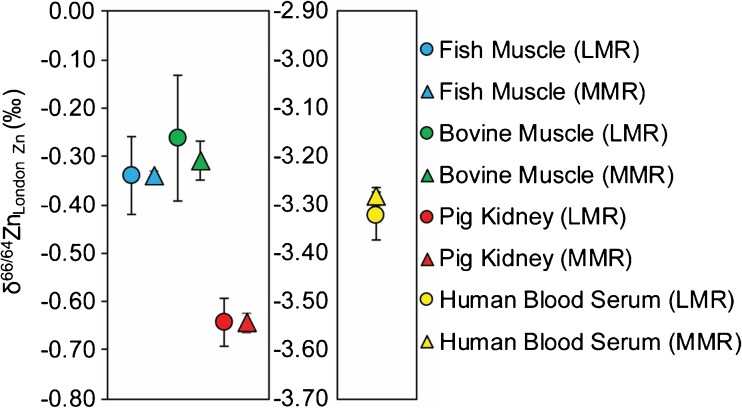
Biological reference materials with well-characterised stable isotope compositions are lacking in the field of 'isotope biochemistry', which seeks to understand bodily processes that rely on essential metals by determining metal stable isotope ratios. Here, we present Zn stable isotope data for six biological reference materials with certified trace metal concentrations: fish muscle, bovine muscle, pig kidney, human hair, human blood serum and human urine. Replicate analyses of multiple aliquots of each material achieved reproducibilities (2sd) of 0.04-0.13‰ for δZn (which denotes the deviation of the Zn/Zn ratio of a sample from a pure Zn reference material in parts per 1000). This implies only very minor isotopic heterogeneities within the samples, rendering them suitable as quality control materials for Zn isotope analyses. This endorsement is reinforced by (i) the close agreement of our Zn isotope data for two of the samples (bovine muscle and human blood serum) to previously published results for different batches of the same material and (ii) the similarity of the isotopic data for the samples (δZn ≈ -0.8 to 0.0‰) to previously published Zn isotope results for similar biological materials. Further tests revealed that the applied Zn separation procedure is sufficiently effective to enable accurate data acquisition even at low mass resolving power (M/ΔM ≈ 400), as measurements and analyses conducted at much higher mass resolution (M/ΔM ≈ 8500) delivered essentially identical results.
在“同位素生物化学”领域,缺乏具有特征明确的稳定同位素组成的生物参考材料。该领域旨在通过测定金属稳定同位素比率来了解依赖必需金属的身体过程。在此,我们展示了六种具有认证痕量金属浓度的生物参考材料的锌稳定同位素数据:鱼肉、牛肉、猪肾、人发、人血清和人尿。对每种材料的多个等分试样进行重复分析,得到的δZn(表示样品中锌/锌比率相对于纯锌参考材料的千分偏差)的重现性(2sd)为0.04 - 0.13‰。这意味着样品中仅存在非常微小的同位素不均匀性,使其适合作为锌同位素分析的质量控制材料。以下两点进一步证实了这一认可:(i)我们对其中两个样品(牛肉和人血清)的锌同位素数据与先前发表的同一材料不同批次的结果高度一致;(ii)样品的同位素数据(δZn≈ - 0.8至0.0‰)与先前发表的类似生物材料的锌同位素结果相似。进一步测试表明,所应用的锌分离程序足够有效,即使在低质量分辨率(M/ΔM≈400)下也能进行准确的数据采集,因为在高得多的质量分辨率(M/ΔM≈8500)下进行的测量和分析得出了基本相同的结果。