Institute for Health Care Research In Oncology.
Hematology/Oncology Group Practice.
Ann Oncol. 2011 Apr;22(4):931-938. doi: 10.1093/annonc/mdq455. Epub 2010 Oct 6.
Systematic evaluation of psychosocial distress in oncology outpatients is an important issue. We assessed feasibility and benefit of standardized routine screening using the Distress Thermometer (DT) and Problem List (PL) in all patients of our community-based hematooncology group practice.
One thousand four hundred forty-six patients were screened between July 2008 and September 2008. Five hundred randomly selected patients were sent a feedback form.
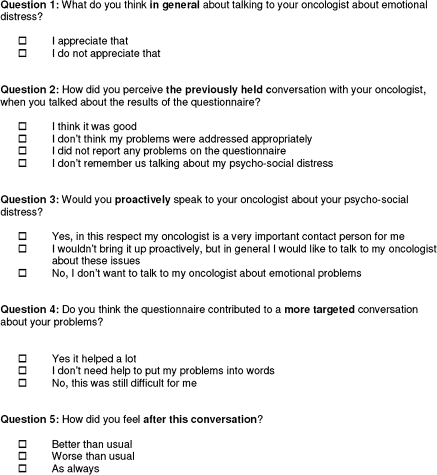
The average distress level was 4.7, with 37% indicating a distress level >5. Patients with nonmalignant diseases (81% autoimmune diseases or hereditary hemochromatosis) showed the highest distress level of 5.2. Most distressed were patients who just learned about relapse or metastases (6.4), patients receiving best supportive care (5.4) and patients receiving adjuvant antihormonal therapy (5.4). Ninety-seven percent of patients appreciated to speak to their doctor about their distress. Fifty-six percent felt better than usual after this consultation.
DT and PL are feasible instruments to measure distress in hematooncology outpatients receiving routine care. DT and PL are able to improve doctor-patient communication and thus should be implemented in routine patient care. The study shows that distress is distributed differently between individuals, disease groups and treatment phases.
对肿瘤门诊患者的心理困扰进行系统评估是一个重要问题。我们评估了在我们的社区血液肿瘤科常规实践中,使用痛苦温度计(DT)和问题清单(PL)对所有患者进行标准化常规筛查的可行性和益处。
2008 年 7 月至 2008 年 9 月期间,对 1446 名患者进行了筛查。随机选择了 500 名患者发送反馈表。
平均困扰水平为 4.7,37%的患者表示困扰水平>5。患有非恶性疾病(81%为自身免疫性疾病或遗传性血色素沉着症)的患者困扰水平最高,为 5.2。最困扰的是刚刚得知复发或转移的患者(6.4)、接受最佳支持治疗的患者(5.4)和接受辅助抗激素治疗的患者(5.4)。97%的患者希望与医生谈论自己的困扰。56%的患者在咨询后感觉比平时好。
DT 和 PL 是衡量接受常规护理的血液肿瘤科门诊患者困扰的可行工具。DT 和 PL 能够改善医患沟通,因此应在常规患者护理中实施。该研究表明,困扰在个体、疾病群体和治疗阶段之间的分布不同。