Alshaer Ahmad, Abdel-Meguid Mohamed Essam, Ibraheim Osama, Fawzi Khaled, Abdulsalam Ibrahim, Sheta Saad, Abdullah Khaled M, El-Demerdash Ahmed, Al-Satli Raed, Abdelall Mohamed, Bakir Bakir M, Alnahal Nezar, Abdulrahman Yasser, Alhamoud Hanaa
Cardiac Anesthesia Division, King Fahad Cardiac Center, Riyadh, Saudi Arabia.
Saudi J Anaesth. 2010 May;4(2):63-7. doi: 10.4103/1658-354X.65129.
To examine the validity of central venous oxygen saturation (ScvO(2)) as a numerical substitution of mixed venous oxygen saturation (SvO(2)) in adult patients undergoing normothermic on pump beating coronary artery bypass grafting (CABG).
Prospective clinical observational study was done at King Khalid University Hospital, King Saud University, Riyadh, Kingdom of Saudi Arabia. Thirty four adult patients scheduled for coronary artery surgery were included. Patients were monitored by a pulmonary artery catheter (PAC) as a part of our routine intraoperative monitoring. SvO(2) and ScvO(2) were simultaneously measured 15 minutes (T1) and 30 minutes (T2) after induction of anesthesia, 15 and 30 minutes after initiation of cardiopulmonary bypass (T3 and T4), and 15 and 30 minutes after admission to intensive care unit (T5 and T6).
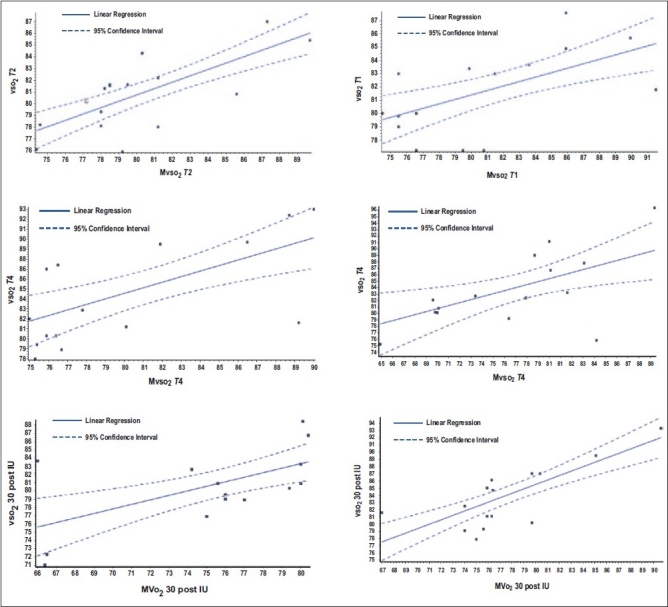
ScvO(2) showed higher reading than SvO(2) all through our study. Our results showed perfect positive statistically significant correlation between SvO(2) and ScvO(2) at all data points. Individual mean of difference (MOD) between both the readings at study time showed MOD of 1.34 and 1.44 at T1 and T2 simultaneously. This MOD was statistically insignificant, but after on pump beating normothermic bypass was initiated; MOD was 5.2 and 4.4 at T3 and T4 with high statistical significance. In ICU, MOD continues to have high statistical significance, MOD was 6.3 at T5 and at T6 it was 4.6.
In on pump beating CABG patients; ScvO(2) and SvO(2) are not interchangeable numerically. ScvO(2) is useful in the meaning of trend; our data suggest that ScvO(2) is equivalent to SvO(2) , only in the course of clinical decisions as long as absolute values are not required.
探讨在接受常温体外循环心脏跳动冠状动脉搭桥术(CABG)的成年患者中,中心静脉血氧饱和度(ScvO₂)作为混合静脉血氧饱和度(SvO₂)数值替代指标的有效性。
在沙特阿拉伯利雅得沙特国王大学哈利德王储大学医院进行前瞻性临床观察研究。纳入34例计划行冠状动脉手术的成年患者。作为我们常规术中监测的一部分,患者通过肺动脉导管(PAC)进行监测。在麻醉诱导后15分钟(T1)和30分钟(T2)、体外循环开始后15分钟和30分钟(T3和T4)以及重症监护病房入院后15分钟和30分钟(T5和T6)同时测量SvO₂和ScvO₂。
在我们的整个研究过程中,ScvO₂的读数均高于SvO₂。我们的结果显示,在所有数据点上,SvO₂和ScvO₂之间存在完全正相关且具有统计学意义。研究时间点上两者读数的个体平均差异(MOD)在T1和T2时分别为1.34和1.44。该MOD无统计学意义,但在开始常温体外循环心脏跳动搭桥术后;T3和T4时的MOD分别为5.2和4.4,具有高度统计学意义。在重症监护病房,MOD继续具有高度统计学意义,T5时为6.3,T6时为4.6。
在体外循环心脏跳动CABG患者中;ScvO₂和SvO₂在数值上不可互换。ScvO₂在趋势意义上是有用的;我们的数据表明,ScvO₂等同于SvO₂,仅在临床决策过程中,只要不需要绝对值。