School of Biological Sciences, University of Liverpool, Crown Street, Liverpool L69 7ZB, UK.
Science. 2010 Oct 8;330(6001):243-6. doi: 10.1126/science.1190333.
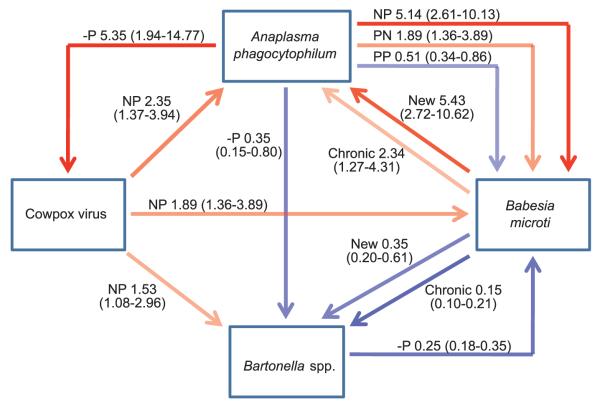
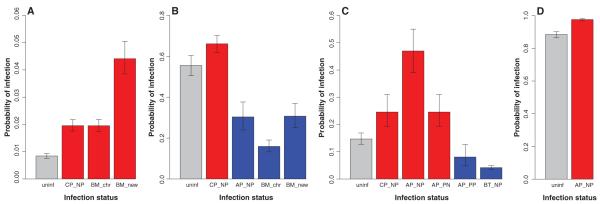
Most hosts, including humans, are simultaneously or sequentially infected with several parasites. A key question is whether patterns of coinfection arise because infection by one parasite species affects susceptibility to others or because of inherent differences between hosts. We used time-series data from individual hosts in natural populations to analyze patterns of infection risk for a microparasite community, detecting large positive and negative effects of other infections. Patterns remain once variations in host susceptibility and exposure are accounted for. Indeed, effects are typically of greater magnitude, and explain more variation in infection risk, than the effects associated with host and environmental factors more commonly considered in disease studies. We highlight the danger of mistaken inference when considering parasite species in isolation rather than parasite communities.
大多数宿主,包括人类,同时或先后感染几种寄生虫。一个关键问题是,合并感染的模式是由于一种寄生虫物种的感染影响了对其他寄生虫的易感性,还是由于宿主之间固有的差异。我们使用来自自然种群中个体宿主的时间序列数据来分析微寄生虫群落的感染风险模式,检测到其他感染的大的正效应和负效应。在考虑宿主易感性和暴露的变化后,模式仍然存在。事实上,与疾病研究中通常考虑的与宿主和环境因素相关的效应相比,这些效应的幅度通常更大,并且能解释感染风险变化的更多原因。我们强调了在孤立地考虑寄生虫物种而不是寄生虫群落时,错误推断的危险。