Department of Psychology, Princeton University, Princeton, NJ, USA.
Cognition. 2010 Dec;117(3):355-60. doi: 10.1016/j.cognition.2010.09.002. Epub 2010 Oct 8.
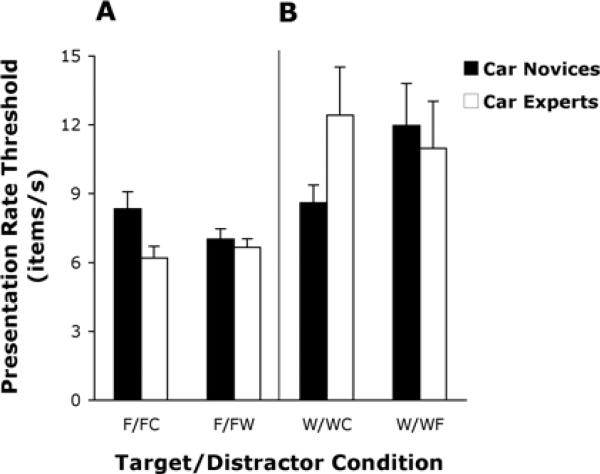
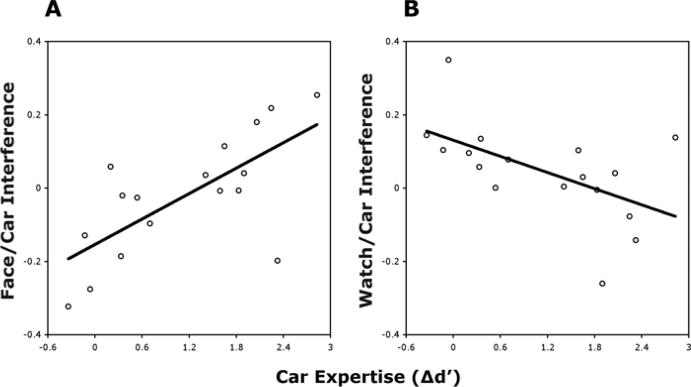
Recent studies indicate that expertise with objects can interfere with face processing. Although competition occurs between faces and objects of expertise, it remains unclear whether this reflects an expertise-specific bottleneck or the fact that objects of expertise grab attention and thereby consume more central resources. We investigated the perceptual costs of expertise by measuring visual thresholds for identifying targets embedded within RSVP sequences presented at varying temporal rates. Car experts and novices searched for face targets among face and car distractors, or watch targets among watch and car distractors. Remarkably, car experts were slower than novices at identifying faces among task-irrelevant cars, yet faster than novices at identifying watches among cars. This suggests that car expertise leads to greater functional overlap between cars and faces while reducing the functional overlap between cars and objects, a result incompatible with the notion of an encapsulated module for exclusive processing of faces.
最近的研究表明,对物体的专业知识可能会干扰面部处理。尽管在专业知识的面孔和物体之间存在竞争,但目前尚不清楚这是反映了特定专业知识的瓶颈,还是因为专业知识的物体吸引了注意力,从而消耗了更多的中央资源。我们通过测量在不同时间速率下呈现的 RSVP 序列中嵌入目标的视觉阈值来研究专业知识的感知成本。汽车专家和新手在面部和汽车干扰物中寻找面部目标,或者在手表和汽车干扰物中寻找手表目标。值得注意的是,汽车专家在识别与任务无关的汽车中的面孔时比新手慢,但在识别汽车中的手表时比新手快。这表明,汽车专业知识导致汽车和面孔之间的功能重叠更大,同时减少了汽车和物体之间的功能重叠,这一结果与专门处理面孔的封闭模块的概念不一致。