Tekur Padmini, Chametcha Singphow, Hongasandra Ramarao Nagendra, Raghuram Nagarathna
Division of Yoga and Life Sciences, Swami Vivekananda Yoga Research Foundation (SVYASA), Bangalore, India.
Int J Yoga. 2010 Jan;3(1):10-7. doi: 10.4103/0973-6131.66773.
In two of the earlier Randomized Control Trials on yoga for chronic lower back pain (CLBP), 12 to 16 weeks of intervention were found effective in reducing pain and disability.
To study the efficacy of a residential short term intensive yoga program on quality of life in CLBP.
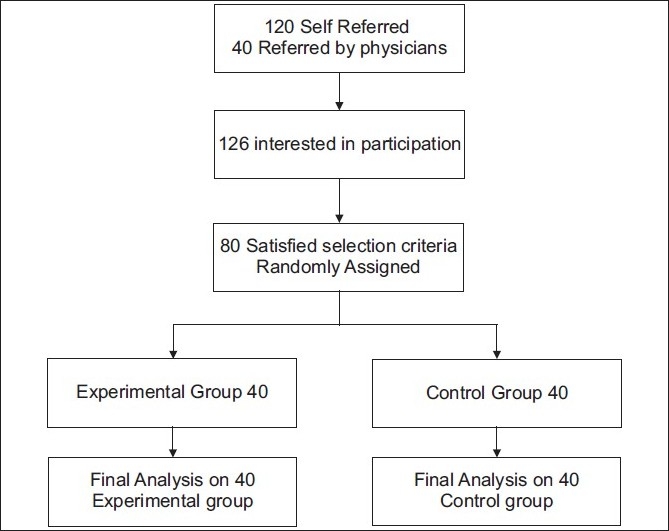
About 80 patients with CLBP (females 37) registered for a week long treatment at SVYASA Holistic Health Centre in Bengaluru, India. They were randomized into two groups (40 each). The yoga group practiced a specific module for CLBP comprising of asanas (physical postures), pranayama (breathing practices), meditation and lectures on yoga philosophy. The control group practiced physical therapy exercises for back pain. Perceived stress scale (PSS) was used to measure baseline stress levels. Outcome measures were WHOQOL Bref for quality of life and straight leg raising test (SLR) using a Goniometer.
There were significant negative correlations (Pearson's, P<0.005, r>0.30) between baseline PSS with all four domains and the total score of WHOQOLBref. All the four domains' WHOQOLBref improved in the yoga group (repeated measures ANOVA P=0.001) with significant grouptime interaction (P<0.05) and differences between groups (P<0.01). SLR increased in both groups (P=0.001) with higher increase in yoga (31.1 % right, 28.4 % left) than control (18.7% right, 21.5 % left) group with significant grouptime interaction (SLR right leg P=0.044).
In CLBP, a negative correlation exists between stress and quality of life. Yoga increases quality of life and spinal flexibility better than physical therapy exercises.
在两项较早的关于瑜伽治疗慢性下腰痛(CLBP)的随机对照试验中,发现12至16周的干预措施在减轻疼痛和残疾方面有效。
研究住院短期强化瑜伽项目对CLBP患者生活质量的疗效。
约80例CLBP患者(女性37例)在印度班加罗尔的SVYASA整体健康中心登记参加为期一周的治疗。他们被随机分为两组(每组40例)。瑜伽组练习针对CLBP的特定模块,包括体式(身体姿势)、调息(呼吸练习)、冥想以及瑜伽哲学讲座。对照组进行背部疼痛的物理治疗练习。使用感知压力量表(PSS)测量基线压力水平。结果指标为用于评估生活质量的世界卫生组织生活质量简表(WHOQOL Bref)以及使用角度计进行的直腿抬高试验(SLR)。
基线PSS与WHOQOL Bref的所有四个领域及总分之间存在显著负相关(Pearson检验,P<0.005,r>0.30)。瑜伽组的WHOQOL Bref所有四个领域均有所改善(重复测量方差分析P = 0.001),具有显著的组时间交互作用(P<0.05)以及组间差异(P<0.01)。两组的SLR均增加(P = 0.001),瑜伽组的增加幅度更高(右侧31.1%,左侧28.4%),高于对照组(右侧18.7%,左侧21.5%),具有显著的组时间交互作用(右腿SLR P = 0.044)。
在CLBP中,压力与生活质量之间存在负相关。瑜伽比物理治疗练习更能提高生活质量和脊柱灵活性。