Noonan Emily J, Place Robert F, Basak Shashwati, Pookot Deepa, Li Long-Cheng
Center for Molecular Biology in Medicine, Veterans Affairs Palo Alto Health Care System, Palo Alto, CA, USA.
Oncotarget. 2010 Sep;1(5):349-58. doi: 10.18632/oncotarget.167.
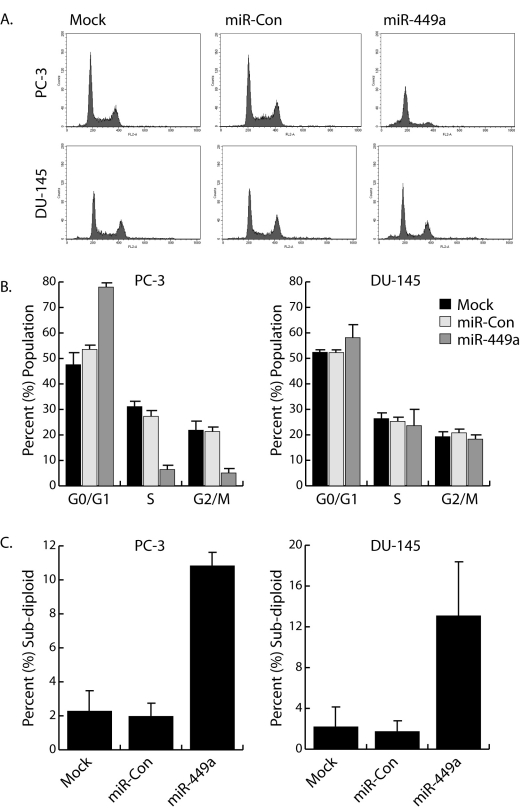
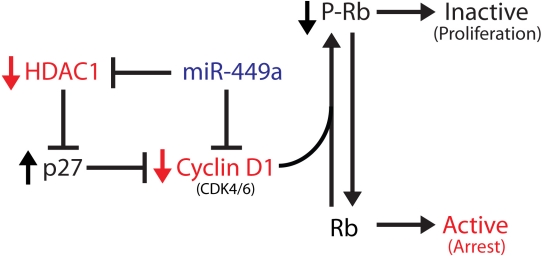
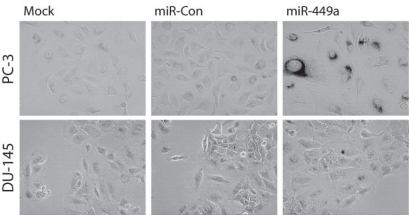
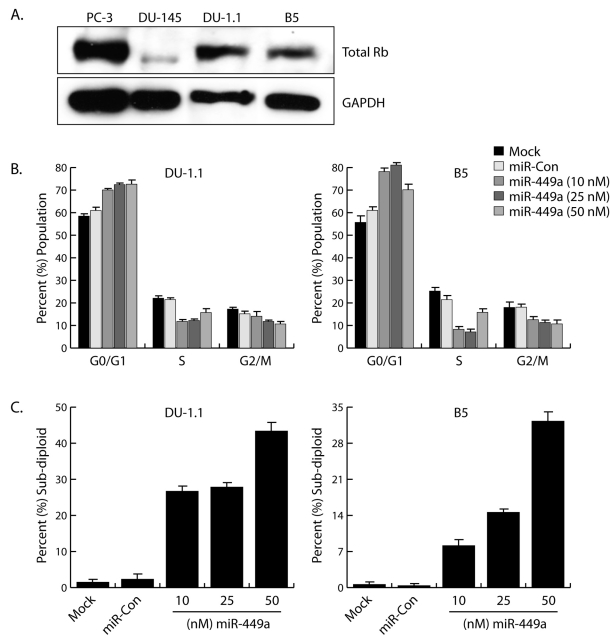
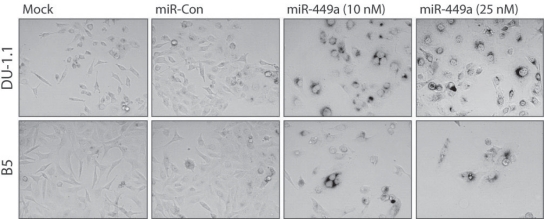
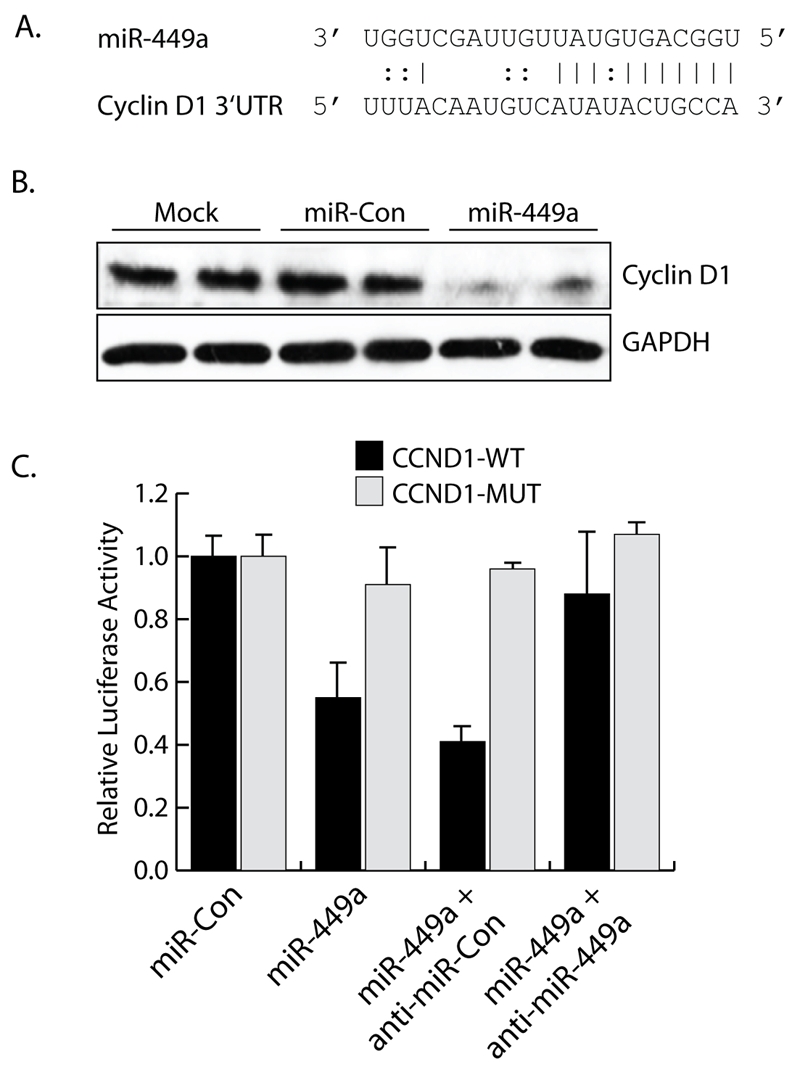
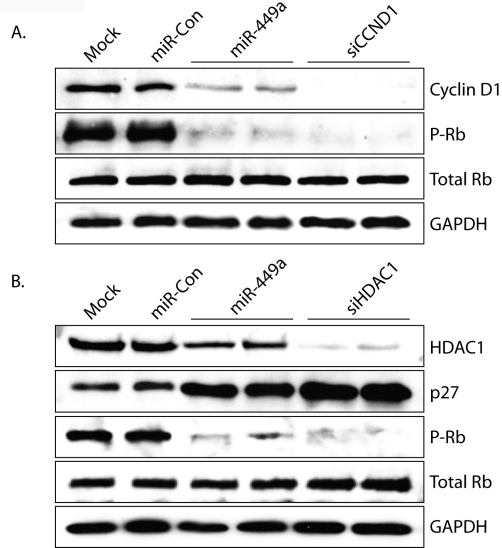
MicroRNAs (miRNAs) are a class of small non-coding RNAs (ncRNAs) that regulate gene expression by repressing translation or triggering the degradation of complementary mRNA sequences. Certain miRNAs have been shown to function as integral components of the p53 and/or retinoblastoma (Rb) regulatory networks. As such, miRNA dysregulation can have a profound effect on cancer development. Previous studies have shown that miR-449a is down-regulated in human prostate cancer tissue and possesses potential tumor suppressor function. In the present study, we identify miR-449a-mediated growth arrest in prostate cancer cells is dependent on the Rb protein. We show that mutant Rb prostate cancer cells (DU- 145) are resistant to cell cycle arrest and cellular senescence induced by miR- 449a, while overexpression of wild-type Rb in DU-145 sublines (DU-1.1 and B5) restores miR-449a function. In silico analysis of 3'UTR regions reveal a putative miR-449a target site in the transcript of Cyclin D1 (CCND1); an oncogene involved in directly regulating Rb activity and cell cycle progression. Luciferase 3'UTR reporter constructs and inhibitory oligonucleotides confirm that Cyclin D1 is a direct downstream target of miR-449a. We also reveal that miR-449a suppresses Rb phosphorylation through the knockdown of Cyclin D1 and previously validated target HDAC1. By targeting genes involved in controlling Rb activity, miR- 449a regulates growth and senescence in an Rb-dependent manner. These data indicate that miR-449a is a miRNA component of the Rb pathway and its tumor suppressor-like effects, in part, depends on Rb status in prostate cancer cells.
微小RNA(miRNA)是一类小的非编码RNA(ncRNA),通过抑制翻译或触发互补mRNA序列的降解来调节基因表达。某些miRNA已被证明是p53和/或视网膜母细胞瘤(Rb)调控网络的组成部分。因此,miRNA失调可对癌症发展产生深远影响。先前的研究表明,miR-449a在人前列腺癌组织中表达下调,并具有潜在的肿瘤抑制功能。在本研究中,我们发现miR-449a介导的前列腺癌细胞生长停滞依赖于Rb蛋白。我们发现,突变型Rb前列腺癌细胞(DU-145)对miR-449a诱导的细胞周期停滞和细胞衰老具有抗性,而在DU-145亚系(DU-1.1和B5)中过表达野生型Rb可恢复miR-449a的功能。对3'UTR区域的计算机分析揭示了细胞周期蛋白D1(CCND1)转录本中一个假定的miR-449a靶位点;CCND1是一种癌基因,直接参与调节Rb活性和细胞周期进程。荧光素酶3'UTR报告基因构建体和抑制性寡核苷酸证实细胞周期蛋白D1是miR-449a的直接下游靶标。我们还发现,miR-449a通过敲低细胞周期蛋白D1和先前验证的靶标HDAC1来抑制Rb磷酸化。通过靶向参与控制Rb活性的基因,miR-449a以Rb依赖的方式调节生长和衰老。这些数据表明,miR-449a是Rb途径的一个miRNA组成部分,其类似肿瘤抑制的作用部分取决于前列腺癌细胞中的Rb状态。