• 文献检索
  • 文档翻译
  • 深度研究
  • 学术资讯
  • Suppr Zotero 插件Zotero 插件
  • 邀请有礼
  • 套餐&价格
  • 历史记录
应用&插件
Suppr Zotero 插件Zotero 插件浏览器插件Mac 客户端Windows 客户端微信小程序
定价
高级版会员购买积分包购买API积分包
服务
文献检索文档翻译深度研究API 文档MCP 服务
关于我们
关于 Suppr公司介绍联系我们用户协议隐私条款
关注我们

Suppr 超能文献

核心技术专利:CN118964589B侵权必究
粤ICP备2023148730 号-1Suppr @ 2026

文献检索

告别复杂PubMed语法,用中文像聊天一样搜索,搜遍4000万医学文献。AI智能推荐,让科研检索更轻松。

立即免费搜索

文件翻译

保留排版,准确专业,支持PDF/Word/PPT等文件格式,支持 12+语言互译。

免费翻译文档

深度研究

AI帮你快速写综述,25分钟生成高质量综述,智能提取关键信息,辅助科研写作。

立即免费体验

幼儿及照顾者龋齿风险因素的社会人口学差异

Sociodemographic variation of caries risk factors in toddlers and caregivers.

作者信息

Eckert G J, Jackson R, Fontana M

机构信息

Division of Biostatistics, Indiana University School of Medicine, Indianapolis, IN 46202, USA.

出版信息

Int J Dent. 2010;2010. doi: 10.1155/2010/593487. Epub 2010 Sep 23.

DOI:10.1155/2010/593487
PMID:20953367
原文链接:https://pmc.ncbi.nlm.nih.gov/articles/PMC2952902/
Abstract

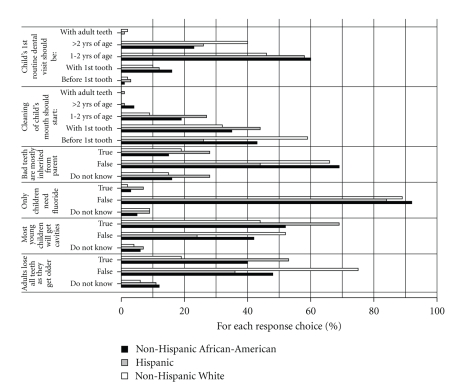
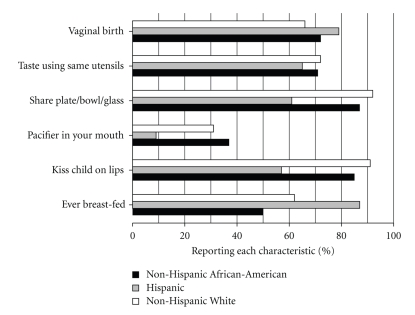
Objectives. Dental caries is the most common chronic childhood disease, with numerous identified risk factors. Risk factor differences could indicate the need to target caregiver/patient education/preventive care intervention strategies based on population and/or individual characteristics. The purpose of this study was to evaluate caries risk factors differences by race/ethnicity, income, and education. Methods. We enrolled 396 caregiver-toddler pairs and administered a 105-item questionnaire addressing demographics, access to care, oral bacteria transmission, caregiver's/toddler's dental and medical health practices, caregiver's dental beliefs, and caregiver's/toddler's snacking/drinking habits. Logistic regressions and ANOVAs were used to evaluate the associations of questionnaire responses with caregiver's race/ethnicity, income, and education. Results. Caregivers self-identified as Non-Hispanic African-American (44%), Non-Hispanic White (36%), Hispanic (19%), and "other" (1%). Differences related to race/ethnicity, income, and education were found in all risk factor categories. Conclusions. Planning of caregiver/patient education/preventive care intervention strategies should be undertaken with these caries risk factor differences kept in mind.

摘要

目标。龋齿是儿童最常见的慢性疾病,有许多已确定的风险因素。风险因素的差异可能表明需要根据人群和/或个体特征制定针对照顾者/患者教育/预防护理的干预策略。本研究的目的是评估按种族/民族、收入和教育程度划分的龋齿风险因素差异。方法。我们招募了396对照顾者-幼儿对,并发放了一份包含105个条目的问卷,内容涉及人口统计学、就医机会、口腔细菌传播、照顾者/幼儿的口腔和医疗健康习惯、照顾者的口腔观念以及照顾者/幼儿的零食/饮水习惯。使用逻辑回归和方差分析来评估问卷回答与照顾者的种族/民族、收入和教育程度之间的关联。结果。照顾者自我认定为非西班牙裔非裔美国人(44%)、非西班牙裔白人(36%)、西班牙裔(19%)和“其他”(1%)。在所有风险因素类别中均发现了与种族/民族、收入和教育程度相关的差异。结论。在制定照顾者/患者教育/预防护理干预策略时应考虑到这些龋齿风险因素差异。
https://cdn.ncbi.nlm.nih.gov/pmc/blobs/235c/2952902/a46a7b495ae6/IJD2010-593487.002.jpg
https://cdn.ncbi.nlm.nih.gov/pmc/blobs/235c/2952902/4bd2bdc3aa9a/IJD2010-593487.001.jpg
https://cdn.ncbi.nlm.nih.gov/pmc/blobs/235c/2952902/a46a7b495ae6/IJD2010-593487.002.jpg
https://cdn.ncbi.nlm.nih.gov/pmc/blobs/235c/2952902/4bd2bdc3aa9a/IJD2010-593487.001.jpg
https://cdn.ncbi.nlm.nih.gov/pmc/blobs/235c/2952902/a46a7b495ae6/IJD2010-593487.002.jpg

相似文献

1
Sociodemographic variation of caries risk factors in toddlers and caregivers.幼儿及照顾者龋齿风险因素的社会人口学差异
Int J Dent. 2010;2010. doi: 10.1155/2010/593487. Epub 2010 Sep 23.
2
Relationship between caregiver's and child's caries prevalence among disadvantaged African Americans.弱势非裔美国人中照顾者与儿童龋齿患病率之间的关系。
Community Dent Oral Epidemiol. 2008 Jun;36(3):191-200. doi: 10.1111/j.1600-0528.2007.00392.x.
3
Caregiver's education level and child's dental caries in African Americans: a path analytic study.非裔美国人中照顾者的教育水平与儿童龋齿:一项路径分析研究
Caries Res. 2015;49(2):177-83. doi: 10.1159/000368560. Epub 2015 Feb 3.
4
Primary Caregiver Retention and Perceptions of Retention Strategies in a 36-Month Prospective Childhood Caries Study.36 个月前瞻性儿童龋齿研究中主要照顾者的保留率及其对保留策略的看法。
J Prim Care Community Health. 2022 Jan-Dec;13:21501319221097668. doi: 10.1177/21501319221097668.
5
Sociodemographic Factors and Characteristics of Caregivers as Determinants of Skilled Nursing Facility Admissions When Modeled Jointly With Functional Limitations.当与功能限制联合建模时,社会人口因素和护理人员特征是熟练护理机构入院的决定因素。
J Am Med Dir Assoc. 2019 Dec;20(12):1599-1604.e4. doi: 10.1016/j.jamda.2019.01.154. Epub 2019 Mar 20.
6
Dental screening and referral of young children by pediatric primary care providers.儿科初级保健提供者对幼儿进行牙科筛查和转诊。
Pediatrics. 2004 Nov;114(5):e642-52. doi: 10.1542/peds.2004-1269.
7
Association between caregiver ability and quality of life for people with inflammatory bowel disease: The mediation effect of positive feelings of caregivers.炎症性肠病患者的照料者能力与生活质量之间的关联:照料者积极情绪的中介作用。
Front Psychol. 2022 Oct 4;13:988150. doi: 10.3389/fpsyg.2022.988150. eCollection 2022.
8
Social interaction in the emergence of toddler's mealtime spoon use.幼儿进餐时使用勺子过程中的社会互动。
Dev Psychobiol. 2020 Dec;62(8):1124-1133. doi: 10.1002/dev.21978. Epub 2020 May 7.
9
[Caregiver burden in relatives of persons with schizophrenia: an overview of measure instruments].[精神分裂症患者亲属的照顾者负担:测量工具概述]
Encephale. 2003 Mar-Apr;29(2):137-47.
10
Comparing protection-motivation theory-based intervention with routine public dental health care.比较基于保护动机理论的干预与常规公共口腔卫生保健。
Int J Dent Hyg. 2021 Aug;19(3):279-286. doi: 10.1111/idh.12522. Epub 2021 Jun 4.

引用本文的文献

1
Early childhood caries risk prediction using machine learning approaches in Bangladesh.在孟加拉国使用机器学习方法预测幼儿龋齿风险。
BMC Oral Health. 2025 Jan 8;25(1):49. doi: 10.1186/s12903-025-05419-2.
2
Probabilistic graphical modelling of early childhood caries development.儿童早期龋齿发病的概率图形建模。
PLoS One. 2023 Oct 30;18(10):e0293221. doi: 10.1371/journal.pone.0293221. eCollection 2023.
3
Maturation of the Oral Microbiome in Caries-Free Toddlers: A Longitudinal Study.无龋幼儿口腔微生物组的成熟:一项纵向研究。

本文引用的文献

1
Building caries risk assessment models for children.建立儿童龋病风险评估模型。
J Dent Res. 2010 Jun;89(6):637-43. doi: 10.1177/0022034510364489. Epub 2010 Apr 16.
2
Patient caries risk assessment.患者龋病风险评估。
Monogr Oral Sci. 2009;21:91-101. doi: 10.1159/000224214. Epub 2009 Jun 3.
3
Predictors of dental caries progression in primary teeth.乳牙龋齿进展的预测因素。
J Dent Res. 2020 Feb;99(2):159-167. doi: 10.1177/0022034519889015. Epub 2019 Nov 26.
4
Predicting Caries in Medical Settings: Risk Factors in Diverse Infant Groups.预测医疗环境中的龋齿:不同婴儿群体的风险因素。
J Dent Res. 2019 Jan;98(1):68-76. doi: 10.1177/0022034518799080. Epub 2018 Sep 11.
5
Attitudes of U.S. Hispanic and non-Hispanic women toward congenital CMV prevention behaviors: a cross sectional study.美国西班牙裔和非西班牙裔女性对先天性巨细胞病毒预防行为的态度:一项横断面研究。
BMC Pregnancy Childbirth. 2018 May 24;18(1):181. doi: 10.1186/s12884-018-1807-0.
6
Factors underlying the polarization of early childhood caries within a high-risk population.高风险人群中幼儿龋齿两极分化的潜在因素。
BMC Public Health. 2014 Sep 22;14:988. doi: 10.1186/1471-2458-14-988.
7
Risk factors of caries progression in a Hispanic school-aged population.西班牙语裔学龄人群龋齿进展的风险因素。
J Dent Res. 2011 Oct;90(10):1189-96. doi: 10.1177/0022034511413927. Epub 2011 Jul 15.
J Dent Res. 2009 Mar;88(3):270-5. doi: 10.1177/0022034508331011.
4
Policy on early childhood caries (ECC): classifications, consequences, and preventive strategies.幼儿龋齿(ECC)政策:分类、后果及预防策略
Pediatr Dent. 2008;30(7 Suppl):40-3.
5
Policy on use of a caries-risk assessment tool (CAT) for infants, children, and adolescents.婴幼儿及青少年龋病风险评估工具(CAT)使用政策。
Pediatr Dent. 2008;30(7 Suppl):29-33.
6
Dental caries in 3-year-old children is associated more with child-rearing behaviors than mother-related health behaviors.3岁儿童的龋齿与育儿行为的关联比与母亲相关的健康行为更为密切。
J Public Health Dent. 2009 Spring;69(2):104-10. doi: 10.1111/j.1752-7325.2008.00107.x.
7
A longitudinal study of dental caries risk among very young low SES children.一项针对低社会经济地位幼儿龋齿风险的纵向研究。
Community Dent Oral Epidemiol. 2009 Apr;37(2):116-22. doi: 10.1111/j.1600-0528.2008.00447.x. Epub 2008 Nov 12.
8
Preventive oral health intervention for pediatricians.面向儿科医生的预防性口腔健康干预措施。
Pediatrics. 2008 Dec;122(6):1387-94. doi: 10.1542/peds.2008-2577. Epub 2008 Nov 17.
9
Caries management by risk assessment: implementation guidelines.基于风险评估的龋病管理:实施指南
J Calif Dent Assoc. 2007 Nov;35(11):799-805.
10
Caries risk assessment appropriate for the age 1 visit (infants and toddlers).适合1岁就诊(婴儿和幼儿)时的龋齿风险评估。
J Calif Dent Assoc. 2007 Oct;35(10):687-702.