University of Rochester Medical Center, New York 14642, USA.
Alcohol Clin Exp Res. 2011 Jan;35(1):60-8. doi: 10.1111/j.1530-0277.2010.01322.x. Epub 2010 Oct 19.
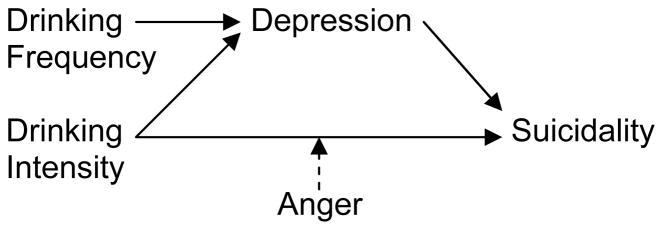
There are few data on the role of drinking patterns in suicidal thoughts or behavior among alcohol-dependent individuals (ADIs) and meager data on variables that may influence the role of drinking in suicidal thoughts and behavior. This study tested a heuristic model that predicts that drinking promotes suicidal thoughts and behavior, the association is mediated (accounted for) by depressive symptoms, and that anger moderates (increases) the risk associated with intense drinking.
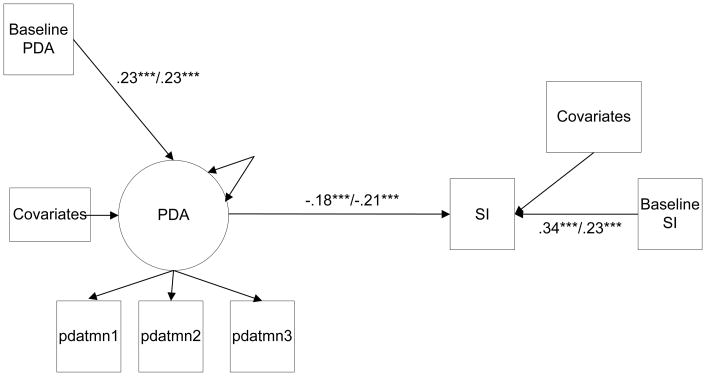
Data from Project MATCH, a multisite alcohol use disorders treatment trial, were analyzed using structural equation modeling. There were 1,726 participants including 24% women and a mean age of 40.2 ± 11.0 years. Subjects were assessed at baseline and at 3-, 9-, and 15-month follow-up. Two categorical measures (presence/absence) of suicidal ideation (SI) were used that were analyzed in separate models. Predictors of interest were continuous assessments of average drinking intensity (i.e., drinks per drinking day or DDD), drinking frequency (i.e., percent days abstinent or PDA), depression, and anger.
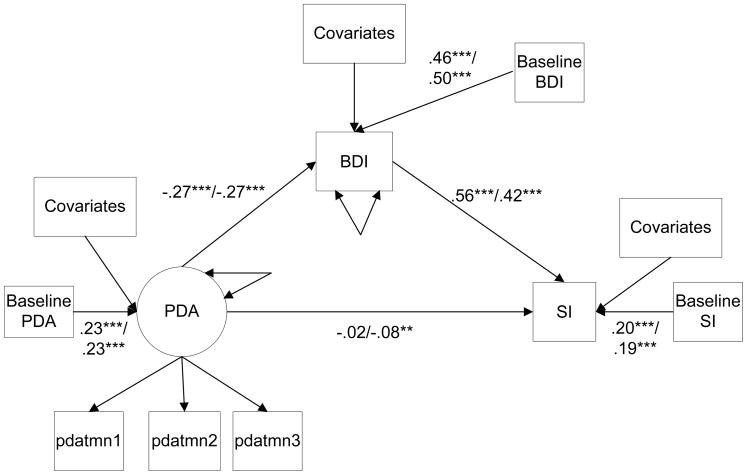
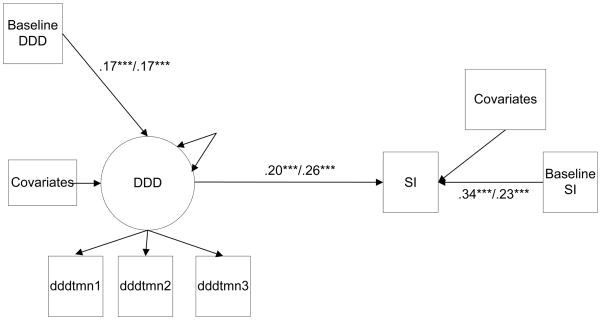
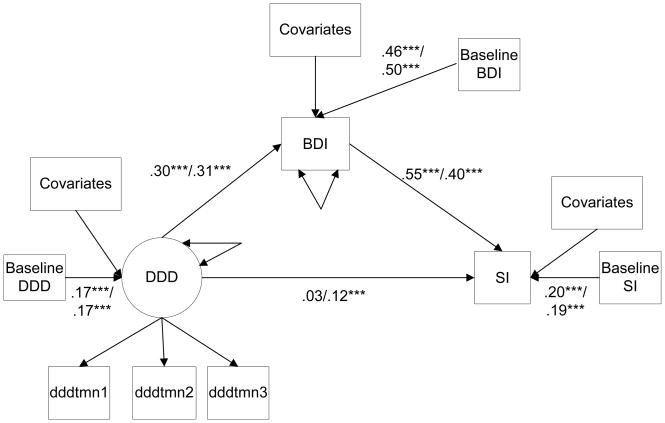
Both DDD and PDA were associated with SI at a statistically significant level, with PDA showing an inverse association. Depression scores served as a partial mediator or a full mediator of the drinking-SI relationship depending on the measure of SI used in the analysis. The models testing anger scores as a moderator fit the data poorly and did not support that anger serves as a moderator of the drinking-SI association.
Greater drinking intensity and drinking frequency predict SI among ADIs and depression serves as a mediator of these associations, but anger does not appear to serve as a moderator. Further research is required to clarify whether depression serves as a partial or full mediator and to see whether the results herein extend to suicidal behavior (i.e., suicide attempt, suicide).
关于饮酒模式在酒精依赖个体(ADIs)自杀意念或行为中的作用,相关数据较少,而关于可能影响饮酒与自杀意念和行为之间关系的变量的数据则更少。本研究检验了一个启发式模型,该模型预测饮酒会促进自杀意念和行为,抑郁症状在其中起中介作用,愤怒则会增加与大量饮酒相关的风险。
本研究使用结构方程模型分析了来自项目 MATCH(一项多地点酒精使用障碍治疗试验)的数据。参与者共 1726 人,包括 24%的女性,平均年龄为 40.2±11.0 岁。在基线和 3、9 和 15 个月的随访时对受试者进行评估。本研究使用了两种自杀意念(SI)的分类测量(存在/不存在),并在单独的模型中进行了分析。感兴趣的预测因素是平均饮酒强度(即每天饮酒量或 DDD)和饮酒频率(即无饮酒天数的百分比或 PDA)、抑郁和愤怒的连续评估。
DDD 和 PDA 与 SI 呈显著相关,PDA 呈负相关。抑郁评分作为饮酒-SI 关系的部分或完全中介,具体取决于分析中使用的 SI 测量。检验愤怒评分作为调节因素的模型拟合数据效果不佳,不支持愤怒作为饮酒-SI 关系的调节因素。
更高的饮酒强度和饮酒频率预测 ADIs 的 SI,抑郁作为这些关联的中介,而愤怒似乎不是调节因素。需要进一步的研究来阐明抑郁是否作为部分或完全中介,以及本研究结果是否适用于自杀行为(即自杀企图、自杀)。