Faculty of Infectious and Tropical Diseases, London School of Hygiene & Tropical Medicine, London, UK.
Malar J. 2010 Oct 26;9:294. doi: 10.1186/1475-2875-9-294.
The use of malaria rapid diagnostic tests (RDTs) has been widely advocated to improve Plasmodium falciparum diagnosis, especially in settings where quality microscopy is not available. RDTs based on the detection of histidine-rich protein 2 (HRP-2) can remain positive for several weeks after an infection is cured, due to the persistence of HRP-2 antigens. As a result, test specificity may vary between age groups with different prevalence of P. falciparum infection.
A community-based cross-sectional survey, carried out in southern Tanzania in July and August 2004, evaluated the performance of the Paracheck Pf in comparison with microscopy (number of P. falciparum parasites/200 leucocytes). A sample of 598 individuals living in an area of intense malaria transmission had demographic data collected before an RDT was performed. HRP-2 test sensitivity, specificity, positive and negative predictive values were calculated and compared between distinct age groups, using microscopy as "gold standard".
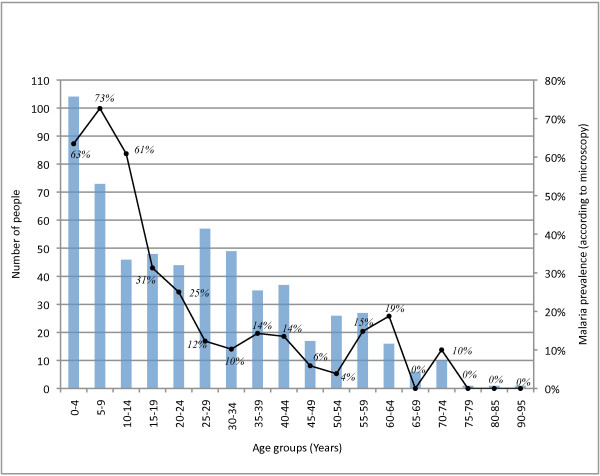
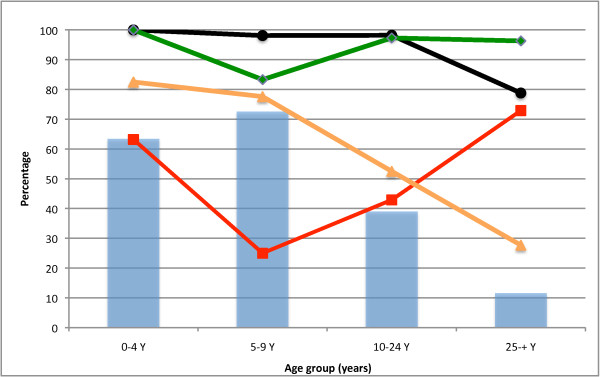
The overall malaria prevalence was 34.3% according to microscopy and 57.2% according to the HRP-2 test. The HRP-2 test had a sensitivity of 96.1%, a specificity of 63.1%, a positive predictive value of 57.6% and a negative predictive value of 96.9%. The test sensitivity was higher (ranging from 98% to 100%) amongst people less than 25 years of age, but decreased to 81.3% in older adults. The HRP-2 test specificity varied between age groups, ranging from 25% among children of five to nine years of age, to 73% among adults aged 25 or more. The test positive predictive value increased with malaria prevalence, while the negative predictive value was consistently high across age groups.
These results suggest that the performance of HRP-2 tests in areas of intense malaria transmission varies by age and the prevalence of P. falciparum infection. The particularly low specificity among children will lead to the over-estimation of malaria infection prevalence in this group.
疟疾快速诊断检测(RDT)的使用已被广泛提倡,以改善恶性疟原虫的诊断,特别是在无法获得高质量显微镜的情况下。基于检测组氨酸丰富蛋白 2(HRP-2)的 RDT 在感染治愈后几周内仍可能呈阳性,这是由于 HRP-2 抗原的持续存在。因此,在不同恶性疟原虫感染流行率的年龄组之间,检测的特异性可能有所不同。
2004 年 7 月至 8 月,在坦桑尼亚南部进行了一项基于社区的横断面调查,评估了 Paracheck Pf 在与显微镜检查(每 200 个白细胞中的恶性疟原虫寄生虫数)相比时的性能。在进行 RDT 之前,对生活在疟疾高度传播地区的 598 名个体收集了人口统计学数据。使用显微镜检查作为“金标准”,计算并比较了不同年龄组之间 HRP-2 检测的敏感性、特异性、阳性预测值和阴性预测值。
根据显微镜检查,总疟疾患病率为 34.3%,根据 HRP-2 检测为 57.2%。HRP-2 检测的敏感性为 96.1%,特异性为 63.1%,阳性预测值为 57.6%,阴性预测值为 96.9%。在年龄小于 25 岁的人群中,检测的敏感性更高(范围为 98%至 100%),但在年龄较大的成年人中降至 81.3%。HRP-2 检测的特异性在年龄组之间有所不同,范围从 5 至 9 岁儿童的 25%到 25 岁或以上成年人的 73%。检测的阳性预测值随着疟疾流行率的增加而增加,而阴性预测值在各年龄组之间保持较高水平。
这些结果表明,在疟疾高度传播地区,HRP-2 检测的性能因年龄和恶性疟原虫感染的流行率而异。儿童中特别低的特异性会导致该年龄段疟疾感染流行率的高估。