Department of Ophthalmology, Children's Hospital, Chongqing Medical University, Chongqing, People's Republic of China.
Int J Med Sci. 2010 Oct 18;7(6):342-53. doi: 10.7150/ijms.7.342.
This study investigated the distribution pattern of refractive status and prevalence of refractive errors in school-age children in Western China to determine the possible environmental factors.
A random sampling strategy in geographically defined clusters was used to identify children aged 6-15 years in Yongchuan, a socio-economically representative area in Western China. We carried out a door-to-door survey and actual eye examinations, including visual acuity measurements, stereopsis examination, anterior segment and eyeball movements, fundus examinations, and cycloplegic retinoscopy with 1% cyclopentolate.
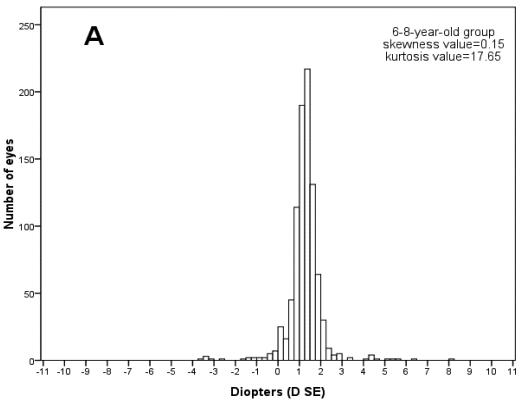
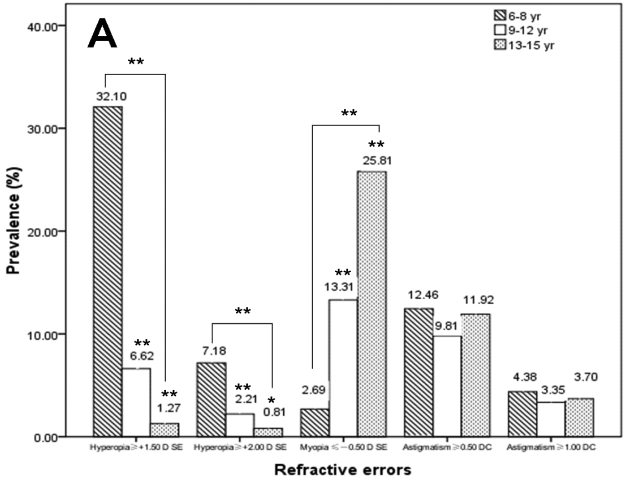
A total of 3469 children living in 2552 households were selected, and 3070 were examined. The distributions of refractive status were positively-skewed for 6-8-year-olds, and negatively-skewed for 9-12 and 13-15-year-olds. The prevalence of hyperopia (≥+2.00 D spherical equivalent [SE]), myopia (≤-0.50 D SE), and astigmatism (≥1.00 diopter of cylinder [DC]) were 3.26%, 13.75%, and 3.75%, respectively. As children's ages increased, the prevalence rate of hyperopia decreased (P<0.001) and that of myopia increased significantly (P<0.001). Children in academically challenging schools had a higher risk of myopia (P<0.001) and astigmatism (≥1.00DC, P =0.04) than those in regular schools.
The distribution of refractive status changes gradually from positively-skewed to negatively-skewed distributions as age increases, with 9-year-old being the critical age for the changes. Environmental factors and study intensity influence the occurrence and development of myopia.
本研究旨在探讨中国西部学龄儿童屈光状态分布特征及屈光不正的流行情况,以确定可能的环境因素。
采用地理区域界定的随机抽样策略,在重庆市永川区(一个具有社会经济代表性的地区)确定 6-15 岁儿童。我们进行了逐户调查和实际的眼科检查,包括视力测量、立体视检查、眼前节和眼球运动、眼底检查以及 1%环戊酮散瞳后的视网膜检影验光。
共选取了 2552 户家庭中的 3469 名儿童,对 3070 名儿童进行了检查。6-8 岁儿童的屈光状态分布呈正偏态,9-12 岁和 13-15 岁儿童的屈光状态分布呈负偏态。远视(≥+2.00 D 球镜等效值[SE])、近视(≤-0.50 D SE)和散光(≥1.00 屈光度的圆柱镜[DC])的患病率分别为 3.26%、13.75%和 3.75%。随着儿童年龄的增长,远视的患病率降低(P<0.001),而近视的患病率显著增加(P<0.001)。在学业要求较高的学校就读的儿童发生近视(P<0.001)和散光(≥1.00 DC,P=0.04)的风险高于在普通学校就读的儿童。
随着年龄的增长,屈光状态的分布逐渐从正偏态变为负偏态,9 岁是变化的关键年龄。环境因素和学习强度影响近视的发生和发展。