• 文献检索
  • 文档翻译
  • 深度研究
  • 学术资讯
  • Suppr Zotero 插件Zotero 插件
  • 邀请有礼
  • 套餐&价格
  • 历史记录
应用&插件
Suppr Zotero 插件Zotero 插件浏览器插件Mac 客户端Windows 客户端微信小程序
定价
高级版会员购买积分包购买API积分包
服务
文献检索文档翻译深度研究API 文档MCP 服务
关于我们
关于 Suppr公司介绍联系我们用户协议隐私条款
关注我们

Suppr 超能文献

核心技术专利:CN118964589B侵权必究
粤ICP备2023148730 号-1Suppr @ 2026

文献检索

告别复杂PubMed语法,用中文像聊天一样搜索,搜遍4000万医学文献。AI智能推荐,让科研检索更轻松。

立即免费搜索

文件翻译

保留排版,准确专业,支持PDF/Word/PPT等文件格式,支持 12+语言互译。

免费翻译文档

深度研究

AI帮你快速写综述,25分钟生成高质量综述,智能提取关键信息,辅助科研写作。

立即免费体验

4411 名中国小学生近视患病率高,远视储备低及相关危险因素分析。

High prevalence of myopia and low hyperopia reserve in 4411 Chinese primary school students and associated risk factors.

机构信息

Department of Ophthalmology, Chongqing Key Laboratory of Ophthalmology, First Affiliated Hospital of Chongqing Medical University, Chongqing Eye Institute, Chongqing Branch of National Clinical Research Center for Ocular Diseases, 1 Youyi Road, Chongqing, 400016, China.

Department of Ophthalmology, Chongqing General Hospital, University of Chinese Academy of Sciences, 104 Pipashan Road, Chongqing, 400014, China.

出版信息

BMC Ophthalmol. 2022 May 11;22(1):212. doi: 10.1186/s12886-022-02436-5.

DOI:10.1186/s12886-022-02436-5
PMID:35545760
原文链接:https://pmc.ncbi.nlm.nih.gov/articles/PMC9092685/
Abstract

PURPOSE

To investigate the prevalence of myopia in Chinese primary school students and their ocular biometrics including axial length (AL), corneal radius of curvature (CRC) and spherical equivalent refraction (SER). To analyze their association with potential myopia risk factors, such as body mass index (BMI), cram school, time of outdoor activity and electronic screen use.

METHODS

In this cross-sectional study of 4500 primary school students from 5 schools, participants underwent refraction using non-cycloplegic autorefractor and visual acuity testing. A follow-up study in the same schools was conducted in 2022. Myopia was defined as SER ≤ -0.50 diopter (D) and uncorrected visual acuity (UCVA) < 0.00 logMAR (6/6). Logistic regression models were used to determine factors associated with myopia.

RESULTS

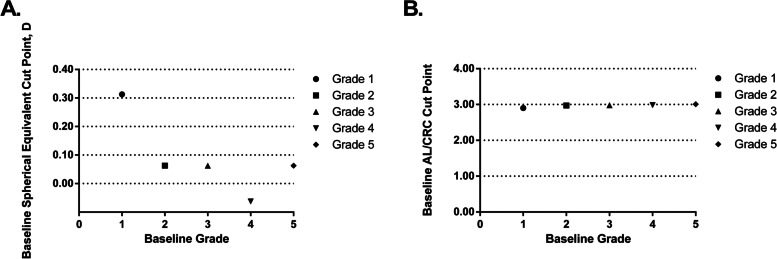
After excluding 389 participants, the overall prevalence of myopia was 33.6%. The prevalence of high myopia was 0.6%. The prevalence of myopia in girls was significantly higher than that in boys (37.6% vs. 30.0%, p < 0.001). The height, weight and BMI were significantly associated with AL (r = 0.471, r = 0.440, r = 0.276, p < 0.001, respectively). AL/CRC ratio was more highly correlated with SER than AL alone. Regression analysis showed that AL/CRC and hyperopia reserve were associated with myopia onset in the subsequent year (F = 201.557, p < 0.001; F = 68.934, p < 0.001). The cut point of hyperopia reserve for myopia in the subsequent year for grade 1 students was + 0.31D. Age (p < 0.001), parental myopia (p = 0.001) and lack of outdoor activity between classes (p = 0.049) were independently associated with higher prevalence rates of myopia.

CONCLUSION

The prevalence of myopia among Chinese schoolchildren is alarming high. Consistent with previous cross-sectional data, AL/CRC and hyperopia reserve could function as myopia detection indicators. The hyperopia reserve among children aged between 6 ~ 7 years was low. Healthcare providers need to raise parents' awareness of the importance of regular eye examination and proper optical correction.

摘要

目的

调查中国小学生近视的流行情况及其眼生物测量学指标,包括眼轴(AL)、角膜曲率半径(CRC)和等效球镜屈光度(SER)。分析它们与潜在近视危险因素的关系,如体重指数(BMI)、课外辅导班、户外活动时间和电子屏幕使用时间。

方法

在这项来自 5 所学校的 4500 名小学生的横断面研究中,使用非睫状肌麻痹自动折射仪进行屈光检查和视力测试。在 2022 年对同一学校进行了随访研究。近视定义为 SER≤-0.50 屈光度(D)和未矫正视力(UCVA)<0.00 对数视力表(6/6)。使用逻辑回归模型确定与近视相关的因素。

结果

排除 389 名参与者后,近视总患病率为 33.6%。高度近视患病率为 0.6%。女生近视患病率显著高于男生(37.6%比 30.0%,p<0.001)。身高、体重和 BMI 与 AL 显著相关(r=0.471、r=0.440、r=0.276,p<0.001)。AL/CRC 比值与 SER 的相关性高于 AL 单独的相关性。回归分析显示,AL/CRC 和远视储备与次年近视的发生有关(F=201.557,p<0.001;F=68.934,p<0.001)。一年级学生次年近视的远视储备切点为+0.31D。年龄(p<0.001)、父母近视(p=0.001)和课间缺乏户外活动(p=0.049)与近视患病率的增加独立相关。

结论

中国学龄儿童近视的患病率令人震惊。与之前的横断面数据一致,AL/CRC 和远视储备可作为近视检测指标。6~7 岁儿童的远视储备较低。医疗保健提供者需要提高家长对定期眼部检查和适当光学矫正的重要性的认识。

https://cdn.ncbi.nlm.nih.gov/pmc/blobs/01cf/9092685/0a09fbe98ba4/12886_2022_2436_Fig3_HTML.jpg
https://cdn.ncbi.nlm.nih.gov/pmc/blobs/01cf/9092685/d53c151bf7bb/12886_2022_2436_Fig1_HTML.jpg
https://cdn.ncbi.nlm.nih.gov/pmc/blobs/01cf/9092685/b420c6a0d7d4/12886_2022_2436_Fig2_HTML.jpg
https://cdn.ncbi.nlm.nih.gov/pmc/blobs/01cf/9092685/0a09fbe98ba4/12886_2022_2436_Fig3_HTML.jpg
https://cdn.ncbi.nlm.nih.gov/pmc/blobs/01cf/9092685/d53c151bf7bb/12886_2022_2436_Fig1_HTML.jpg
https://cdn.ncbi.nlm.nih.gov/pmc/blobs/01cf/9092685/b420c6a0d7d4/12886_2022_2436_Fig2_HTML.jpg
https://cdn.ncbi.nlm.nih.gov/pmc/blobs/01cf/9092685/0a09fbe98ba4/12886_2022_2436_Fig3_HTML.jpg

相似文献

1
High prevalence of myopia and low hyperopia reserve in 4411 Chinese primary school students and associated risk factors.4411 名中国小学生近视患病率高,远视储备低及相关危险因素分析。
BMC Ophthalmol. 2022 May 11;22(1):212. doi: 10.1186/s12886-022-02436-5.
2
Axial length to corneal radius of curvature ratio and refractive error in Chinese preschoolers aged 4-6 years: a retrospective cross-sectional study.4-6 岁中国学龄前儿童眼轴长度与角膜曲率半径比和屈光不正的关系:一项回顾性横断面研究。
BMJ Open. 2023 Dec 30;13(12):e075115. doi: 10.1136/bmjopen-2023-075115.
3
[Cohort study on the association between hyperopia reserve and myopia incidence in primary school students: the Anyang Childhood Eye Study].小学生远视储备与近视发生率关联的队列研究:安阳儿童眼研究
Zhonghua Yan Ke Za Zhi. 2022 Oct 11;58(10):754-759. doi: 10.3760/cma.j.cn112142-20211028-00509.
4
Ocular biometrics and uncorrected visual acuity for detecting myopia in Chinese school students.眼生物测量和未矫正视力在检测中国学生近视中的应用。
Sci Rep. 2022 Nov 4;12(1):18644. doi: 10.1038/s41598-022-23409-0.
5
Associations between anthropometric indicators and both refraction and ocular biometrics in a cross-sectional study of Chinese schoolchildren.横断面研究中中国学童的人体测量指标与屈光和眼生物测量指标的相关性。
BMJ Open. 2019 May 10;9(5):e027212. doi: 10.1136/bmjopen-2018-027212.
6
The Impact of Parental Myopia and High Myopia on the Hyperopia Reserve of Preschool Children.父母近视和高度近视对学龄前儿童远视储备的影响。
Ophthalmic Res. 2024;67(1):115-124. doi: 10.1159/000535193. Epub 2023 Nov 21.
7
Prevalence of myopia and vision impairment in school students in Eastern China.中国东部地区学生近视和视力损害的患病率。
BMC Ophthalmol. 2020 Jan 2;20(1):2. doi: 10.1186/s12886-019-1281-0.
8
Distribution, Progression, and Associated Factors of Refractive Status of Children in Lhasa, Tibet, after COVID-19 Quarantine.拉萨市新冠疫情隔离后儿童屈光状态的分布、进展及相关因素。
Ophthalmic Res. 2022;65(3):321-327. doi: 10.1159/000522548. Epub 2022 Feb 16.
9
Incidence of and Factors Associated With Myopia and High Myopia in Chinese Children, Based on Refraction Without Cycloplegia.基于不散瞳折射的中国儿童近视和高度近视的发生率及相关因素
JAMA Ophthalmol. 2018 Sep 1;136(9):1017-1024. doi: 10.1001/jamaophthalmol.2018.2658.
10
[Analysis of the influence factors of school-age children's refractive status].[学龄儿童屈光状态的影响因素分析]
Zhonghua Yan Ke Za Zhi. 2016 Nov 11;52(11):831-835. doi: 10.3760/cma.j.issn.0412-4081.2016.11.006.

引用本文的文献

1
A study on the status of myopia and pre-myopia among primary school students in different regions of Shaanxi Province, China.中国陕西省不同地区小学生近视及近视前期状况的研究。
Front Pediatr. 2025 Jun 12;13:1596389. doi: 10.3389/fped.2025.1596389. eCollection 2025.
2
Effect of optical technical of guiding emmetropization lenses on myopia prevention in children without myopia.引导正视化镜片光学技术对未患近视儿童预防近视的作用。
Sci Rep. 2025 Apr 25;15(1):14422. doi: 10.1038/s41598-025-98526-7.
3
The hyperopia reserve in 3- to 6- years-old preschool children in North China: the Beijing hyperopia reserve research.

本文引用的文献

1
Smartphone Overuse and Visual Impairment in Children and Young Adults: Systematic Review and Meta-Analysis.智能手机过度使用与儿童和青年视觉障碍:系统评价和荟萃分析。
J Med Internet Res. 2020 Dec 8;22(12):e21923. doi: 10.2196/21923.
2
The Complications of Myopia: A Review and Meta-Analysis.近视的并发症:综述和荟萃分析。
Invest Ophthalmol Vis Sci. 2020 Apr 9;61(4):49. doi: 10.1167/iovs.61.4.49.
3
Prevalence of myopia and associated risk factors among primary students in Chongqing: multilevel modeling.重庆小学生近视患病率及相关危险因素:多水平模型研究。
中国北方3至6岁学龄前儿童的远视储备:北京远视储备研究
BMC Ophthalmol. 2025 Apr 7;25(1):175. doi: 10.1186/s12886-025-04008-9.
4
Parental awareness on myopia prevention and control among 350 children.350名儿童家长对近视防控的认知情况
Int J Ophthalmol. 2024 Nov 18;17(11):2109-2119. doi: 10.18240/ijo.2024.11.18. eCollection 2024.
5
Causal association of obesity-related anthropometric traits with myopia and the mediating role of educational attainment: a Mendelian randomization study.肥胖相关人体测量学特征与近视的因果关联及受教育程度的中介作用:一项孟德尔随机化研究
Int J Ophthalmol. 2024 Nov 18;17(11):2082-2092. doi: 10.18240/ijo.2024.11.15. eCollection 2024.
6
Trends in myopia development among Chinese children and adolescents in Xuzhou during one academic year.徐州地区中国儿童及青少年一学年近视发展趋势
Front Med (Lausanne). 2024 Jul 10;11:1391269. doi: 10.3389/fmed.2024.1391269. eCollection 2024.
7
Distribution and correlation of refractive parameters in children with different corneal curvatures in southeast China.中国东南部不同角膜曲率儿童屈光参数的分布及相关性
Int J Ophthalmol. 2024 Apr 18;17(4):713-720. doi: 10.18240/ijo.2024.04.16. eCollection 2024.
8
Nutritional intake, environmental factors, and their impact on myopia prevalence in Korean children aged 5-12 years.韩国 5-12 岁儿童近视患病率的营养摄入、环境因素及其影响。
J Health Popul Nutr. 2024 Jan 29;43(1):14. doi: 10.1186/s41043-024-00506-6.
9
Axial length to corneal radius of curvature ratio and refractive error in Chinese preschoolers aged 4-6 years: a retrospective cross-sectional study.4-6 岁中国学龄前儿童眼轴长度与角膜曲率半径比和屈光不正的关系:一项回顾性横断面研究。
BMJ Open. 2023 Dec 30;13(12):e075115. doi: 10.1136/bmjopen-2023-075115.
10
Refraction and ocular biometric parameters of preschool children in the Beijing whole childhood eye study: the first-year report.北京全生命周期儿童眼研究中学龄前儿童的屈光度和眼生物测量参数:首年报告。
BMC Ophthalmol. 2023 Sep 5;23(1):366. doi: 10.1186/s12886-023-03112-y.
BMC Ophthalmol. 2020 Apr 15;20(1):146. doi: 10.1186/s12886-020-01410-3.
4
Association of Parental Myopia With Higher Risk of Myopia Among Multiethnic Children Before School Age.父母近视与学龄前多民族儿童近视风险增加相关。
JAMA Ophthalmol. 2020 May 1;138(5):501-509. doi: 10.1001/jamaophthalmol.2020.0412.
5
High prevalence of myopia in children and their parents in Hong Kong Chinese Population: the Hong Kong Children Eye Study.香港华人儿童及其父母近视的高患病率:香港儿童眼研究
Acta Ophthalmol. 2020 Aug;98(5):e639-e648. doi: 10.1111/aos.14350. Epub 2020 Jan 24.
6
A review on the epidemiology of myopia in school children worldwide.一项关于全球学龄儿童近视流行病学的综述。
BMC Ophthalmol. 2020 Jan 14;20(1):27. doi: 10.1186/s12886-019-1220-0.
7
PREVALENCE AND TIME TRENDS OF MYOPIA IN CHILDREN AND ADOLESCENTS IN CHINA: A Systemic Review and Meta-Analysis.中国儿童和青少年近视的患病率和时间趋势:系统评价和荟萃分析。
Retina. 2020 Mar;40(3):399-411. doi: 10.1097/IAE.0000000000002590.
8
Associations between anthropometric indicators and both refraction and ocular biometrics in a cross-sectional study of Chinese schoolchildren.横断面研究中中国学童的人体测量指标与屈光和眼生物测量指标的相关性。
BMJ Open. 2019 May 10;9(5):e027212. doi: 10.1136/bmjopen-2018-027212.
9
The prevalence of myopia and the factors associated with it among university students in Nanjing: A cross-sectional study.南京大学生近视患病率及其相关因素:一项横断面研究。
Medicine (Baltimore). 2019 Mar;98(10):e14777. doi: 10.1097/MD.0000000000014777.
10
Myopic maculopathy: Current status and proposal for a new classification and grading system (ATN).近视性黄斑病变:现状与新分类分级系统(ATN)的建议
Prog Retin Eye Res. 2019 Mar;69:80-115. doi: 10.1016/j.preteyeres.2018.10.005. Epub 2018 Nov 1.