Department of Epidemiology, Welch Center for Prevention, Epidemiology and Clinical Research, Johns Hopkins Bloomberg School of Public Health, Baltimore, Maryland, USA.
Diabetes. 2011 Jan;60(1):298-305. doi: 10.2337/db10-1198. Epub 2010 Oct 26.
Glycated hemoglobin was recently recommended for use as a diagnostic test for diabetes. We examined the association between 2010 American Diabetes Association diagnostic cut points for glycated hemoglobin and microvascular outcomes (chronic kidney disease, end-stage renal disease [ESRD], and retinopathy) and formally tested for the presence of risk thresholds in the relationships of glycated hemoglobin with these outcomes.
Prospective cohort and cross-sectional analyses of 11,357 participants (773 with a history of diagnosed diabetes) from the Atherosclerosis Risk in Communities (ARIC) Study.
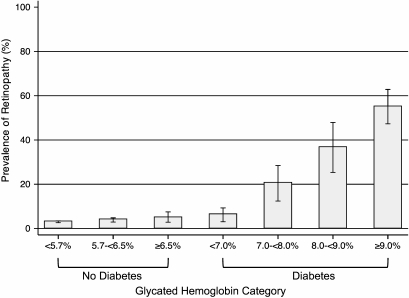
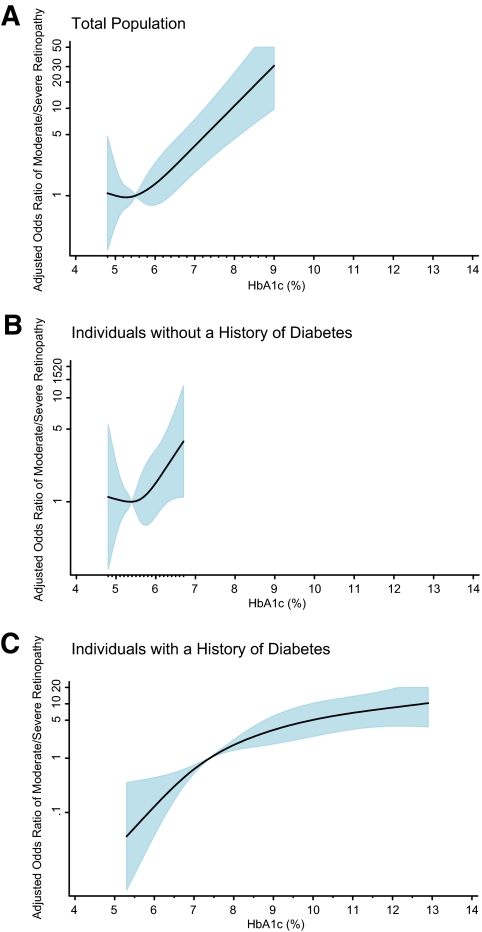
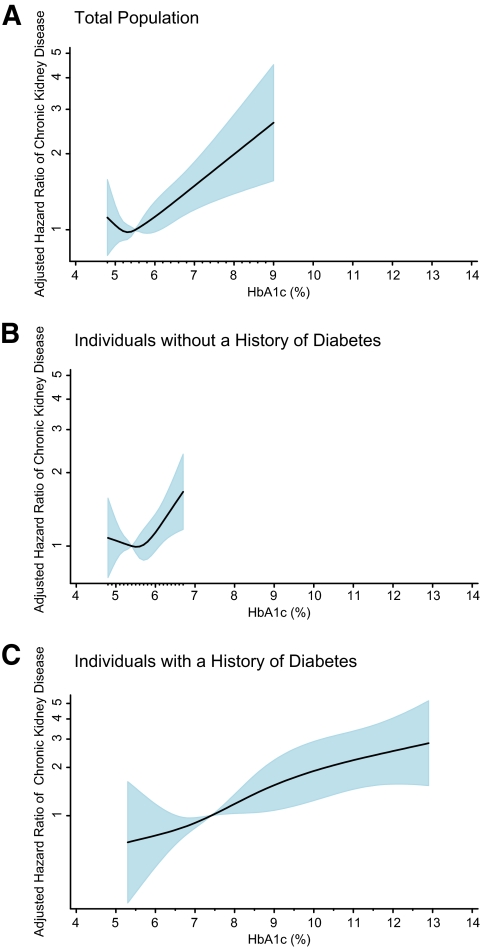
During a median of 14 years of follow-up of individuals without diagnosed diabetes at baseline, clinical categories of glycated hemoglobin were associated with risk of chronic kidney disease, with adjusted hazard ratios (HRs) of 1.12 (0.94-1.34) and 1.39 (1.04-1.85) for glycated hemoglobin 5.7-6.4% and ≥6.5%, respectively, as compared with <5.7% (P trend = 0.002). The corresponding HRs for ESRD were 1.51 (0.82-2.76) and 1.98 (0.83-4.73), respectively (P trend = 0.047). In the absence of diagnosed diabetes, glycated hemoglobin was cross sectionally associated with the presence of moderate/severe retinopathy, with adjusted odds ratios of 1.42 (0.69-2.92) and 2.91 (1.19-7.11) for glycated hemoglobin 5.7-<6.5% and ≥6.5%, respectively, compared with <5.7% (P trend = 0.011). Risk associations were stronger among individuals with a history of diabetes. We did not observe significant thresholds in the associations of glycated hemoglobin with kidney disease risk or retinopathy.
These data from a community-based, biracial population support the use of new 2010 American Diabetes Association glycated hemoglobin cut points for the diagnosis of diabetes.
糖化血红蛋白最近被推荐用于糖尿病的诊断测试。我们研究了 2010 年美国糖尿病协会诊断切点的糖化血红蛋白与微血管结局(慢性肾脏病、终末期肾病[ESRD]和视网膜病变)之间的关系,并正式检验了糖化血红蛋白与这些结局之间关系中存在风险阈值的情况。
前瞻性队列和横断面分析来自动脉粥样硬化风险社区(ARIC)研究的 11357 名参与者(773 名有确诊糖尿病病史)。
在基线时无确诊糖尿病的个体中位随访 14 年期间,临床类别糖化血红蛋白与慢性肾脏病风险相关,糖化血红蛋白为 5.7-6.4%和≥6.5%的校正危害比(HR)分别为 1.12(0.94-1.34)和 1.39(1.04-1.85),与<5.7%相比(P 趋势=0.002)。ESRD 的相应 HR 分别为 1.51(0.82-2.76)和 1.98(0.83-4.73)(P 趋势=0.047)。在没有确诊糖尿病的情况下,糖化血红蛋白与中度/重度视网膜病变的存在呈横断面相关,糖化血红蛋白为 5.7-<6.5%和≥6.5%的校正比值比(OR)分别为 1.42(0.69-2.92)和 2.91(1.19-7.11),与<5.7%相比(P 趋势=0.011)。在有糖尿病病史的个体中,风险关联更强。我们没有观察到糖化血红蛋白与肾脏病风险或视网膜病变之间关联的显著阈值。
这些来自基于社区的、多种族人群的数据支持使用新的 2010 年美国糖尿病协会糖化血红蛋白切点来诊断糖尿病。