Department of Preventive Medicine, University of Ulsan College of Medicine, Seoul, Korea.
J Korean Med Sci. 2010 Nov;25(11):1582-8. doi: 10.3346/jkms.2010.25.11.1582. Epub 2010 Oct 26.
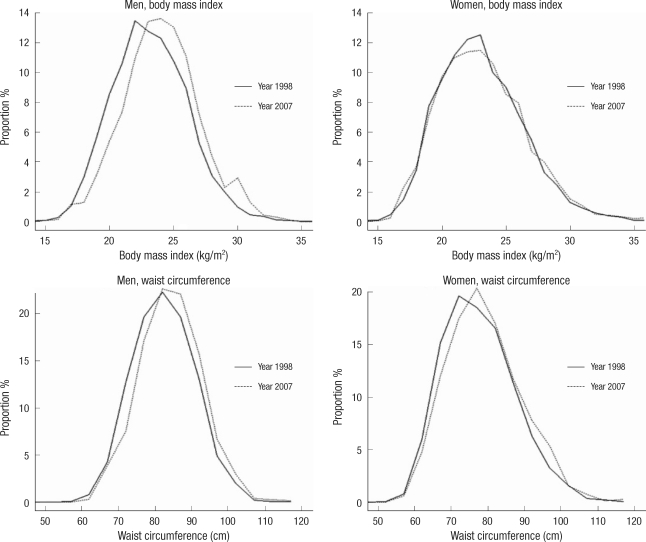
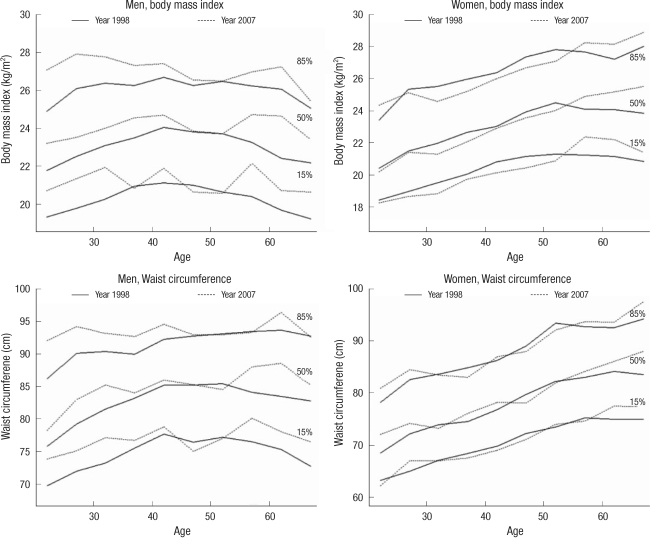
We examined trends in obesity among Korean adults, using body mass index (BMI) and waist circumference (WC) as reported in national surveys. Data (10,043 men and 12,758 non-pregnant women) were derived from four waves of the Korea National Health and Nutrition Examination Survey conducted in 1998, 2001, 2005, and 2007. Between 1998 and 2007, the distribution of BMI and WC showed shifts toward the right among men. Mean values of BMI and WC and the corresponding overweight (includes obesity) and obesity prevalences showed increasing trends in men but not in women. Women aged 60+ showed significant increases in obesity measures, including mean BMI and WC, and the associated prevalences. Among women aged 20-39, the prevalence of underweight increased significantly between 1998 and 2007, and BMI showed a decreasing tendency. These time trends in young women were the reverse of the trends in young men. In conclusion, policy efforts to abate overweight and obesity trends need to be exercised among men and older women. In addition, more national studies regarding potential increases in underweight among young women are warranted.
我们使用全国调查中报告的体重指数 (BMI) 和腰围 (WC) 来研究韩国成年人肥胖趋势。数据来自于 1998 年、2001 年、2005 年和 2007 年进行的四次韩国国家健康和营养检查调查,包括 10043 名男性和 12758 名非孕妇。在 1998 年至 2007 年期间,男性的 BMI 和 WC 分布向右转移。男性的 BMI 和 WC 平均值以及相应的超重(包括肥胖)和肥胖患病率呈上升趋势,但女性则没有。60 岁以上的女性肥胖指标(包括平均 BMI 和 WC)及其相关患病率显著增加。在 20-39 岁的女性中,1998 年至 2007 年间体重不足的患病率显著增加,BMI 呈下降趋势。这些年轻女性的时间趋势与年轻男性的趋势相反。总之,需要在男性和老年女性中采取政策努力来遏制超重和肥胖趋势。此外,需要进行更多的关于年轻女性体重不足潜在增加的全国性研究。