Division of Pulmonary and Critical Care Medicine, Department of Internal Medicine, Chung-Ang University College of Medicine, Seoul, Korea.
J Korean Med Sci. 2010 Nov;25(11):1633-7. doi: 10.3346/jkms.2010.25.11.1633. Epub 2010 Oct 26.
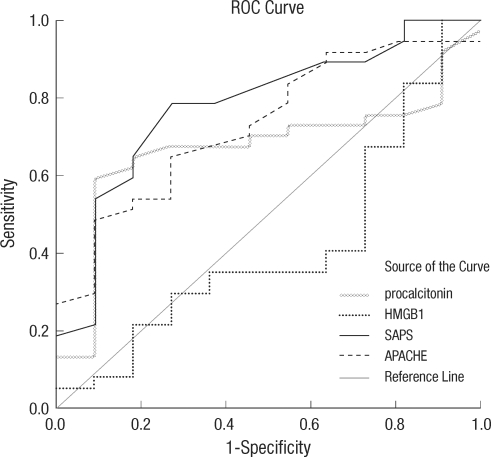
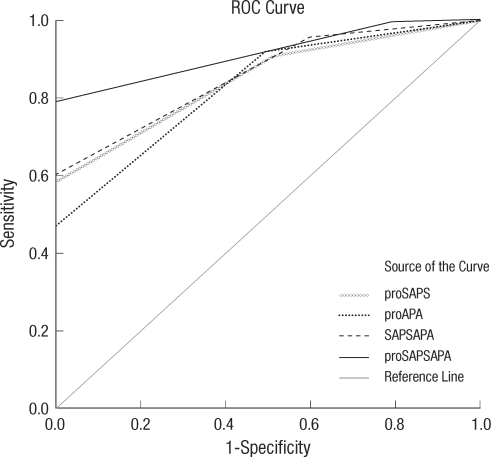
Early and accurate differentiation between infectious and non-infectious fever is vitally important in the intensive care unit (ICU). In the present study, patients admitted to the medical ICU were screened daily from August 2008 to February 2009. Within 24 hr after the development of fever (>38.3℃), serum was collected for the measurement of the procalcitonin (PCT) and high mobility group B 1 levels. Simplified Acute Physiology Score (SAPS) II and Acute Physiology And Chronic Health Evaluation (APACHE) III scores were also analyzed. Sixty-three patients developed fever among 448 consecutive patients (14.1%). Fever was caused by either infectious (84.1%) or non-infectious processes (15.9%). Patients with fever due to infectious causes showed higher values of serum PCT (7.8±10.2 vs 0.5±0.2 ng/mL, P=0.026), SAPS II (12.0±3.8 vs 7.6±2.7, P=0.006), and APACHE III (48±20 vs 28.7±13.3, P=0.039) than those with non-infectious fever. In receiver operating characteristic curve analysis, the area under the curve was 0.726 (95% CI; 0.587-0.865) for PCT, 0.759 (95% CI; 0.597-0.922) for SAPS II, and 0.715 (95% CI; 0.550-0.880) for APACHE III. Serum PCT, SAPS II, and APACHE III are useful in the differentiation between infectious and non-infectious fever in the ICU.
在重症监护病房(ICU)中,早期准确地区分感染性和非感染性发热至关重要。在本研究中,我们对 2008 年 8 月至 2009 年 2 月期间入住内科 ICU 的患者进行了每日筛查。在发热(>38.3℃)后 24 小时内,采集血清以测量降钙素原(PCT)和高迁移率族蛋白 B1 水平。还分析了简化急性生理学评分(SAPS)II 和急性生理学和慢性健康评估(APACHE)III 评分。在 448 例连续患者中,有 63 例发生发热(14.1%)。发热是由感染性(84.1%)或非感染性原因(15.9%)引起的。因感染性原因引起发热的患者血清 PCT 值(7.8±10.2 vs 0.5±0.2ng/mL,P=0.026)、SAPS II(12.0±3.8 vs 7.6±2.7,P=0.006)和 APACHE III(48±20 vs 28.7±13.3,P=0.039)均高于非感染性发热患者。在受试者工作特征曲线分析中,PCT 的曲线下面积为 0.726(95%CI;0.587-0.865),SAPS II 为 0.759(95%CI;0.597-0.922),APACHE III 为 0.715(95%CI;0.550-0.880)。血清 PCT、SAPS II 和 APACHE III 可用于 ICU 中感染性和非感染性发热的鉴别。