Department of Chemistry, University of Washington, Seattle, Washington 98195-1700, USA.
Anal Chem. 2010 Dec 1;82(23):9948-54. doi: 10.1021/ac102173m. Epub 2010 Nov 9.
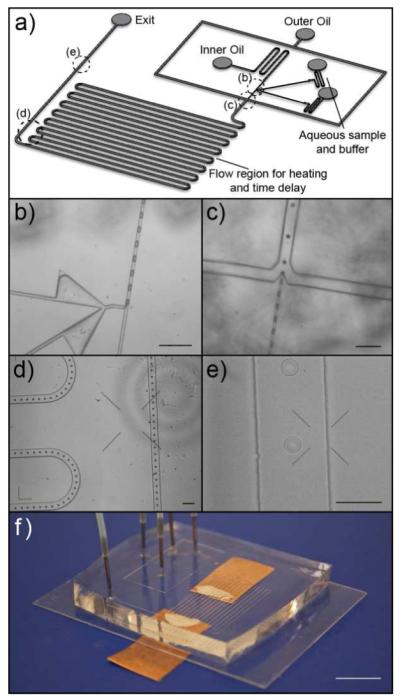
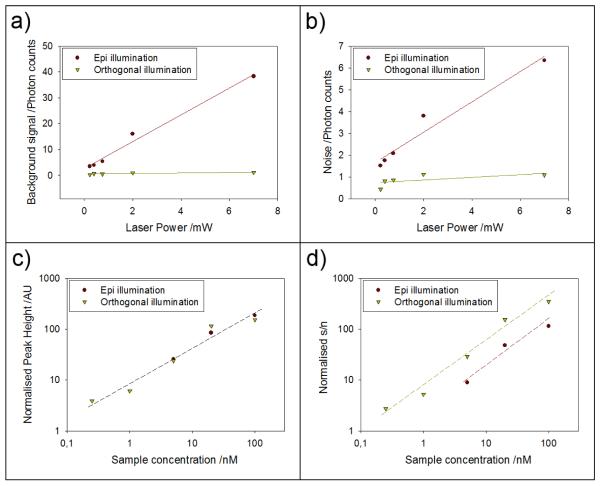
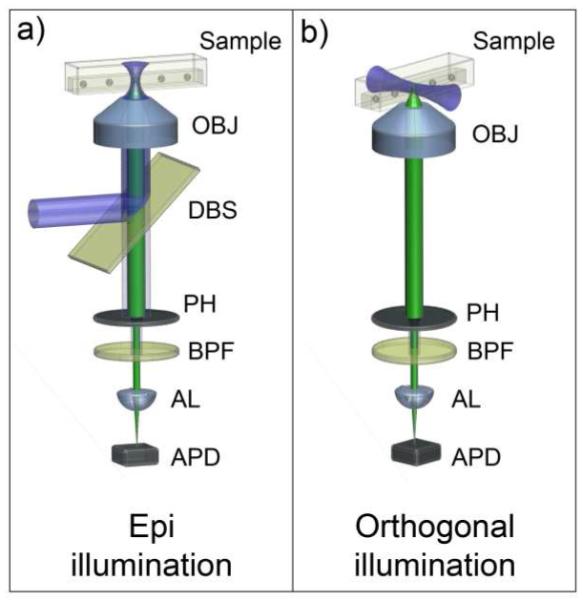
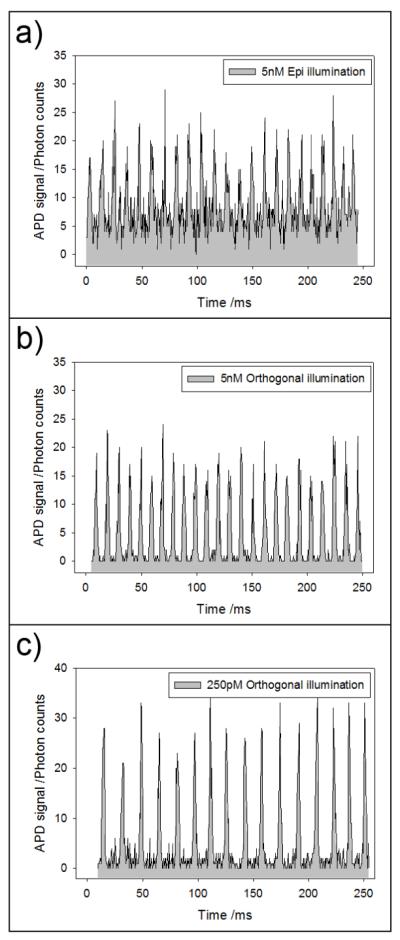
This paper describes a simple modification to traditional confocal fluorescence detection that greatly improves signal-to-noise (s/n) for the high-speed analysis of droplet streams. Rather than using the conventional epi geometry, illumination of the droplet was in the form of a line that is orthogonal to both the direction of flow and the light-collection objective. In contrast to the epi geometry where we observed high levels of scattering background from the droplets, we detected more than 10-fold less background (depending on the laser power used) when orthogonal-line-confocal illumination was used. We characterized this improvement using a standard microfluidic platform over a range of analyte concentrations and observed an improvement in limits of detection of greater than 10. Using this method, we were able to analyze picomolar concentrations of analytes contained within picoliter-volume droplets at a rate of greater than 350 droplets per second.
本文介绍了一种对传统共聚焦荧光检测的简单改进,该方法极大地提高了高速分析液滴流的信噪比(s/n)。与传统的 epi 几何结构不同,液滴的照明采用与流动方向和收集光的物镜都正交的线形式。与 epi 几何结构中观察到的来自液滴的高水平散射背景相比,当使用正交线共焦照明时,我们检测到的背景少了 10 倍以上(取决于所用的激光功率)。我们使用标准微流控平台在一系列分析物浓度下对这种改进进行了表征,并观察到检测限提高了 10 倍以上。使用这种方法,我们能够以每秒大于 350 个液滴的速度分析皮摩尔浓度的分析物包含在皮升体积的液滴中。