[1] Viertel Centre for Research in Cancer Control, Cancer Council Queensland, 553 Gregory Terrace, GPO Box 201 Spring Hill, Fortitude Valley QLD 4006, Australia.
Br J Cancer. 2010 Nov 23;103(11):1663-70. doi: 10.1038/sj.bjc.6605985. Epub 2010 Nov 9.
This study provides the latest available relative survival data for Australian childhood cancer patients.
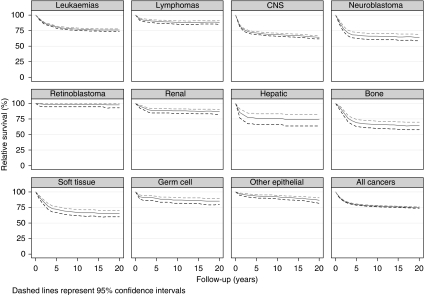
Data from the population-based Australian Paediatric Cancer Registry were used to describe relative survival outcomes using the period method for 11,903 children diagnosed with cancer between 1983 and 2006 and prevalent at any time between 1997 and 2006.
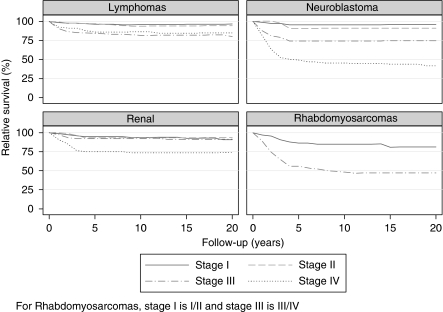
The overall relative survival was 90.4% after 1 year, 79.5% after 5 years and 74.7% after 20 years. Where information onstage at diagnosis was available (lymphomas, neuroblastoma, renal tumours and rhabdomyosarcomas), survival was significantly poorer for more-advanced stage. Survival was lower among infants compared with other children for those diagnosed with leukaemia, tumours of the central nervous system and renal tumours but higher for neuroblastoma. Recent improvements in overall childhood cancer survival over time are mainly because of improvements among leukaemia patients.
The high and improving survival prognosis for children diagnosed with cancer in Australia is consistent with various international estimates. However, a 5-year survival estimate of 79% still means that many children who are diagnosed with cancer will die within 5 years, whereas others have long-term health morbidities and complications associated with their treatments. It is hoped that continued developments in treatment protocols will result in further improvements in survival.
本研究提供了澳大利亚儿童癌症患者最新的相对存活率数据。
利用基于人群的澳大利亚儿科癌症登记处的数据,采用时期法,对 1983 年至 2006 年间确诊、1997 年至 2006 年期间任何时候均处于发病状态的 11903 例儿童的相对存活率结果进行描述。
1 年后总体相对存活率为 90.4%,5 年后为 79.5%,20 年后为 74.7%。在有诊断时的分期信息(淋巴瘤、神经母细胞瘤、肾肿瘤和横纹肌肉瘤)情况下,分期较晚的患者的存活率明显较差。与其他儿童相比,诊断为白血病、中枢神经系统肿瘤和肾肿瘤的婴儿存活率较低,而神经母细胞瘤的存活率较高。随着时间的推移,整体儿童癌症存活率的提高主要是因为白血病患者的存活率提高。
澳大利亚儿童癌症诊断后的高且不断提高的存活率与各种国际估计一致。然而,5 年生存率 79%仍意味着许多被诊断患有癌症的儿童将在 5 年内死亡,而其他人则存在长期的健康病态和与治疗相关的并发症。希望治疗方案的持续发展将进一步提高存活率。