Coillard Christine, Circo Alin B, Rivard Charles H
Sainte Justine Hospital, 3175, Chemin de la Côte-Sainte-Catherine Montréal, H3T 1C5 Quebec, Canada.
Scoliosis. 2010 Nov 10;5:25. doi: 10.1186/1748-7161-5-25.
Juvenile idiopathic scoliosis is a condition used to describe patients who are least 4 years of age but younger than 10 when the deformity is first identified. In these patients, the condition is usually progressive and those that are diagnosed at five years or younger have a high chance of progression to a large curve, with additional pulmonary and cardiac complications. The main form of conservative treatment for juvenile scoliosis is the use of a bracing system. This prospective interventional study was conducted to evaluate the effectiveness of the Dynamic SpineCor orthosis for juvenile idiopathic scoliosis as well as to evaluate the stability of the spine after the weaning point.
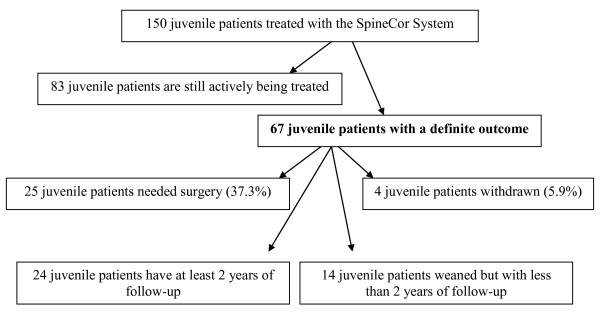
For this study, 150 juvenile patients were treated by the SpineCor orthosis between 1993 and 2009. Of these, 67 patients had a definite outcome and 83 are still actively being treated. To determine the effectiveness of the brace the OUTCOME criteria recommended by the SRS was used.
The results from our study showed that of the 67 patients with a definite outcome, 32.9% corrected their Cobb angle by at least 5° and 10.5% had a stabilization of their Cobb angle. Within the patients with a definite outcome, 37.3% of patients where recommended for surgery before authorized end of treatment. For this group of patients, surgery was postponed. Looking at the stability of the curves 2 years after the end of the treatment, we found 12.5% of the patients continued their correction without the brace being used and 71.4% remained stable.
From our study we can clearly see that the effectiveness of the SpineCor orthosis in obtaining and maintaining the neuromuscular integration of the corrective movement can be achieved effectively for juvenile patients. Over 75% of all patients that finished the treatment had remained stable with a few continuing to correct their Cobb angle after the use of the SpineCor orthosis was discontinued.
Our conclusion from this study is that the SpineCor orthosis is a very effective method of treatment of juvenile idiopathic scoliosis. The results obtained also indicate that treatment outcomes are better with early bracing. Most encouraging perhaps is the fact that the positive outcome appears to be maintained in the long term, and that surgery can be avoided or at least postponed.
青少年特发性脊柱侧弯是一种用于描述首次发现畸形时年龄至少4岁但小于10岁患者的病症。在这些患者中,病情通常会进展,那些在5岁或更小年龄被诊断出的患者有很大几率进展为大的脊柱侧弯,并伴有额外的肺部和心脏并发症。青少年脊柱侧弯保守治疗的主要形式是使用支具系统。本前瞻性干预性研究旨在评估动态SpineCor矫形器对青少年特发性脊柱侧弯的有效性,并评估达到撤支点后脊柱的稳定性。
在本研究中,150名青少年患者于1993年至2009年间接受了SpineCor矫形器治疗。其中,67名患者有明确的治疗结果,83名仍在接受积极治疗。为确定支具的有效性,采用了脊柱侧弯研究学会(SRS)推荐的疗效标准。
我们的研究结果显示,在67名有明确治疗结果的患者中,32.9%的患者Cobb角至少矫正了5°,10.5%的患者Cobb角保持稳定。在有明确治疗结果的患者中,37.3%的患者在授权的治疗结束前被建议进行手术。对于这组患者,手术被推迟。观察治疗结束后2年曲线的稳定性,我们发现12.5%的患者在未使用支具的情况下继续矫正,71.4%的患者保持稳定。
从我们的研究中可以清楚地看到,对于青少年患者,SpineCor矫形器在获得和维持矫正运动的神经肌肉整合方面的有效性可以有效实现。所有完成治疗的患者中,超过75%保持稳定,少数患者在停止使用SpineCor矫形器后继续矫正Cobb角。
我们从本研究中得出的结论是,SpineCor矫形器是治疗青少年特发性脊柱侧弯的一种非常有效的方法。所获得的结果还表明,早期使用支具治疗效果更好。最令人鼓舞的或许是,积极的治疗结果似乎能长期维持,并且可以避免手术或至少推迟手术。