Department of Paediatrics, Division of Oncology-Haematology, VU University Medical Center, Amsterdam, the Netherlands.
BMC Cancer. 2010 Nov 11;10:624. doi: 10.1186/1471-2407-10-624.
Childhood cancer and its treatment have considerable impact on a child's physical and mental wellbeing. Especially long-term administration of chemotherapy and/or radiotherapy impairs physical fitness both during and after therapy, when children often present with muscle weakness and/or low cardiorespiratory fitness. Physical exercise can improve these two elements of physical fitness, but the positive effects of physical exercise might be further increased when a child's wellbeing is simultaneously enhanced by psychosocial training. Feeling better may increase the willingness and motivation to engage in sports activities. Therefore, this multi-centre study evaluates the short and long-term changes in physical fitness of a child with a childhood malignancy, using a combined physical exercise and psychosocial intervention program, implemented during or shortly after treatment. Also examined is whether positive effects on physical fitness reduce inactivity-related adverse health problems, improve quality of life, and are cost-effective.
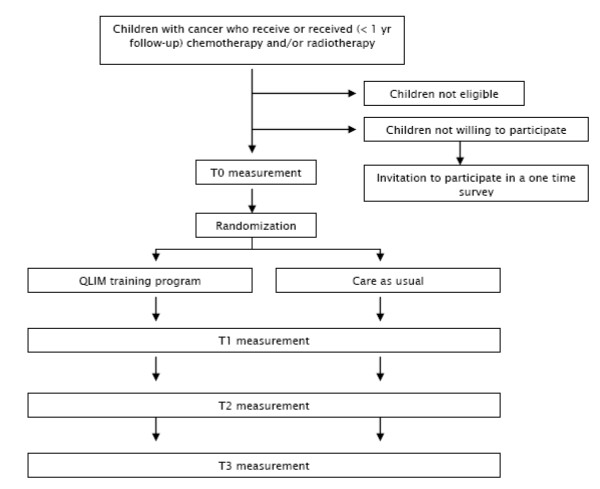
This multi-centre randomized controlled trial compares a combined physical and psychosocial intervention program for children with cancer, with care as usual (controls). Children with cancer (aged 8-18 years) treated with chemotherapy and/or radiotherapy, and who are no longer than 1 year post-treatment, are eligible for participation. A total of 100 children are being recruited from the paediatric oncology/haematology departments of three Dutch university medical centres. Patients are stratified according to pubertal stage (girls: age ≤10 or >10 years; boys: ≤11 or >11 years), type of malignancy (haematological or solid tumour), and moment of inclusion into the study (during or after treatment), and are randomly assigned to the intervention or control group.
Childhood cancer patients undergoing long-term cancer therapy may benefit from a combined physical exercise and psychosocial intervention program since it may maintain or enhance their physical fitness and increase their quality of life. However, the feasibility, patient need, and effectiveness of such a program should be established before the program can be implemented as part of standard care.
NTR1531 (The Netherlands National Trial Register).
儿童癌症及其治疗对儿童的身心健康有很大影响。特别是长期化疗和/或放疗会在治疗期间和治疗后损害身体健康,此时儿童常出现肌肉无力和/或心肺功能低下。体育锻炼可以改善这两个身体素质要素,但如果儿童的幸福感同时通过心理社会训练得到增强,体育锻炼的积极效果可能会进一步提高。感觉良好可能会增加参与体育活动的意愿和动力。因此,这项多中心研究评估了在治疗期间或治疗后不久实施的综合体育锻炼和心理社会干预计划对患有儿童恶性肿瘤的儿童的身体适应性的短期和长期变化。还研究了对身体适应性的积极影响是否减少与不活动相关的不良健康问题,提高生活质量,并具有成本效益。
这项多中心随机对照试验比较了癌症儿童的综合身体和心理社会干预计划与常规护理(对照组)。正在接受化疗和/或放疗且治疗后不超过 1 年的癌症儿童(年龄 8-18 岁)有资格参加。共有 100 名儿童从荷兰三家大学医学中心的儿科肿瘤/血液科招募。根据青春期阶段(女孩:年龄≤10 岁或>10 岁;男孩:≤11 岁或>11 岁)、恶性肿瘤类型(血液系统或实体瘤)和纳入研究的时间点(治疗期间或治疗后)对患者进行分层,并随机分配到干预组或对照组。
正在接受长期癌症治疗的儿童癌症患者可能受益于综合体育锻炼和心理社会干预计划,因为它可能维持或增强他们的身体适应性并提高他们的生活质量。然而,在该计划可以作为标准护理的一部分实施之前,应确定该计划的可行性、患者需求和有效性。
NTR1531(荷兰国家试验注册处)。