Department of Pediatric Oncology/Hematology, VU University Medical Center, Amsterdam, the Netherlands.
Amsterdam Center for Innovative Health Practice, Faculty of Health, Amsterdam University of Applied Sciences, Amsterdam, the Netherlands.
BMC Cancer. 2018 Dec 27;18(1):1289. doi: 10.1186/s12885-018-5181-0.
Physical fitness and psychosocial function is often reduced in children during or shortly after cancer treatment. This study evaluates the effect of a combined physical exercise and psychosocial intervention on cardiorespiratory fitness, muscle strength, body composition, psychosocial function and health-related quality of life (HrQoL). In addition, intervention mediators, applicability and adherence were examined.
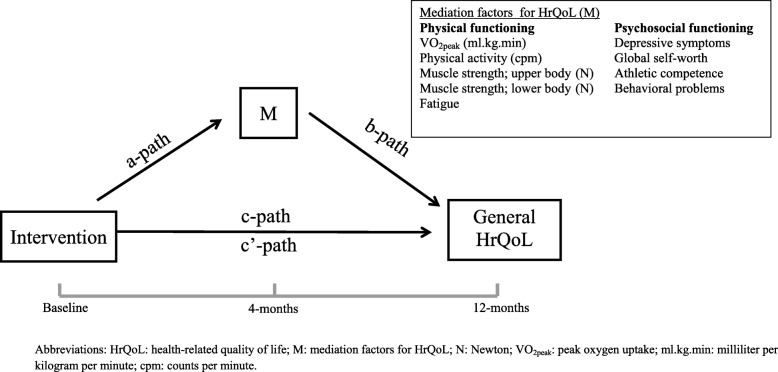
This multicenter randomized controlled trial included 68 children with cancer [mean age 13.2 (SD: 3.1) years; 54% male] during treatment or within 12-months post-treatment. The 12-week intervention consisted of 24 individual physical exercise sessions supervised by a physiotherapist, and 6 psychosocial training sessions for children and 2 for parents. Physical fitness and psychosocial function were assessed at baseline, directly post-intervention and at 12 months' post-baseline. Generalized estimating equations were used to simultaneously assess intervention effects at short and long-term. Additionally, we evaluated within-group differences over time. Potential physical and psychosocial mediators in the intervention effect on HrQoL were examined using the product-of-coefficient test. Applicability and adherence were assessed by trainer-report.
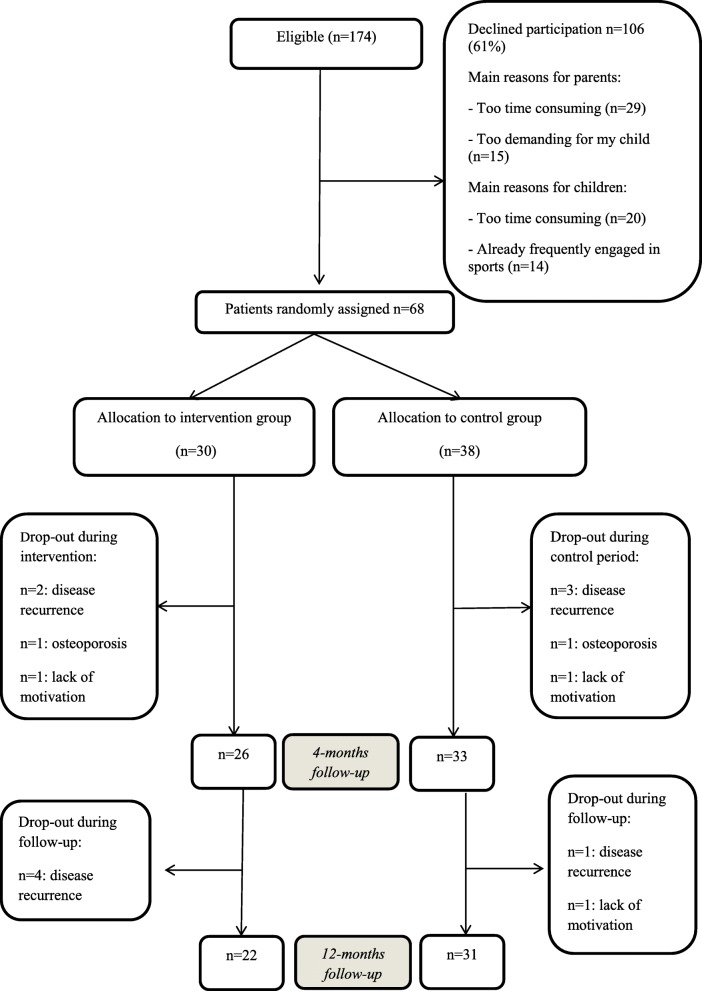
This study was able to compare 26 children who received the study intervention, with 33 children who received usual care. No significant differences in the effects of the intervention were found on physical fitness and psychosocial function at short-term. At 12-months follow-up, significantly larger improvements in lower body muscle strength (β = 56.5 Newton; 95% CI: 8.5; 104.5) were found in the intervention group when compared to the control group. Within-group changes showed significant improvements over time in HrQoL and bone density in both groups. Intervention effects on HrQoL were not significantly mediated by physical fitness and psychological function. Intervention applicability was satisfactory with an average session attendance of 67% and 22% dropout (mainly due to disease recurrence).
This 12-week physical exercise and psychosocial training intervention for children with cancer was applicable and showed satisfactory adherence. We found no significant between-group differences in effect, except for a significant improvement in lower body muscle strength at long-term in the intervention group compared to the control group. Yet, both the intervention and the control group showed improvements in bone mineral density and HrQoL over time.
The trial was registered at the Dutch Trial Registry ( NTR1531 ). Registered 12 November 2008.
在癌症治疗期间或治疗后不久,儿童的身体机能和心理社会功能往往会下降。本研究评估了综合体能锻炼和心理社会干预对心肺功能、肌肉力量、身体成分、心理社会功能和健康相关生活质量(HrQoL)的影响。此外,还检查了干预的中介因素、适用性和依从性。
这是一项多中心随机对照试验,纳入了 68 名癌症患儿[平均年龄 13.2(SD:3.1)岁;54%为男性],他们处于治疗中或治疗后 12 个月内。为期 12 周的干预包括 24 次个体体能锻炼课程,由物理治疗师监督,以及 6 次儿童心理社会培训课程和 2 次家长培训课程。在基线、干预后直接和基线后 12 个月评估身体机能和心理社会功能。使用广义估计方程同时评估短期和长期的干预效果。此外,我们还评估了随时间的组内差异。使用乘积系数检验评估干预对 HrQoL 的影响的潜在身体和心理社会中介因素。通过培训师报告评估适用性和依从性。
本研究能够比较接受研究干预的 26 名儿童和接受常规护理的 33 名儿童。在短期,干预对身体机能和心理社会功能的影响没有显著差异。在 12 个月的随访中,与对照组相比,干预组的下肢肌肉力量显著提高(β=56.5 牛顿;95%CI:8.5;104.5)。两组的生活质量和骨密度随时间均有显著改善。干预对生活质量的影响并没有通过身体机能和心理功能显著介导。干预的适用性令人满意,平均出席率为 67%,22%的儿童(主要由于疾病复发)中途退出。
这项针对癌症患儿的 12 周体能锻炼和心理社会训练干预是适用的,且依从性良好。除了干预组在长期与对照组相比下肢肌肉力量有显著改善外,我们没有发现组间差异有统计学意义。然而,干预组和对照组的骨矿物质密度和生活质量都随时间改善。
该试验在荷兰试验注册处(NTR1531)注册。2008 年 11 月 12 日注册。