Institute for Clinical Research and Health Policy Studies, Tufts Medical Center, Boston, Massachusetts, United States of America.
PLoS One. 2010 Nov 1;5(11):e13782. doi: 10.1371/journal.pone.0013782.
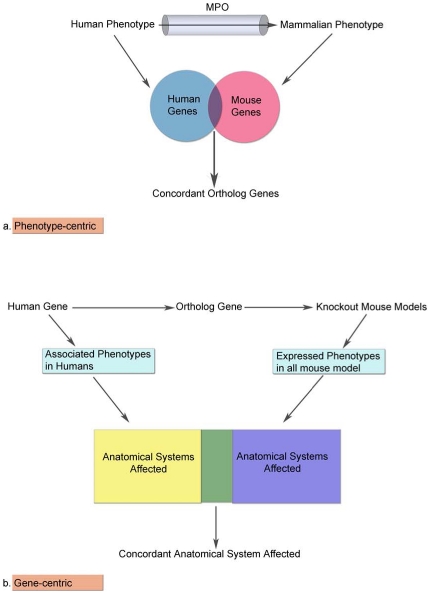
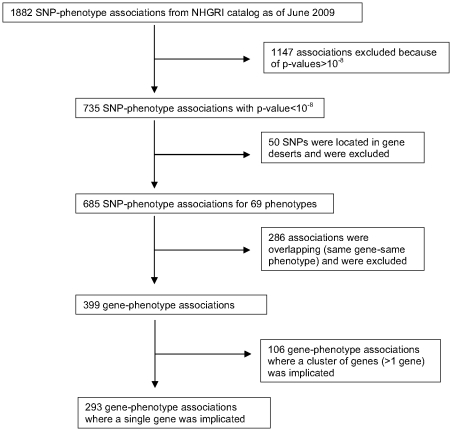
The agnostic screening performed by genome-wide association studies (GWAS) has uncovered associations for previously unsuspected genes. Knowledge about the functional role of these genes is crucial and laboratory mouse models can provide such information. Here, we describe a systematic juxtaposition of human GWAS-discovered loci versus mouse models in order to appreciate the availability of mouse models data, to gain biological insights for the role of these genes and to explore the extent of concordance between these two lines of evidence. We perused publicly available data (NHGRI database for human associations and Mouse Genome Informatics database for mouse models) and employed two alternative approaches for cross-species comparisons, phenotype- and gene-centric. A total of 293 single gene-phenotype human associations (262 unique genes and 69 unique phenotypes) were evaluated. In the phenotype-centric approach, we identified all mouse models and related ortholog genes for the 51 human phenotypes with a comparable phenotype in mice. A total of 27 ortholog genes were found to be associated with the same phenotype in humans and mice, a concordance that was significantly larger than expected by chance (p<0.001). In the gene-centric approach, we were able to locate at least 1 knockout model for 60% of the 262 genes. The knockouts for 35% of these orthologs displayed pre- or post-natal lethality. For the remaining non-lethal orthologs, the same organ system was involved in mice and humans in 71% of the cases (p<0.001). Our project highlights the wealth of available information from mouse models for human GWAS, catalogues extensive information on plausible physiologic implications for many genes, provides hypothesis-generating findings for additional GWAS analyses and documents that the concordance between human and mouse genetic association is larger than expected by chance and can be informative.
全基因组关联研究(GWAS)进行的不可知论筛查揭示了以前未被怀疑的基因的关联。这些基因的功能作用的知识是至关重要的,而实验室小鼠模型可以提供这样的信息。在这里,我们描述了一个系统的人类 GWAS 发现的基因座与小鼠模型的并列,以便了解小鼠模型数据的可用性,为这些基因的作用获得生物学见解,并探索这两种证据之间的一致性程度。我们查阅了公开可用的数据(人类关联的 NHGRI 数据库和小鼠基因组信息学数据库的小鼠模型),并采用了两种替代的跨物种比较方法,即表型和基因中心方法。总共评估了 293 个单基因表型人类关联(262 个独特基因和 69 个独特表型)。在表型中心方法中,我们确定了人类 51 个表型中与小鼠具有可比表型的所有小鼠模型和相关同源基因。总共发现 27 个同源基因与人类和小鼠的相同表型相关联,这种一致性明显大于偶然(p<0.001)。在基因中心方法中,我们能够为 262 个基因中的 60%找到至少一个敲除模型。这些同源基因中有 35%的敲除体在出生前或出生后具有致死性。对于其余非致死性同源基因,在 71%的情况下,小鼠和人类涉及相同的器官系统(p<0.001)。我们的项目突出了小鼠模型为人类 GWAS 提供的丰富信息,为许多基因的合理生理影响编目了广泛的信息,为额外的 GWAS 分析提供了产生假说的发现,并证明了人类和小鼠遗传关联之间的一致性大于偶然,并且具有信息性。