Institute for Evolution and Biodiversity, University of Muenster, Hüfferstraße 1, 48149 Münster, Germany.
BMC Evol Biol. 2010 Nov 12;10:352. doi: 10.1186/1471-2148-10-352.
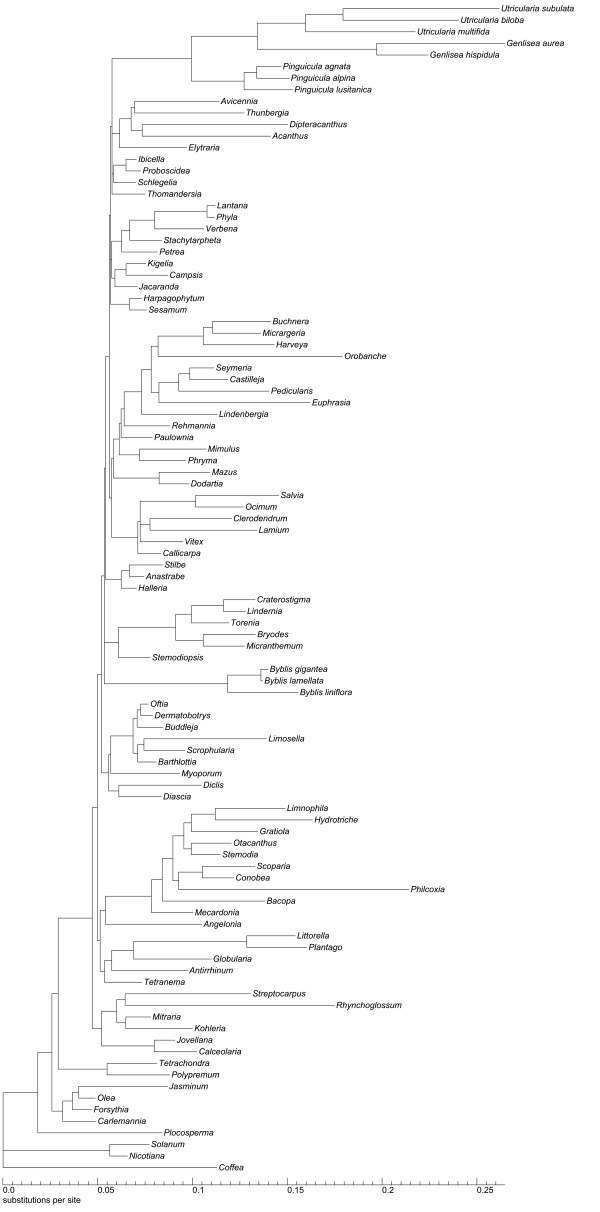
In the large angiosperm order Lamiales, a diverse array of highly specialized life strategies such as carnivory, parasitism, epiphytism, and desiccation tolerance occur, and some lineages possess drastically accelerated DNA substitutional rates or miniaturized genomes. However, understanding the evolution of these phenomena in the order, and clarifying borders of and relationships among lamialean families, has been hindered by largely unresolved trees in the past.
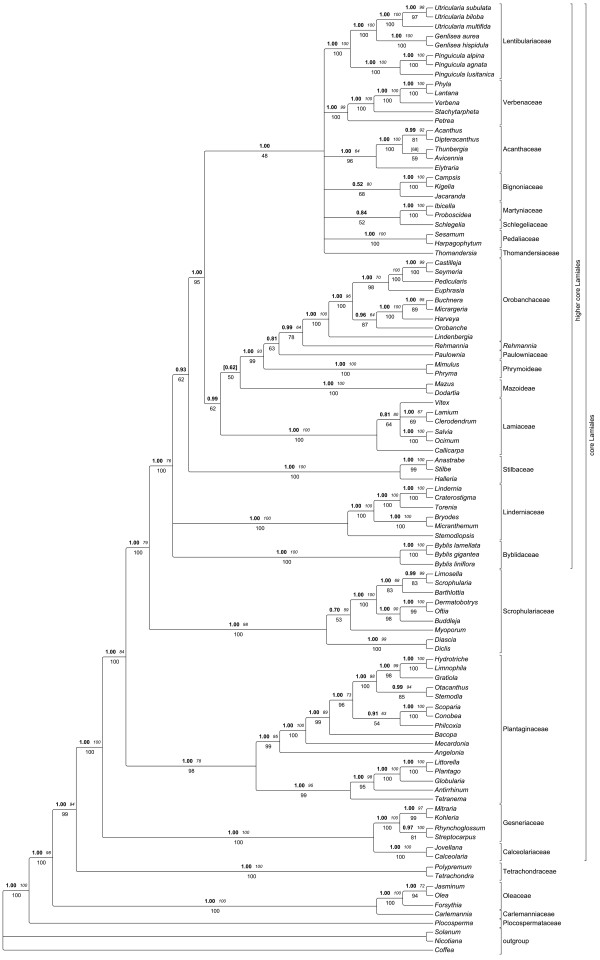
Our analysis of the rapidly evolving trnK/matK, trnL-F and rps16 chloroplast regions enabled us to infer more precise phylogenetic hypotheses for the Lamiales. Relationships among the nine first-branching families in the Lamiales tree are now resolved with very strong support. Subsequent to Plocospermataceae, a clade consisting of Carlemanniaceae plus Oleaceae branches, followed by Tetrachondraceae and a newly inferred clade composed of Gesneriaceae plus Calceolariaceae, which is also supported by morphological characters. Plantaginaceae (incl. Gratioleae) and Scrophulariaceae are well separated in the backbone grade; Lamiaceae and Verbenaceae appear in distant clades, while the recently described Linderniaceae are confirmed to be monophyletic and in an isolated position.
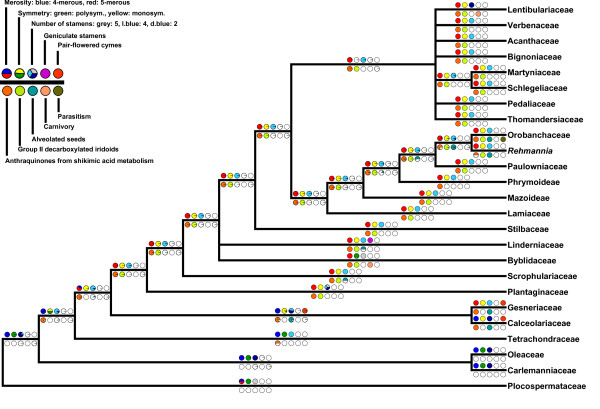
Confidence about deep nodes of the Lamiales tree is an important step towards understanding the evolutionary diversification of a major clade of flowering plants. The degree of resolution obtained here now provides a first opportunity to discuss the evolution of morphological and biochemical traits in Lamiales. The multiple independent evolution of the carnivorous syndrome, once in Lentibulariaceae and a second time in Byblidaceae, is strongly supported by all analyses and topological tests. The evolution of selected morphological characters such as flower symmetry is discussed. The addition of further sequence data from introns and spacers holds promise to eventually obtain a fully resolved plastid tree of Lamiales.
在大型被子植物菊目(Lamiales)中,存在着多种多样的高度特化的生活策略,如肉食性、寄生性、附生性和耐旱性,并且一些谱系具有急剧加速的 DNA 替代率或微型化的基因组。然而,过去由于树状图尚未完全解决,该目中这些现象的进化以及Lamialean 科之间的边界和关系的厘清一直受到阻碍。
我们对快速进化的 trnK/matK、trnL-F 和 rps16 叶绿体区域的分析,使我们能够为 Lamiales 推断出更精确的系统发育假说。Lamiales 树中九个首次分支的科之间的关系现在得到了非常有力的支持。在 Plocospermataceae 之后,一个由 Carlemanniaceae 加 Oleaceae 分支组成的分支,其次是 Tetrachondraceae 和一个新推断的由 Gesneriaceae 加 Calceolariaceae 组成的分支,这也得到了形态特征的支持。车前科(包括 Gratioleae)和玄参科在骨干等级中被很好地分开;唇形科和马鞭草科出现在遥远的分支中,而最近描述的林德恩科被确认为单系且处于孤立的位置。
对 Lamiales 树的深节点的置信度是理解主要开花植物类群的进化多样化的重要步骤。这里获得的分辨率程度现在为讨论 Lamiales 中形态和生化特征的进化提供了第一个机会。肉食性综合征的多次独立进化,一次在狸藻科,另一次在睡菜科,得到了所有分析和拓扑检验的强烈支持。讨论了花对称性等选定形态特征的进化。从内含子和间隔区添加更多的序列数据有望最终获得 Lamiales 的完全解析的质体树。