Reyes-Castro L A, Rodriguez J S, Rodríguez-González G L, Wimmer R D, McDonald T J, Larrea F, Nathanielsz P W, Zambrano E
Department of Reproductive Biology, Instituto Nacional de Ciencias Médicas y Nutrición Salvador Zubirán, Mexico City, 14000, Mexico.
Int J Dev Neurosci. 2011 Apr;29(2):177-82. doi: 10.1016/j.ijdevneu.2010.11.002. Epub 2010 Nov 13.
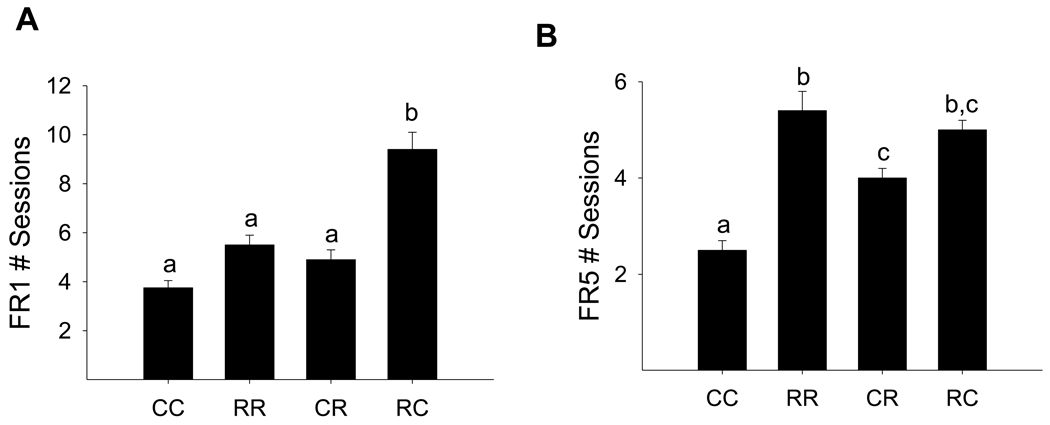
Suboptimal developmental environments program offspring to lifelong health complications including affective and cognitive disorders. Little is known about the effects of suboptimal intra-uterine environments on associative learning and motivational behavior. We hypothesized that maternal isocaloric low protein diet during pregnancy and lactation would impair offspring associative learning and motivation as measured by operant conditioning and the progressive ratio task, respectively. Control mothers were fed 20% casein (C) and restricted mothers (R) 10% casein to provide four groups: CC, RR, CR, and RC (first letter pregnancy diet and second letter lactation diet), to evaluate effects of maternal diet on male offspring behavior. Impaired learning was observed during fixed ratio-1 operant conditioning in RC offspring that required more sessions to learn vs. the CC offspring (9.4±0.8 and 3.8±0.3 sessions, respectively, p<0.05). Performance in fixed ratio-5 conditioning showed the RR (5.4±1.1), CR (4.0±0.8), and RC (5.0±0.8) offspring required more sessions to reach performance criterion than CC offspring (2.5±0.5, p<0.05). Furthermore, motivational effects during the progressive ratio test revealed less responding in the RR (48.1±17), CR (74.7±8.4), and RC (65.9±11.2) for positive reinforcement vs. the CC offspring (131.5±7.5, p<0.05). These findings demonstrate negative developmental programming effects due to perinatal isocaloric low protein diet on learning and motivation behavior with the nutritional challenge in the prenatal period showing more vulnerability in offspring behavior.
发育环境欠佳会使后代易于出现包括情感和认知障碍在内的终身健康问题。关于欠佳的子宫内环境对联想学习和动机行为的影响,目前所知甚少。我们假设,在怀孕和哺乳期间,母体摄入等热量低蛋白饮食会分别通过操作性条件反射和渐进比率任务损害后代的联想学习和动机。给对照母鼠喂食20%的酪蛋白(C),给受限母鼠(R)喂食10%的酪蛋白,从而形成四组:CC、RR、CR和RC(第一个字母代表孕期饮食,第二个字母代表哺乳期饮食),以评估母体饮食对雄性后代行为的影响。在固定比率为1的操作性条件反射过程中,观察到RC组后代的学习能力受损,与CC组后代相比,它们需要更多的训练次数才能学会(分别为9.4±0.8次和3.8±0.3次,p<0.05)。在固定比率为5的条件反射中的表现显示,RR组(5.4±1.1)、CR组(4.0±0.8)和RC组(5.0±0.8)后代达到表现标准所需的训练次数比CC组后代(2.5±0.5)更多(p<0.05)。此外,在渐进比率测试中的动机效应显示,与CC组后代(131.5±7.5)相比,RR组(48.1±17)、CR组(74.7±8.4)和RC组(65.9±11.2)对正强化的反应较少(p<0.05)。这些发现表明,围产期等热量低蛋白饮食会对学习和动机行为产生负面的发育编程效应,产前阶段的营养挑战使后代行为更易受到影响。