Program in Public Health, College of Health Sciences, University of California, Irvine, CA 92697, USA.
Malar J. 2010 Nov 16;9:329. doi: 10.1186/1475-2875-9-329.
Plasmodium knowlesi, a malaria species that normally infects long-tailed macaques, was recently found to be prevalent in humans in Southeast Asia. While human host competency has been demonstrated experimentally, the extent to which the parasite can be transmitted from human back to mosquito vector in nature is unclear.
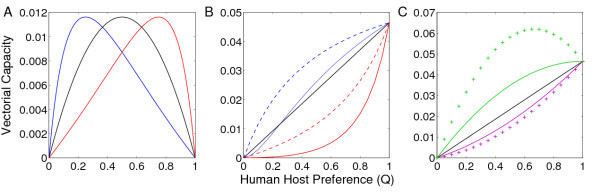
Using a mathematical model, the influence of human host competency on disease transmission is assessed. Adapting a standard model for vector-borne disease transmission and using an evolutionary invasion analysis, the paper explores how differential host competency between humans and macaques can facilitate the epidemiological processes of P. knowlesi infection between different hosts.
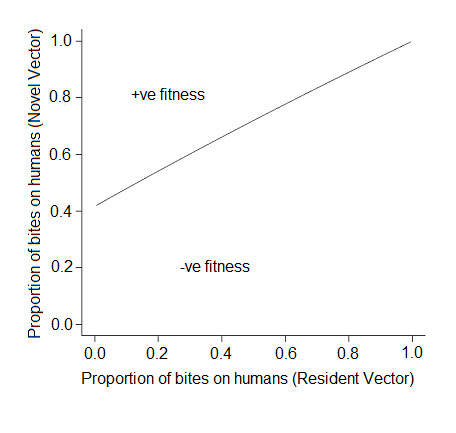
Following current understanding of the evolutionary route of other human malaria vectors and parasites, an increasing human population in knowlesi malaria endemic regions will select for a more anthropophilic vector as well as a parasite that preferentially transmits between humans. Applying these adaptations, evolutionary invasion analysis yields threshold conditions under which this macaque disease may become a significant public health issue.
These threshold conditions are discussed in the context of malaria vector-parasite co-evolution as a function of anthropogenic effects.
疟原虫 knowlesi,一种通常感染长尾猕猴的疟疾物种,最近在东南亚被发现广泛存在于人类中。虽然已经在实验中证明了人类宿主的易感性,但寄生虫在自然界中从人类传播回蚊子媒介的程度尚不清楚。
使用数学模型评估人类宿主易感性对疾病传播的影响。通过适应用于媒介传播疾病的标准模型并使用进化入侵分析,本文探讨了人类和猕猴之间宿主易感性的差异如何促进不同宿主之间疟原虫 knowlesi 感染的流行病学过程。
根据其他人类疟疾媒介和寄生虫的进化途径的现有理解,疟原虫 knowlesi 流行地区的人口增长将选择更具嗜人特性的媒介以及更倾向于在人类之间传播的寄生虫。应用这些适应性,进化入侵分析得出了这些条件下,这种猕猴疾病可能成为重大公共卫生问题的阈值条件。
本文在疟疾媒介-寄生虫共同进化的背景下,讨论了作为人为影响的函数的这些阈值条件。