Aix-Marseille Université, CNRS, IRD, UMR 6116-IMEP, Equipe Evolution, Génome et Environnement, Marseille, France.
Bioinformatics. 2011 Jan 15;27(2):277-8. doi: 10.1093/bioinformatics/btq641. Epub 2010 Nov 16.
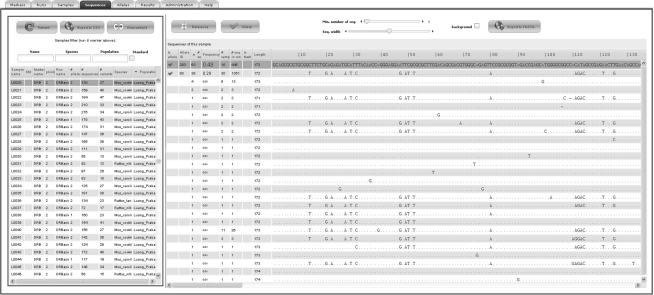
Characterizing genetic diversity through genotyping short amplicons is central to evolutionary biology. Next-generation sequencing (NGS) technologies changed the scale at which these type of data are acquired. SESAME is a web application package that assists genotyping of multiplexed individuals for several markers based on NGS amplicon sequencing. It automatically assigns reads to loci and individuals, corrects reads if standard samples are available and provides an intuitive graphical user interface (GUI) for allele validation based on the sequences and associated decision-making tools. The aim of SESAME is to help allele identification among a large number of sequences.
SESAME and its documentation are freely available under the Creative Commons Attribution-NonCommercial-ShareAlike 3.0 Unported Licence for Windows and Linux from http://www1.montpellier.inra.fr/CBGP/NGS/ or http://tinyurl.com/ngs-sesame.
通过基因分型短扩增子来描述遗传多样性是进化生物学的核心。下一代测序(NGS)技术改变了获取此类数据的规模。SESAME 是一个网络应用程序包,用于根据 NGS 扩增子测序对多个标记的多位个体进行基因分型。它可以自动将读取分配给基因座和个体,如果有标准样本,则可以对读取进行校正,并提供基于序列的直观图形用户界面(GUI),用于基于决策工具进行等位基因验证。SESAME 的目的是帮助在大量序列中识别等位基因。
SESAME 及其文档可根据 Windows 和 Linux 下的知识共享署名-非商业性使用-相同方式共享 3.0 未本地化版本的许可,从 http://www1.montpellier.inra.fr/CBGP/NGS/ 或 http://tinyurl.com/ngs-sesame 免费获得。