Department of Physiology and Developmental Biology, Brigham Young University, Provo, Utah 84602, USA.
Environ Health Perspect. 2011 Mar;119(3):332-6. doi: 10.1289/ehp.1002520. Epub 2010 Nov 18.
Receptors for advanced glycation end-products (RAGE) are cell-surface receptors expressed by alveolar type I (ATI) epithelial cells and are implicated in mechanisms of alveolar development and sustained pulmonary inflammation.
In the present study, we tested the hypothesis that diesel particulate matter (DPM) up-regulates RAGE in rat ATI-like R3/1 cells and human primary small airway epithelial cells (SAECs), leading to an inflammatory response.
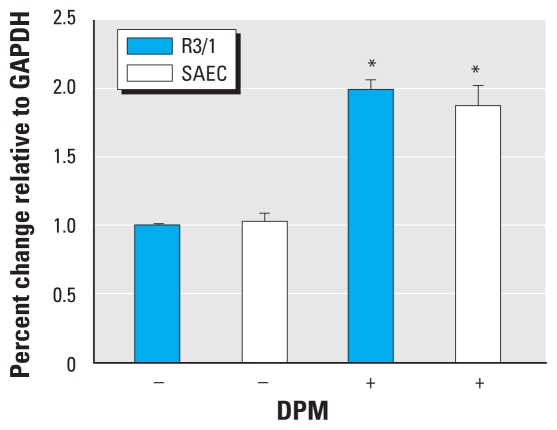
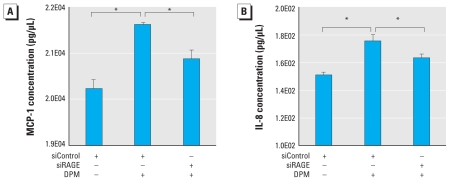
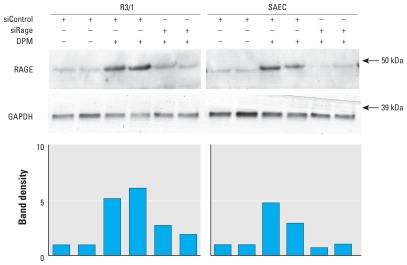
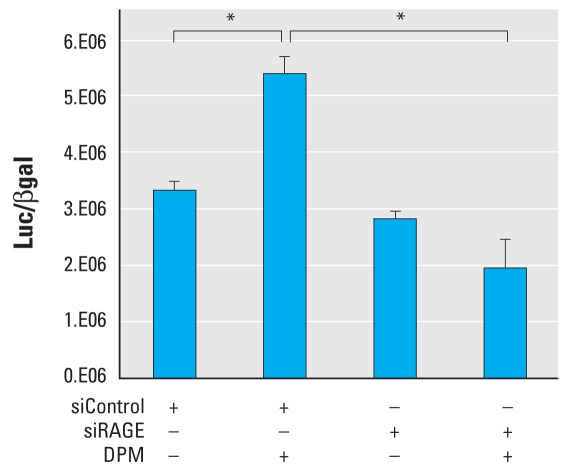
Using real-time reverse transcriptase polymerase chain reaction and immunoblotting, we found that RAGE mRNA and protein are up-regulated in cells exposed to DPM for 2 hr. Use of a luciferase reporter containing nuclear factor-κB (NF-κB) response elements revealed decreased NF-κB activation in cells transfected with small interfering RNA (siRNA) for RAGE (siRAGE) before DPM exposure compared with cells transfected with scrambled control siRNA (siControl). In addition, immunostaining revealed diminished nuclear translocation of NF-κB in DPM-exposed cells transfected with siRAGE compared with cells transfected with siControl before DPM stimulation. Enzyme-linked immunosorbent assay demonstrated that in R3/1 cells DPM induced secretion of monocyte chemoattractant protein-1 (MCP-1) and interleukin-8 (IL-8), two cytokines induced by NF-κB and associated with leukocyte chemotaxis during an inflammatory response. Incorporating siRAGE was sufficient to significantly decrease DPM-induced MCP-1 and IL-8 secretion compared with cells transfected with siControl.
These data offer novel insights into potential mechanisms whereby RAGE influences pulmonary inflammation exacerbated by DPM exposure. Further research may demonstrate that molecules involved in RAGE signaling are potential targets in lessening the degree of particulate matter-induced exacerbations of inflammatory lung disease.
晚期糖基化终产物受体(RAGE)是肺泡 I 型(ATI)上皮细胞表达的细胞表面受体,与肺泡发育和持续的肺部炎症机制有关。
本研究旨在验证以下假设,即柴油机颗粒物(DPM)可上调大鼠 ATI 样 R3/1 细胞和人原代小气道上皮细胞(SAEC)中的 RAGE,从而引发炎症反应。
通过实时逆转录聚合酶链反应和免疫印迹,我们发现 DPM 暴露 2 小时后细胞中 RAGE mRNA 和蛋白表达上调。使用含有核因子-κB(NF-κB)反应元件的荧光素酶报告基因显示,与转染 scrambled 对照 siRNA(siControl)的细胞相比,转染 RAGE 小干扰 RNA(siRAGE)的细胞在 DPM 暴露前 NF-κB 激活减少。此外,免疫染色显示,与 DPM 刺激前转染 siControl 的细胞相比,DPM 暴露的转染 siRAGE 的细胞中 NF-κB 的核易位减少。酶联免疫吸附试验表明,在 R3/1 细胞中,DPM 诱导单核细胞趋化蛋白-1(MCP-1)和白细胞介素-8(IL-8)的分泌,这两种细胞因子由 NF-κB 诱导,与炎症反应期间白细胞趋化有关。与转染 siControl 的细胞相比,转染 siRAGE 足以显著降低 DPM 诱导的 MCP-1 和 IL-8 分泌。
这些数据为 RAGE 影响 DPM 暴露加重的肺部炎症的潜在机制提供了新的见解。进一步的研究可能表明,RAGE 信号通路中的分子可能是减轻颗粒物引起的炎症性肺病恶化的潜在靶点。