Aldovini A, Young R A
Whitehead Institute for Biomedical Research, Nine Cambridge Center, Massachusetts 02142.
J Virol. 1990 May;64(5):1920-6. doi: 10.1128/JVI.64.5.1920-1926.1990.
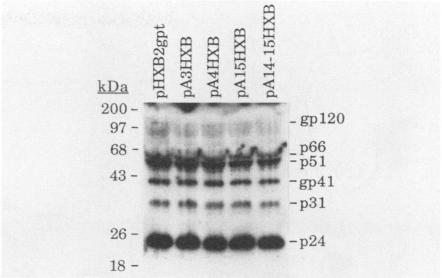
To identify RNA and protein sequences involved in packaging of human immunodeficiency virus type 1 (HIV-1), various mutations were introduced into the viral genome. Portions of the human immunodeficiency virus type 1 genome between the first splice donor site and the gag initiation codon were deleted to investigate the RNA packaging site (psi). Point mutations that alter cysteine residues in one or both zinc finger motifs of p7, a cleavage product of the gag precursor, were created to study the role of the gag zinc fingers in packaging. The psi site mutants and the gag mutants exhibited similar phenotypes. Cells transfected with the mutant genomes, while expressing normal levels of human immunodeficiency virus type 1 RNA and proteins, produced viral particles that were normal in protein content but lacked detectable viral RNA. These mutant virions were unable to productively infect cells. The combination of human immunodeficiency virus type 1 packaging mutations should minimize fortuitous assembly of infectious virus and may provide a means to produce noninfectious particles for candidate vaccines.
为了鉴定参与1型人类免疫缺陷病毒(HIV-1)包装的RNA和蛋白质序列,研究人员在病毒基因组中引入了各种突变。删除了1型人类免疫缺陷病毒基因组中第一个剪接供体位点和gag起始密码子之间的部分序列,以研究RNA包装位点(ψ)。对gag前体的裂解产物p7的一个或两个锌指基序中的半胱氨酸残基进行点突变,以研究gag锌指在包装中的作用。ψ位点突变体和gag突变体表现出相似的表型。用突变基因组转染的细胞,在表达正常水平的1型人类免疫缺陷病毒RNA和蛋白质时,产生的病毒颗粒蛋白质含量正常,但缺乏可检测到的病毒RNA。这些突变病毒粒子无法有效感染细胞。1型人类免疫缺陷病毒包装突变的组合应能最大限度地减少传染性病毒的偶然组装,并可能提供一种生产用于候选疫苗的非传染性颗粒的方法。