Sackler Institute for Developmental Psychobiology, Weill Cornell Medical College, New York, NY 10065, USA.
J Am Acad Child Adolesc Psychiatry. 2010 Dec;49(12):1189-201; quiz 1285. doi: 10.1016/j.jaac.2010.08.017. Epub 2010 Oct 8.
Adolescence is a developmental period that entails substantial changes in risk-taking behavior and experimentation with alcohol and drugs. Understanding how the brain is changing during this period relative to childhood and adulthood and how these changes vary across individuals are key in predicting risk for later substance abuse and dependence.
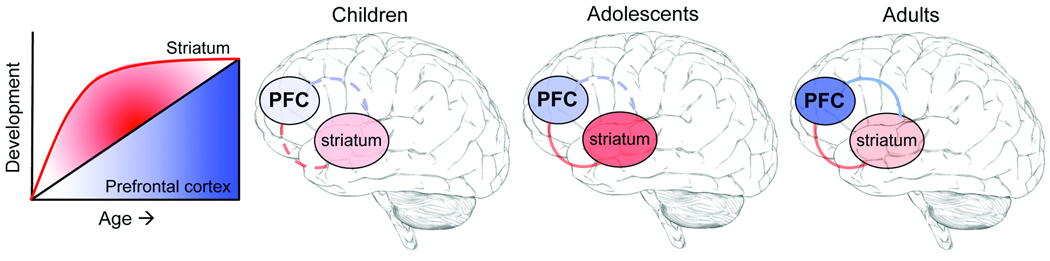
This review discusses recent human imaging and animal work in the context of an emerging view of adolescence as characterized by a tension between early emerging "bottom-up" systems that express exaggerated reactivity to motivational stimuli and later maturing "top-down" cognitive control regions. Behavioral, clinical, and neurobiological evidences are reported for dissociating these two systems developmentally. The literature on the effects of alcohol and its rewarding properties in the brain is discussed in the context of these two systems.
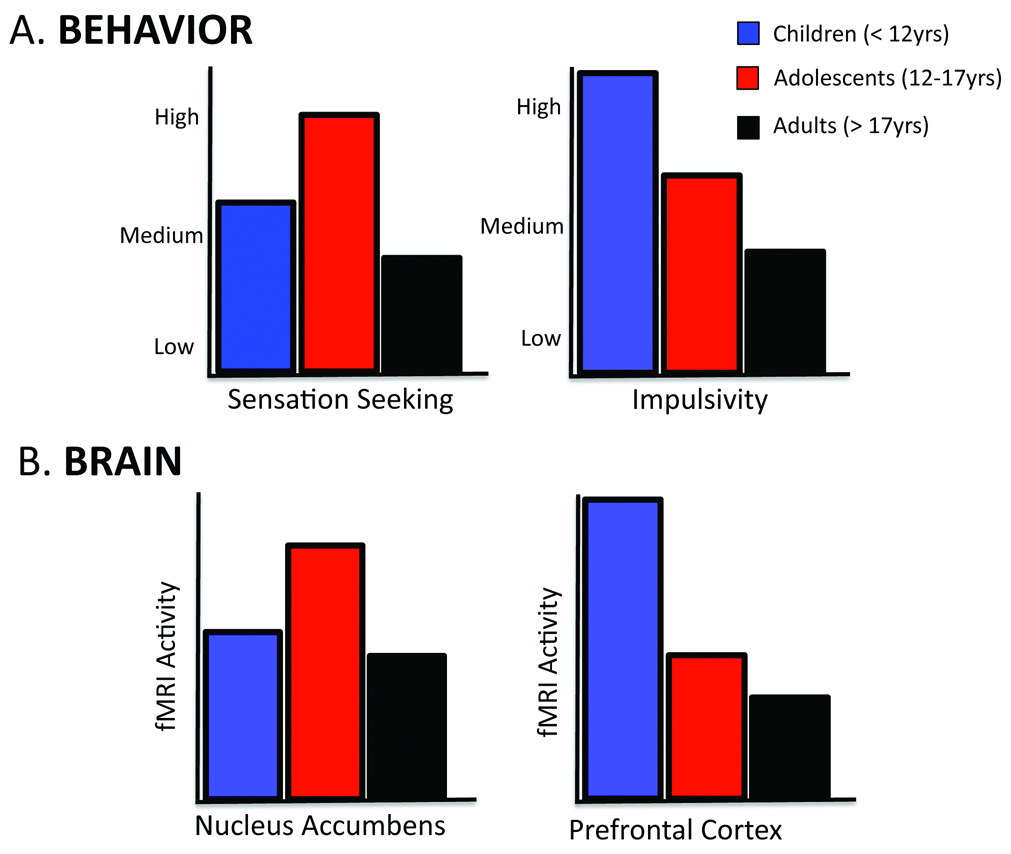
Collectively, these studies show curvilinear development of motivational behavior and the underlying subcortical brain regions, with a peak inflection from 13 to 17 years. In contrast, prefrontal regions, important in top-down regulation of behavior, show a linear pattern of development well into young adulthood that parallels that seen in behavioral studies of impulsivity.
The tension or imbalance between these developing systems during adolescence may lead to cognitive control processes being more vulnerable to incentive-based modulation and increased susceptibility to the motivational properties of alcohol and drugs. As such, behavior challenges that require cognitive control in the face of appetitive cues may serve as useful biobehavioral markers for predicting which teens may be at greater risk for alcohol and substance dependence.
青春期是一个风险行为和酒精及药物试验发生重大变化的发展阶段。了解与儿童期和成年期相比,大脑在此期间如何变化,以及这些变化如何在个体之间变化,是预测后期物质滥用和依赖风险的关键。
本综述讨论了最近的人类影像学和动物研究,这些研究与青春期的一种新观点有关,即表现为早期出现的“自下而上”系统与后来成熟的“自上而下”认知控制区域之间的紧张关系。报告了行为、临床和神经生物学证据,以在发展上区分这两个系统。本文还讨论了酒精及其在大脑中的奖赏特性对这两个系统的影响。
这些研究表明,动机行为和潜在的皮质下脑区呈曲线发展,从 13 岁到 17 岁出现峰值拐点。相比之下,在行为冲动性研究中,前额叶区域在行为的自上而下调节中起着重要作用,其线性发展一直持续到成年早期。
青春期期间这些发育中的系统之间的紧张或不平衡可能导致认知控制过程更容易受到基于激励的调节,并且对酒精和药物的动机特性的敏感性增加。因此,在面对诱人线索时需要认知控制的行为挑战可能是预测哪些青少年更有可能出现酒精和物质依赖风险的有用生物行为标志物。