Department of Kinesiology and Community Health, University of Illinois at Urbana-Champaign, 61801, USA.
Arch Phys Med Rehabil. 2010 Dec;91(12):1942-7. doi: 10.1016/j.apmr.2010.08.011.
To validate accelerometry based on its correlations with 6-minute walk distance (6MWD) and oxygen cost of walking as objective markers of walking limitations in multiple sclerosis (MS).
Cross-sectional.
Laboratory and general community.
Ambulatory participants with MS (N=26) who resided in the local community.
Not applicable.
Patient Determined Disease Steps (PDDS) scale and Multiple Sclerosis Walking Scale-12 (MSWS-12); 6-minute walk test while wearing a portable metabolic unit for measuring the 6MWD and oxygen cost of walking; accelerometer during the waking hours of a 7-day period.
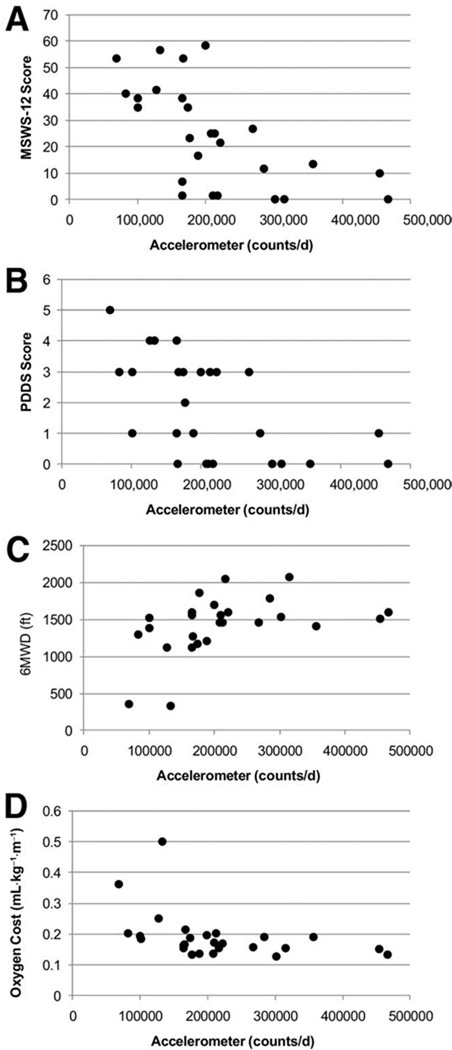
The average of total daily movement counts from the accelerometer correlated significantly and strongly with MSWS-12 scores (ρ=-.681, P=.001), PDDS scores (ρ=-.609, P=.001), 6MWD (ρ=.519, P=.003), and oxygen cost of walking (ρ=-.541, P=.002).
We provide evidence that further supports the validity of accelerometry as a measure of walking limitations in ambulatory persons with MS.
基于与 6 分钟步行距离(6MWD)和步行氧耗的相关性,验证加速度计作为多发性硬化症(MS)患者步行受限的客观标志物的有效性。
横断面研究。
实验室和一般社区。
居住在当地社区的、有步行能力的多发性硬化症患者(N=26)。
无。
患者确定疾病步数(PDDS)量表和多发性硬化症步行量表-12(MSWS-12);佩戴便携式代谢装置进行 6 分钟步行测试,以测量 6MWD 和步行氧耗;在 7 天的清醒时间内使用加速度计。
加速度计的平均每日总运动计数与 MSWS-12 评分(ρ=-.681,P=.001)、PDDS 评分(ρ=-.609,P=.001)、6MWD(ρ=.519,P=.003)和步行氧耗(ρ=-.541,P=.002)呈显著正相关。
我们提供的证据进一步支持了加速度计作为评估有步行能力的多发性硬化症患者步行受限的有效性。