Institut national de santé publique du Québec, Québec, Canada.
BMC Fam Pract. 2010 Dec 1;11:95. doi: 10.1186/1471-2296-11-95.
The Canadian healthcare system is currently experiencing important organizational transformations through the reform of primary healthcare (PHC). These reforms vary in scope but share a common feature of proposing the transformation of PHC organizations by implementing new models of PHC organization. These models vary in their performance with respect to client affiliation, utilization of services, experience of care and perceived outcomes of care.
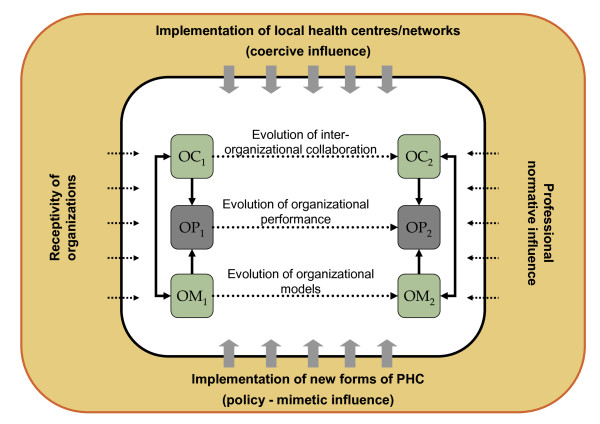
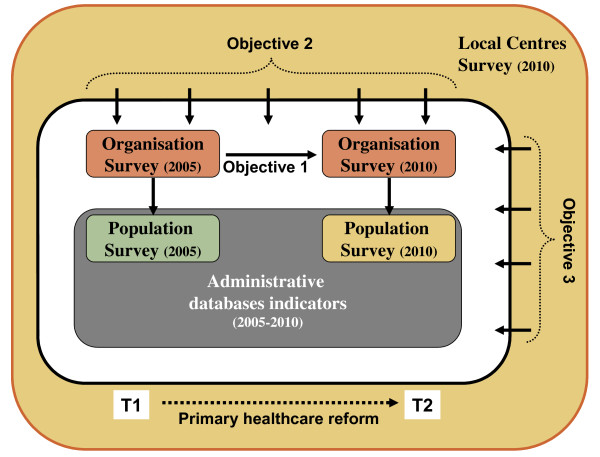
In early 2005 we conducted a study in the two most populous regions of Quebec province (Montreal and Montérégie) which assessed the association between prevailing models of primary healthcare (PHC) and population-level experience of care. The goal of the present research project is to track the evolution of PHC organizational models and their relative performance through the reform process (from 2005 until 2010) and to assess factors at the organizational and contextual levels that are associated with the transformation of PHC organizations and their performance.
METHODS/DESIGN: This study will consist of three interrelated surveys, hierarchically nested. The first survey is a population-based survey of randomly-selected adults from two populous regions in the province of Quebec. This survey will assess the current affiliation of people with PHC organizations, their level of utilization of healthcare services, attributes of their experience of care, reception of preventive and curative services and perception of unmet needs for care. The second survey is an organizational survey of PHC organizations assessing aspects related to their vision, organizational structure, level of resources, and clinical practice characteristics. This information will serve to develop a taxonomy of organizations using a mixed methods approach of factorial analysis and principal component analysis. The third survey is an assessment of the organizational context in which PHC organizations are evolving. The five year prospective period will serve as a natural experiment to assess contextual and organizational factors (in 2005) associated with migration of PHC organizational models into new forms or models (in 2010) and assess the impact of this evolution on the performance of PHC.
The results of this study will shed light on changes brought about in the organization of PHC and on factors associated with these changes.
加拿大医疗保健系统目前正在通过改革初级保健(PHC)经历重要的组织变革。这些改革的范围各不相同,但都有一个共同的特点,即通过实施新的 PHC 组织模式来提出 PHC 组织的转型。这些模式在客户隶属关系、服务利用、护理体验和护理结果感知方面的表现各不相同。
2005 年初,我们在魁北克省人口最多的两个地区(蒙特利尔和蒙泰雷吉埃)进行了一项研究,评估了主要的初级保健(PHC)模式与人群护理体验之间的关联。本研究项目的目标是通过改革过程(从 2005 年到 2010 年)跟踪 PHC 组织模式的演变及其相对绩效,并评估组织和背景层面的因素与 PHC 组织的转型及其绩效相关。
方法/设计:这项研究将包括三个相互关联的调查,层次嵌套。第一个调查是对魁北克省两个人口稠密地区的随机选择的成年人进行的一项基于人群的调查。这项调查将评估人们与 PHC 组织的当前隶属关系、他们对医疗服务的利用程度、护理体验的属性、预防和治疗服务的接收情况以及对护理未满足需求的看法。第二项调查是对 PHC 组织的组织调查,评估与组织愿景、组织结构、资源水平和临床实践特征相关的方面。这些信息将用于使用因子分析和主成分分析的混合方法来开发组织分类法。第三次调查是对 PHC 组织所处的组织环境进行评估。五年的前瞻性时期将作为一项自然实验,以评估与 PHC 组织模式向新形式或模型(2010 年)迁移相关的背景和组织因素,并评估这种演变对 PHC 绩效的影响。
这项研究的结果将阐明 PHC 组织带来的变化以及与这些变化相关的因素。